
As flood crisis worsens, the economy will suffer more


Play
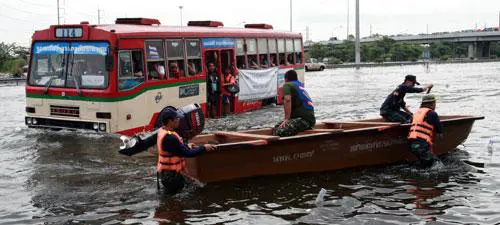
The flood water run-off north of Bangkok has broken a flood barrier next to Sukhumvit Road Soi 50, as the waters inch closer to the heart of Bangkok.
Prior to this, most flooded areas were in outlying areas of the capital, such as Bang Plad district and Charun Sanidwong Road in the western part of the city, and Don Mueang Airport and Sai Mai district in the northern suburbs.
The inundation in the Sukhumvit Soi 50 area has raised the stakes in the government’s bid to fight the country’s worst flooding in more than five decades, as the deluge is now much closer to the capital’s inner city and business areas.
Along Sukhumvit Road, which runs from the heart of Bangkok at Soi Nana next to the Ploenchit area, out to Samut Prakan, are hundreds of high-rise office, hotel, residential and other commercial buildings. They include the upmarket Emporium shopping complex, which is not far from other landmark tourist and shopping destinations in the nearby Ploenchit, Ratchaprasong, Pathumwan and Siam Square areas.
According to a Reuters report, this massive flooding has become a formidable test for the three-month-old Yingluck Shinawatra government, which is being severely criticised for its poor performance in coping with this crisis.
Prime Minister Yingluck, who was handpicked by her fugitive brother Thaksin for the top executive post, has failed on several fronts, especially in inter-agency policy cooperation and coordination, and communications with the general public.
The crisis will definitely worsen over this weekend if many of Bangkok’s flood barriers are broken by the water run-off and high tides on the Chao Phraya River.
In such an event, many more areas of the capital city, which has more than 12 million residents, will be under the water, crippling the country’s national economy and prolonging the negative consequences of this three-month flooding crisis.
So far, more than 30 provinces have been affected and the Bank of Thailand has revised this year’s GDP growth forecast downwards to only 2.6 per cent compared to 4.1 per cent earlier.
However, optimists say Yingluck may still survive this crisis if her government can implement post-flood rehabilitation measures successfully.
“Even though many people are unhappy with this situation and hope the premier becomes tougher in solving this crisis, we’re sure she will bring the country out of this situation soon. Rehabilitation will be the test of her leadership,” said a key member of the ruling Pheu Thai Party, who asked not to be named.
So far, the massive flooding has killed 377 people and affected 2.2 million Thais, while over 10,000 firms have been hit hard and 1,000 factories inside seven industrial estates have been inundated, causing estimated damage to the tune of Bt800 billion.
The automotive, electronic, food and other sectors are the major victims of this disaster, which has affected more than 600,000 workers so far.
The agricultural sector has been also severely hit, with rice production and exports forecast to decline by six million tonnes this year.
In addition, more and more people do not trust the government’s Flood Relief Operation Command’s daily statements and evacuation warnings due to its earlier shortcomings.
For Yingluck, “incompetent” and “indecisive” are now some of the key words used to describe the government’s performance in handling this crisis.
