
Will the winds of the Arab Spring die down in Egypt?


Play
The ongoing confrontation between the military authorities and people in Egypt is a clear portrayal of who in the Middle East is against freedom in the Muslim world.
The old story of the authorities blocking freedom for the masses, with or without external support, does not seem to go away in spite of the sacrifice of many lives.
The problem in the Muslim Middle East is not about Islamic religious exception to the democratic process; it is basically an illustration that the political situation in the Muslim countries is not different from that in other countries witnessing similar struggles between the military and political parties. In terms of comparative politics, many Third World countries have moved along the path to democracy, but in the case of most of the Middle East, as seen this year, this path is being effectively blocked by those in power. The only success story has been Tunisia.
There are two issues behind the continuing problems on Egypt’s path to democratic civilian rule. First is the ruling Supreme Council of the Armed Forces’ (SCAF) resolve to be a continuing political player in future democratic Egypt, and its seeking of self-immunity from any possible prosecution in the future. Second, the Egyptian political parties of different shades have been changing their alliances frequently, with now-united, now-divided roles in the ongoing political scenario. This stance has been exploited by the military, which has curried favour with different political groups since the ouster of Hosni Mubarak in February.
Initially, the military sought to build alliances with the Muslim Brotherhood and other Islamist political parties, while on the other hand, pressured by the secular and liberal parties, the SCAF issued a decree called the “Al-Selmi document” – named after the deputy prime minister of political affairs – containing supra-constitutional principles.
Incidentally, the document contained clauses directed towards safeguarding the privileges of the military, by giving it extra-constitutional powers and status, including the authority to scrutinise the budget and veto government decisions that may not favour the military.
This position is not much different from that seen in other Third World countries where militaries have played crucial roles in the political arena and which are not ready to relinquish their power to emerging future democratic political modules.
The clause protecting the interests of the military brought up opposition from both Islamists and secular parties, leading to the November 18 protests calling for SCAF’s removal and also an early transition to civilian rule. Actually, SCAF has been maneouvring to delay the transfer of power to the civilian body for as long as possible – preferably, in its eyes, until 2013.
The November 18 protests turned out to be violent and bloody, a contest between the military and the police and the people. This was followed by further protests a few days later, led by other political parties who boycotted talks called by SCAF to resolve the matter. SCAF agreed to start the parliamentary election yesterday, and the presidential election by June 30, 2012.
But this has not satisfied everyone. Young activists and revolutionary groups have continued their protests in Cairo’s Tahrir Square, scene of the anti-Mubarek protests earlier this year. The November 18 protests demonstrated that the various opposition forces, from secular to Islamist, are united in their demand for an early return to civilian rule, while SCAF has changed its position frequently for the sake of protecting its interests.
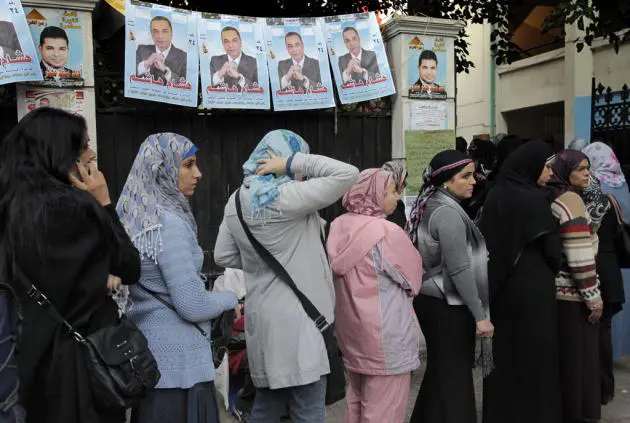
The question before the Egyptian voters yesterday will be how to consolidate their revolution, which is now threatened by power brokers and political actors in the country. They will have to show the Arab socio-political trait as described by renowned Arab historian Philip Hitti that, in Arabia, “all enemies in normal times – prove staunch allies in time of danger”.
In fact, they will have to move beyond this for the sake of political progression and economic development of the country and the region. This will require the building of political trust and unity between various Arab political actors and power holders, including activists, revolutionary groups, presidential candidates and the armed forces.
On the external front, this fast-track change in the political landscape across the Arab world has confounded Middle East specialists; it has drawn the wind out of their expert opinions, as they are baffled by the combined roles played by religion, communication technology and commitment to the universal values of freedom, democracy, gender equality and human dignity, all of which which started the wind of the “Arab Spring”.
SCAF realised that it was not politically wise to postpone the election or prolong the transfer of power to the civilian political body, for doing so would have been to its own peril. The coalition of the Egyptian people is proving difficult for the military to handle. The military elite’s intention to continue to call the shots or seek to become politically untouchable in a future democratic Egypt will not be tolerated by the people.
The political process of returning the military to their barracks and strengthening the democratic process – which started in places like South Korea and Southeast Asia and has now reached the Middle East, beginning with Erdogan’s Turkey and Tunisia – will be a long, drawn-out process. After all, the military has had a long reign in the Middle East.
The ongoing crisis in Syria is another illustration of this scenario. The current popular term “Internet rocks” is proving that the winds of the Arab Spring – being a popular demand for political freedom supported by the social media and by democratic forces consisting of a variety of political shades and activist youth – is rocking the Middle East in unprecedented ways.
Dr Imtiyaz Yusuf is professor of Islamics and religion at the Graduate School of Philosophy and Religion, Assumption University, Bangkok.
