
We must protect tourism sites in a sustainable way


Play
Neglect and exploitation seems to be the mantra of government agencies rather than careful protection and nurturing of our national attractions
The tourism industry is one of the hardest-hit sectors in the flooding crisis. It turns out that natural disasters are taking a toll on tourism more frequently than street protests or any other form of political instability these days. Blame it on climate change, deforestation or watershed destruction, but natural disasters, flooding in particular, will wreak havoc on the industry much more frequently. The tourism sector thus needs a regime of sound preventative and rehabilitation measures to cope with disasters and recover disaster-ravaged tourist sites faster.
Thailand’s tourism industry employs more than 2 million people or about 15 per cent of the workforce, and accounts for roughly 6 per cent of GDP. Due to the flooding, the number of tourist arrivals at Suvarnabhumi Airport dropped from an average of 130,000 a day to about 100,000. The old Don Mueang Airport still remains closed for another month due to flooding.
According to the Minister for Tourism and Sport, Chumpol Silapa-Archa, tourist arrivals may reach between 18 million and 19 million this year (compared to 15 million last year) while total revenue from overseas tourists will total Bt600 billion in 2012. He said the floods won’t have any more impact on Thailand than the political unrest of 2010. His statement came amidst heavy rain that has caused flooding in the central plains as well as six provinces in Thailand’s South, which has seen some of the Kingdom’s tourist attractions inundated.
Some industry observers are already complaining about the authorities’ lack of preparation for rehabilitation and restoration of not just tourist sites, but also facilities like the old Bangkok airport, out of which at least four airlines are operating. What’s true is that our tourist sites tend to be disaster prone, and still nothing is being done to prevent disasters repeating.
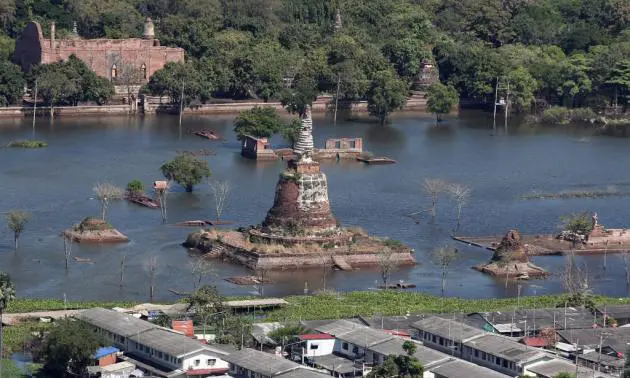
Take the ancient capital of Ayutthaya for instance. This Unesco-designated World Heritage Site has always been a cash cow. Last year, 6.53 million people visited the ancient city, generating revenue of Bt9.9 billion. About 1.3 foreign tourists visited and spent Bt2.8 billion. Yet, even without this year’s large-scale flooding disaster, our ancient city is inundated almost every year anyway. Half of more than 200 monasteries, fortresses and other monuments have been damaged by water that rises up to three metres in places. Ayutthaya is bidding to host the World Expo in 2020, but experts doubt the city will win, given that it’s prone to seasonal flooding and that no preventative measures are in place to keep floods at bay.
Our tourism authorities like to daydream that Thailand is the most popular destination in this region, given that it’s on some travel magazines’ top-10 list of ideal destinations favoured by foreign tourists. They need to wake up and understand that Malaysia boasts more tourist arrivals than Thailand annually and its airports have never been seized by anti-government protesters or inundated by floods. People think of Singapore – not Bangkok – when they want to see Dali masterpieces, the Bolshoi ballet, world class exhibitions, operas, concerts and other cultural shows.
What do we have to lure tourists? Thailand boasts ancient temples, elephant camps and beaches, but they are neglected annually. And we are happy to see them inundated again and again without resorting to any long-term prevention plan to keep tourist attractions safe from natural disaster or at least to minimise damage.
What’s frustrating is that just as the flood waters are receding, the Tourism Authority of Thailand plans a string of celebrations to promote tourism in Ayutthaya. This may be a very good idea. But it also reminds us of a familiar cycle that this country seems happy with: we want more tourists to come and spend time and money in Ayutthaya so that we can make a lot of money and live well and care about little else. Then the monsoon comes, the ancient city will be inundated again, and we will wait until the water recedes and will promote Ayutthaya again. Ayutthaya could be just any tourist site in the country.
That’s an exploitation, not a promotion of tourist attractions. The TAT, the Fine Arts Department and other government bodies involved in the tourism industry need a long-term, sustainable, holistic approach to maintaining and promoting tourist sites. It seems the authorities are eager about spending a lot of money on promoting our tourist sites in foreign magazines and bringing in foreign journalists to write nice things about Thailand. But what they should do is spend as much money as possible on protecting, maintaining and restoring our tourist attractions so they become sustainable in the longer term. Tourism will play a much more significant role in our economy in the future. Who will come to our rescue if panicking investors ultimately decide to move their production bases and take their holidays elsewhere?
