
Opportunity washed away: A confidence debate post mortem


Play
The national suffering as a result of the floods should have been an excellent opportunity for the Thai people to have come together after years of political conflict.
This was not to be. There was certainly plenty of spontaneous outpouring of goodwill towards those suffering from the floods but, in the end, lack of leadership meant that this was not sufficiently forceful to counter the social schism already in existence.
In this environment, it is natural to blame every usual suspect, other than ourselves of course, for the failure. In truth, however, one could see that the buck not only stopped with the political leadership, but started there as well.
The problem was simply that Pheu Thai and the red shirts were not yet used to the fact that they were in power, with esponsibilities, rather than the radical political movement they had been in the three prior years.
This meant that they ignored real problems for too long once they were in power; focusing rather on the delivery of political goals, much of which had to do with Thaksin. This mentality can be understood in the context of Thaksin himself. With political power back in his hand after years of effort and huge financial investment; obsessed with his personal goals and because of distance, Thaksin was not attuned to the sentiments and needs of the public. As Pheu Thai pointed out during the campaign, what Thaksin thinks, Pheu Thai does. So, as he wasn’t thinking much about the floods, Pheu Thai spent its first two months in government doing other things Thaksin considered more important.
The real problem came when they did begin to focus on the flood, because even then they were still hung up on scoring political points they no longer needed (they already had a majority government!). It was notable that Pheu Thai itself was almost invisible during the flood crisis, but that the red-shirt movement was dominant in all government activities. This was not the right approach if you wanted reconciliation. If winners should be generous in their victory, then the red shirts were clearly still of the opinion that they remained the self-styled oppressed losers.
I was by accident in Ban Buathong handing out food packages to isolated households on the day PM Yingluck came to open the “Government Kitchen”. What struck me was how everything was literally in the colour red. The banners of ministries involved were all red, as were T-shirts worn by civil servants. There were banners from red groups from all round the country. This signal was clear: this is a Red government, with a Red agenda.
Tag that together with red-shirt domination in the FROC and the general disbursement of donated goods, it is clear the government played a key role in imprinting an even greater image of a colour-coded split, rather than use the crisis to tone down colour denomination.
What of the opposition? Well, I can confirm that we tried our very best to play a constructive role throughout. When we had to eventually come out to defend our position, it was only because Pheu Thai and the red shirts forced our hand. They tried to lay the blame on us with bogus accusations regarding water levels in dams; they brought out political players such as Ying Sudarat in an early attempt to make political gain in the capital and, eventually, once the waters reached Bangkok, the government started to blame the BMA
directly, even though they knew full well that the BMA was operating entirely within the framework of the FROC.
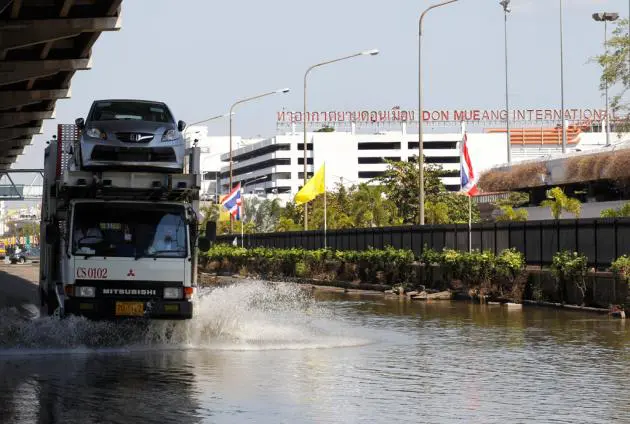
I think back to the day I went to the FROC in Don Muang with opposition, leader Abhisit Vejjajiva. The famous photo of him in consultation with Prime Minister Yingluck was on the front page of all newspapers and magazines. The public wanted to see politicians working in harmony to help alleviate the situation. We understood this, which was why we went, uninvited. Much later, word came that the prime minister would be seeking to meet with Abhisit again, and she even gave an interview to that effect. But the invite never came. Clearly the government made a calculation that it stood more to lose politically. It was a major opportunity missed.
The rest of what we did was the minimum requirement of what we needed to do as the opposition, and we did our work within parliamentary confines. There were no organised mobs, no street protests, nothing outside the parliamentary process.
I would have to say that our efforts were mostly directed towards charity work through flood relief with the Seni Pramoj Foundation. Abhisit and all party members were visiting flooded constituencies practically every day for over two months and were more attuned to the pending disaster than the government itself. So, all in all, any charge of attempting to opportunistically use the floods for political gain would be entirely unfair on the Democrats.
I believe the government needs to act more maturely and responsibly. It has a historic mandate but so far it has fallen way short of expectations. Most importantly, it needs to be magnanimous in victory; it needs to put aside personal agendas and do everything to ensure that the political and social situation returns to normal. With its overwhelming election victory, it needs to settle down and get on with the job. Expectations remain high. Do not disappoint.
Korn Chatikavanij is the deputy leader of the Democrat Party and the shadow deputy prime minister. He can be reached via twitter at @korndemocrat.
