
Hearing the democratic Arab voice for the first time


Play
Former British prime minister Tony Blair received an enthusiastic welcome in Bangkok recently, but most of the Middle East is reluctant to welcome him.
Furthermore, his remarks in an interview with The Nation (January 18) that the Arab Spring is a “risk” tells that he has not learnt from his and George Bush’s failure in their attempts to impose democracy in the Middle East from outside.
Unstable Iraq and Afghanistan are still reeling under the effects of invasion. It is Blair’s kind of view that has prevented the ushering in of democracy in the Middle East for so many decades. Recent Arab Development and Freedom House reports inform that before the Arab Spring only five out of the seventeen states in the Middle East and North Africa granted limited political freedom and civil liberties to citizens. The Arab Spring-inspired opposition to state repression is not led by a single Islamist group such as the Muslim Brotherhood but by thousands of activists – students, women, academics, journalists, labour activists, and cultural and civil organisations. Hence, to talk of risk is a misstep that raises the spectre of Islamophobia. The Arab Spring is a movement of alliances that is not led by a single group. Therefore it is time to end the rhetoric that raises false spectres.
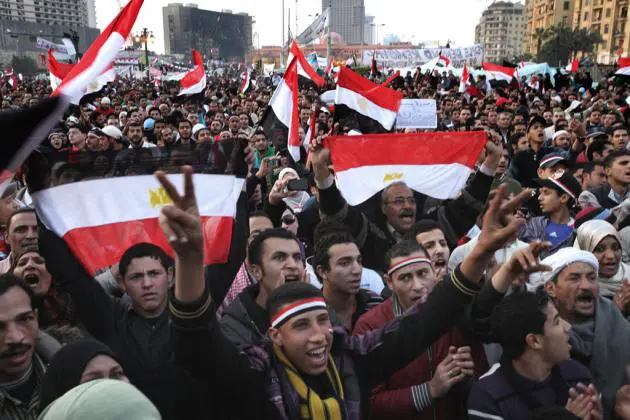
The recent successful elections in Tunisia and Egypt to form representative bodies are attempts to implement a genuine multi-party system. The fact that Muslim democrats were successful in these elections deserves due credit and should be received in a democratic spirit. Needless to say, if they fail to deliver on their promises, it will be their end.
The winners in today’s Middle East have not only the basis of the religious card but also the promise to end repression, corruption and nepotism. As in any democratic process, all parties had an equal opportunity in the political contest, and the victory of political Islam in alliance with secular parties shows there was no vote rigging as seen in the past. Tunisia today is ruled by a unity government, and similar acts will take place in other liberated Arab countries. The reason for this is that both Muslim and secular parties have been persistent critics of corrupt regimes and made sacrifices for liberation while the corrupt regimes got support from outside at the expense of the economic development of the populace.
The Arab Development reports inform that the deprivation and backwardness of the Middle East is the result of decades of mismanagement. The Arab Spring should be viewed as a political reaction in the light of the findings of the reports. Both Muslim secularists and Islamists have been critical of corruption in the Arab world. Hence, their coming to power is not a risk but a step towards the democratisation of the Middle East.
The election in Egypt was a victory for Muslim moderates or the Democratic Alliance led by the Muslim Brotherhood’s Freedom and Justice Party (FJP) in coalition with secular parties, winning 235 seats (46 per cent). The Salafis or Islamist Alliance won 124 seats (24 per cent); another moderate Islamist party, the Wasat – a break off from the Muslim Brotherhood before the revolution – won 10 seats (1 per cent). The Wafd, the oldest liberal party, won 38 seats (7 per cent); the Egyptian Bloc, consisting of the liberal and leftist parties, the main rival to the Democratic Alliance, got 34 seats (6 per cent); Reform and Development, founded by a nephew of Anwar Sadat, won 8 seats (1 per cent); the “Felool” parties, remnants from the former Mubarak regime, comprising 16 parties, won 16 seats (3 per cent). The “Revolution Continues Alliance” won 7 seats (1 per cent). There were 26 independent candidates, while 10 seats were reserved for those selected by the Supreme Council of the Armed Forces – the ruling generals. In spite of being the fairest election in decades, the result did not bring euphoria in the West.
The Muslim Brotherhood was first banned in Egypt in 1954, then allowed to operate within limits since the 1970s. Today’s Brotherhood is a changed movement; it has witnessed differences of opinion between the old guard and its youth wing and political wing – the Freedom and Justice Party (FJP) did not contest the recent election on the premise of establishing an Islamic state. Mohammad al-Katatny, the new speaker of the Egyptian parliament from FJP, promised a new constitutional, democratic and modern Egypt that will respect freedoms.
Similarly, in the Southeast Asian context, the Indonesian Prosperous Justice Party (PKS), formed along the lines of the Egyptian Muslim Brotherhood, has also moderated itself. Both instances indicate a changing political Islam. One reason for this could be that both the secularists and Islamists in the contemporary Muslim world do not contest the idea of Islam as the state but differ about the role of religion in politics. Maya Jribi, the chairwoman of the Progressive Democratic Party, a left and secular opposition party in Tunisia, remarked, “Islam is – and I am convinced of this – a centrist religion, and Tunisia has experienced so many reformist, moderate cultural and political movements in its time. This is why I think we are firmly rooted in this modern, forward-looking, open and tolerant tradition of Islam. My party and I consider ourselves committed to this tradition.”
Moncef Marzouki, the president of Tunisia, who is a paladin of human rights, recently remarked that the Arab Spring has brought democrats to power and the West will be hearing the Arab democratic voice for the first time. The West will have to learn to live with political Islam and its secularist alliance, an emerging reality in the Middle East which had been blocked for decades by the authoritarian kings, dictators and clerics. It is time to move away from the Blairian view of political Islam; the Arab Spring is turning the dictatorial Middle East on its head. Western countries need to rethink their foreign policies.
All sections of Arab societies want change. The democratic Arab governments will need to adopt pragmatic domestic and constructive foreign policies. Internally, they will have to deal with religious and secular fundamentalists, and externally with Islamophobia. Thus the West’s mere support for gender equality, secularism and social coexistence in the Middle East, without overcoming Islamophobia, will not be enough.
Dr Imtiyaz Yusuf is professor of Islamics and religion at the Graduate School of Philosophy and Religion, Assumption University, Bangkok.
