
The case for preserving the Lido and Scala theatres


Play
For Thai movie lovers and fans of luxurious old cinema halls alike, dire news has once again soured the collective mood.
Nearly two years after the fiery demise of the beloved Siam Theatre, its Siam Square brethren - the Lido and Scala theatres - have been listed for demolition. Should the plans go through, Bangkok’s once-illustrious collection of stand-alone movie theatres will be officially non-existent by 2016.
The Lido and Scala, as well as the remainder of Siam Square, sit upon some of the most valuable real estate in Thailand. Chulalongkorn University, Thailand’s perennially top-ranked university and owner of the land, is apparently unsatisfied with the current amount of income it generates from its Siam Square tenants – a medley of boutique clothing stores, trendy cafes and long-established restaurants. To remedy this, university directors have announced plans to raze the entire neighbourhood of three- and four-story shophouses to make way for a series of high-end shopping malls. Raised rents would accompany the completed project.
The economic imperatives of a private institution like Chulalongkorn University are often hard to argue against. In this case, however, since only short-term monetary considerations figure in to a decision that will reflect negatively on both Chulalongkorn and Thailand as a whole, this argument has ample justification.
Firstly, it should be pointed out that from a preservationist standpoint, the Siam Square neighbourhood is by no means architecturally unique. Throughout Bangkok there are neighbourhoods of similar dimension and architectural gauge, erected with growth-minded profusion during the 1960s, ’70s and ’80s. Having said this, razing it would not be a serious loss to the city’s cultural or architectural heritage, although it would have an adverse effect on a well-established business community. Nevertheless, Chula has every prerogative to do what it wants with its property.
Siam Square’s two theatres, on the other hand, the Scala and the Lido, are extremely rare and well worth preserving.
Both theatres were built at the height of Thailand’s movie theatre construction boom, beginning in the mid-1960s and tapering off in the late 1970s (the Lido dates to 1968, the Scala to 1969). They were contracted by Pisit Tansacha, founder of the once-prolific Apex chain of theatres, and have been operated by the Tansacha family ever since.
Over the past two decades, the onslaught of redevelopment that has transformed this neighbourhood has laid waste to many palatial stand-alone cinemas. Just around the corner from Siam Square, in the vicinities of Ratchatewi and Phayathai roads, there once stood numerous movie palaces built during the 1960s and ’70s boom. Among them, the Hollywood, McKenna, President and Stella theatres, all of which have since been demolished to accommodate office towers or condominiums.
Apex, too, might have followed this trend and razed its Siam Square theatres were it not for a simple logic belying their upkeep: Apex has a small-but-loyal customer base to whom they are devoted. This cinephilic patron-client relationship, cultivated over four-plus decades of movie screenings, has resulted in the gradual transformation of the Lido and Scala into some of the country’s only theatres showing alternative films, and ensuring their survival while the rest of Bangkok’s stand-alone theatres faded into oblivion.
If we appraise these theatres based on the law of scarcity – which holds that the decrease in quantity of a particular kind of artefact or institution leads to a corresponding increase in its worth – then the Lido and Scala are priceless, being the last two of their kind in the country.
But it is the intangible historical value they contain which is most difficult to measure. What meaning do they hold to the countless spectators who have sat in their chambers? Which great Thai minds have gained inspiration beneath their illuminated screens? The Scala, it ought not be forgotten, has hosted the most revered of all spectators. In past years, His Majesty the King of Thailand has held charity movie screenings there, with his royal throne temporarily installed to provide him seating.
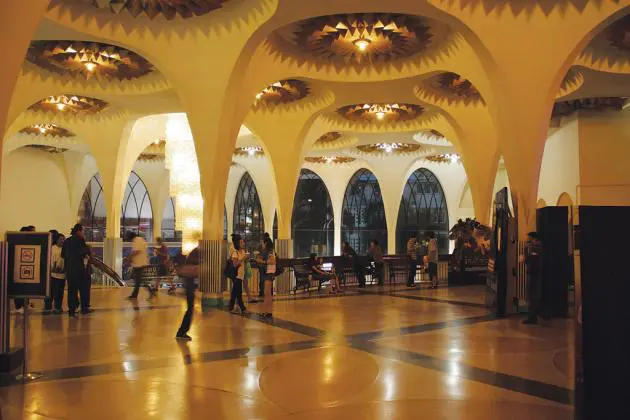
Indeed, the Scala is of especially high cultural and architectural import, as well. It was designed by famed architect Chira Silpakanok – also known for the Indra Hotel – and embodies a uniquely Thai aesthetic that blends elements of tropical art deco with 1960s Thai modern. A vaulted ceiling, accentuated with gold coloured medallions and supported by a series of tapered columns, make the Scala’s lobby a spectacle in itself.
With the Lido divided into three smaller theatres after a 1993 fire, the Scala is also the only operating movie palace in all of Thailand with a single screen.
By way of comparison with other world cities, there are very few that have allowed all of their historic movie theatres to be demolished. Most have designated resources for the preservation and maintenance of at least one. For an important city like Bangkok to allow the landmark Scala to be demolished would be an unnecessary loss to the city’s cultural capital.
Tearing it down to build a shopping mall, moreover, in a neighbourhood already saturated with them, would show short-sightedness and extremely poor taste on the part of prestigious Chulalongkorn University, which normally takes the lead in ensuring the country’s treasures are duly enshrined.
On a personal note, in my travels across Burma, Laos, Vietnam and Thailand, to document what remains of the region’s stand-alone movie theatres, I have yet to encounter a theatre more elegant than the Scala. The closest runner up is the Thamada Cinema in Rangoon, Burma at a distant second.
The demise of the Lido will be a definitive loss to Thailand’s movie-going culture. If the Lido and the Scala are both demolished, Thailand will have abandoned the top position in yet another category to a regional neighbour.
Philip Jablon runs the Southeast Asia Movie Theatre Project at SeaTheater.blogspot.com.
