
A long way to go in Myanmar's process of economic reform


Play
In spite of recent positive political developments in Myanmar, experts warn that the country still has a long way to go towards full economic reform and democracy.
Myanmar does not have enough human resources to carry out rapid economic reform. The country’s existing infrastructure is inadequate to help it fully integrate into the international economic system.
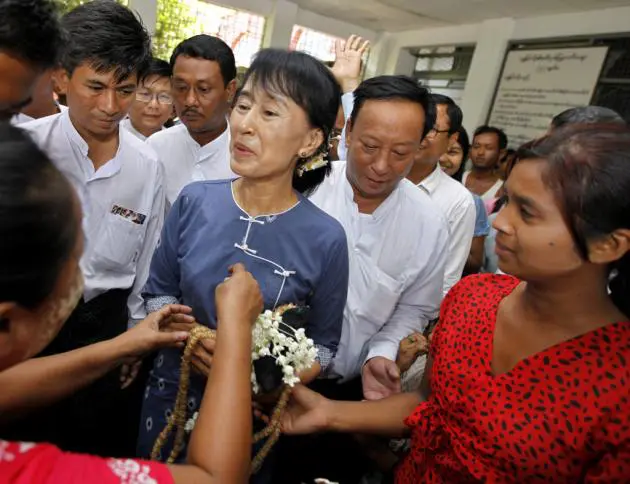
The situation in Myanmar seems to have turned around after the military government ended the house arrest of opposition leader Aung San Suu Kyi, and held by-elections on April 1. Since then, the international community, including the European Union, has eased sanctions on Myanmar. International leaders have also visited the country after decades of isolation.
However, the changes in Myanmar seem to have happened so suddenly that some locals and the authorities are not prepared to cope with the surge of foreign interest. Myanmar economists say it is too early to jump to any conclusion about the reforms, due to the many challenges ahead.
One of the major reforms was the government’s decision to unify its dual exchange rate on April 1. But the country also faces the challenges of a lack of qualified economists at the Myanmar Central Bank, said Aung Tun, a faculty member of the think-tank Myanmar Egres.
Another economist who asked not to be named said it is unclear how the central bank will manage the new floating currency rate because nobody really knows what is a fair exchange rate, even though people are complaining about the appreciating value of the kyat, the local currency.
“Everybody is talking about a nominal rate but nobody knows if the real effective rate is appreciating or depreciating. And most people do not even know what is the difference between nominal and real effective rates,” the economist added.
Myanmar is so far an exemplary case where democratic progress is being made without the violence currently being seen in the Middle East. Zeya Thu, deputy chief editor of The Voice magazine, said, “Myanmar is another ‘spring’. We’ve made a noise but without violence. It is an evolution but still in the sense of radical change.”
He said press control has also been relaxed. His magazine has recently been subject to a lawsuit for a story on alleged corruption, but nevertheless he welcomed the action. “The suit is good because we are still printing. In the past, if they didn’t like our stories, they just shut us down.”
However, the effort to open up the country faces many economic challenges. Myanmar has tried to diversify its trade and investment. So far, the country has relied heavily on only a few countries due to Western economic sanctions. China, Thailand, India and Singapore, accounted for around 95 per cent of Myanmar’s total trade as per 2010 figures.
Trade dependence on a small group of countries has affected Myanmar’s exports. During the period of currency appreciation, the prices of beans and pulses in India – on which Myanmar exporters relied too much – went down tremendously due to an influx of the same products from Canada. Similarly, world rice prices have slumped due to the sale by the Indian government of huge amounts of reserved rice. Many exporters got hurt, and this in turn had a negative affect on farmers, according to the economist.
Nonetheless, most ordinary people in Myanmar do not know about the world market prices of commodities and they thought the problem was only because of the appreciation in the currency, the same economist added.
In the case of foreign investment, Myanmar is facing the challenge of how to open up its market without hurting existing producers. Some in the Myanmar private sector suggest that the country should maintian its closed-door policy and allow only a few foreign investments. But some disagree because Myanmar has been closed for many decades already, and this policy has not helped domestic private industries grow. Instead, lack of competition has made the situation worse for consumers.
Some Myanmar people question whether the government should continue with its restrictive policies for foreign investment, such as the requirements that force foreign investors to compulsorily enter into a joint venture with a local entity, or forces foreign industries to use a high percentage of local content.
Even though these policies might have been effective for some countries in the past, the question that Myanmar is discussing now is whether these restrictive policies are correct right now, at a time when countries in the region are abandoning these practices. The Myanmar people are concerned that if the government continues with these policies, Myanmar will not be competitive and will not attract foreign investors.
Myanmar has undertaken commitments to open up its markets according to the Asean Economic Community. The economist said, “The year 2015 is just around the corner, and we cannot open up our market only at the last minute.”
Myanmar is certainly moving towards the liberalisation path. But for now, Aung Tun said, “the country faces the issues of technicalities versus changes”.
