
PM's advisor formulates strategy for future growth


Play
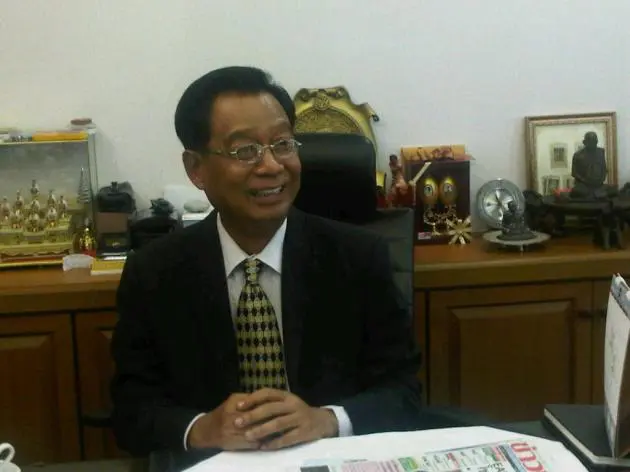
Dr Virabongsa Ramangkura, the prime minister's chief economic advisor, has suggested that the global economic growth poles have shifted to Asia, especially China and India, from the United States and Western Europe.
As a result, Thailand should speed up its investment schemes in transport and related infrastructure, as well as in the information technology sector, to take advantage of the global economic shift to Asia.
During a seminar on the globalisation of economies organised by the Senate last week, Virabongsa cited Myanmar as a key example where Thailand may greatly benefit, as the neighbouring country begins to open up. Thailand shares a 1,500-kilometre border with Myanmar.
Myanmar also has borders with both China and India, which have become the new centres of economic growth as the US and European Union are witnessing slower economic growth rates and even stagnation.
For Thailand, the country should boost its competitiveness by investing in more railways, airports, seaports and high-speed train networks.
The government should also support Thai Airways International in investing more for long-term competitiveness, by guaranteeing the national flag carrier’s future borrowings.
Secondly, the country’s information technology services must be quickly upgraded with a focus on competitive pricing of major services. Instead of using state agencies to generate profit from IT and related services, the government will have to boost competition in this sector so that service quality and prices are more competitive.
For Virabongsa, the priority should be given to railway infrastructure because Thailand is currently lagging far behind other countries in this mode of transport, resulting in high costs for logistics as a percentage of gross domestic product (GDP).
The country now urgently needs high-speed trains with speeds of 250-300 kilometres per hour and 100-120 kilometres per hour for passengers and cargo, respectively, so as to boost the efficiency and competitiveness of our transport and logistic services.
China has already opened discussions and issued a memorandum of understanding with Thailand for construction of a high-speed train link from the northeastern province of Nong Khai to Bangkok. This 600- kilometre-plus route would be joined with the proposed high-speed train route in Laos, which will be linked with cities in southern China.
From Bangkok, the high-speed route would go south to Malaysia and Singapore to create the north-south economic corridor for mainland Asean countries and southern China.
Virabongsa is worried that all these schemes are highly capital intensive and will take years to implement, so the government should consider a series of shorter initial routes.
For example, the northbound domestic route from Bangkok to Chiang Mai should be shortened to Bangkok-Phitsanulok so that it is easier to implement. Once the Bangkok-Phitsanulok route is operational, it can later be extended to Chiang Mai.
For the northeastern high-speed train, the initial route should be Bangkok-Nakhon Ratchasima, then extended up to Nong Khai.
Regarding the Dawei deep-sea port in Myanmar, Thailand will have to work together with Myanmar, China and Japan on the development of this crucial scheme, which can be linked with Thailand’s Laem Chabang port in Chonburi province by motorways and high-speed trains.
All these mega-investment schemes are capital intensive. According to Virabongsa, a part of the country’s international currency reserves should be used to finance these projects.
