
A lengthy road to travel


Play
Myanmar's slow but sure transition to a more open political system may bring democracy, or could legitimise the long-ruling military regime.
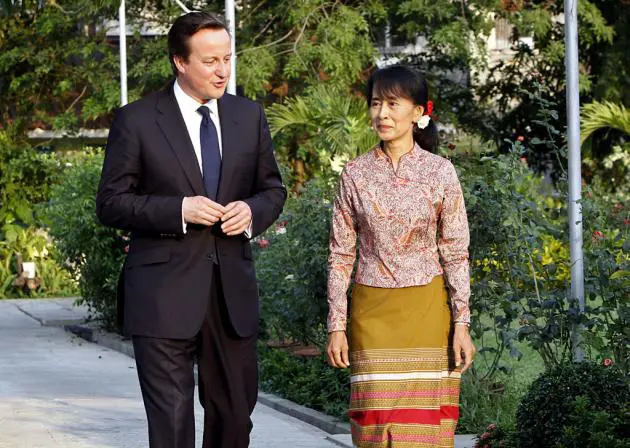
Recently, British Prime Minister David Cameron visited Myanmar and called for a “suspension” of the suffocating economic sanctions slapped on the military rulers. And now the European Union has suspended sanctions. Equally the United States has trimmed some sanctions too.
Indeed in the last six months there’s been a positive and perceptible shift by Myanmar’s nominally-civilian government. Rationales for the change have been easing debilitating economic stagnation caused by the embargos, tilting the country away from total dependence on China, and attempting to defuse growing political pressures from until-recently banned opposition.
Myanmar’s regime, though politically backed by Beijing, remains in the steely grip of mainland Chinese military and commercial deals. Thus the military has tactically allowed a glimmer of hope into what only a few years ago looked hopeless. After all, political parties were banned, Nobel Peace Prize laureate Aung San Suu Kyi was under house arrest and the resource-rich country was mismanaged by corrupt state socialism. Making matters worse, the US and the Europeans enforced punishing economic sanctions which hurt the regime, but in turn made the country infinitely more dependent on China.
In April, free and essentially fair elections were allowed for about 10 per cent of parliamentary seats. Predictably the National League for Democracy, the standard-bearer of the harassed opposition movement, won the seats and Suu Kyi gained a place in parliament. This is by no means a change in government but in attitude and aspirations for 52 million Burmese. There’s a whiff of reform throughout the land.
Amazingly, Suu Kyi will soon travel abroad for the first time in 24 years and visit Norway (to officially receive her 1990 Nobel) as well as Britain.
Reinforcing the fresh start should be suspending but not formally ending the economic sanctions.
Diplomatically it’s the season to visit Myanmar; have a celebratory meeting with Suu Kyi, see the glitz, gilt and gold capital Nay Pyi Daw, to meet and greet soldier-turned-civilian President Thein Sein – the enigmatic face of regime – and then offer words of encouragement for Myanmar’s road to democracy. Hillary Clinton, (first US Secretary of State since John Foster Dulles) David Cameron (first British PM since independence in 1948) and the globe-trotting UN Secretary-General Ban Ki-moon (his third visit) all brought good tidings from the outside world. All fine and well, but there’s a lesson here too.
Just four years ago in May, Cyclone Nargis slammed into the Myanmar coast causing massive devastation. Despite over two million people being trapped, for three fateful weeks the ruling junta forbade and blocked international emergency aid. Ban Ki-moon begged the military to allow humanitarian supplies into flooded communities. At least 130,000 Burmese died, many of whom could have been saved had the regime allowed assistance from the US, Japan, Australia and UN agencies.
Beyond the cruel ineptitude in dealing with natural disasters, Myanmar’s rulers enforce tight control, press censorship and aggressive suppression of ethnic minorities. Economic elements in the military are mired in opium production, deforestation of valuable teak trees and gem smuggling.
But what media exists is predictably mum. For example, Reporters without Borders ranks Myanmar near the bottom of 10 countries lacking press freedoms. The report cites “relentless advanced censorship” and the arrest of journalists and bloggers.
As Ban advised, “Myanmar is only at the beginning of its transition. Many challenges lie ahead ... yet, I am convinced that we have an unprecedented opportunity to help the country advance toward a better future.”
For the US, the Europeans and Myanmar’s other friends, Ronald Reagan’s memorable quote, “Trust but verify” sets the tone. Myanmar’s road ahead is long and uncertain.
John J Metzler is a UN correspondent covering diplomatic and defence issues. He is the author of Transatlantic Divide: USA/Euroland Gap?
