
Another chance for Asean to get it right


Play
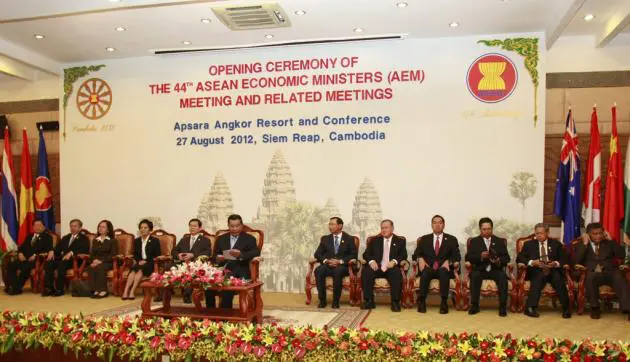
The 44th Asean economic ministers meetings taking place in Siem Reap, Cambodia is the first high-level regional summit after the debacle at the Asean foreign ministers meeting in Phnom Penh one month ago where the ministers failed to issue the customary j
The economic ministers meetings will provide a much-needed platform for Asean to show that they are on track to launch the Asean Economic Community (AEC) in 2015, less than two and half years away .
Asean has to redouble its efforts to keep pace with the binding commitments made in the AEC blueprint.
It is has reached the mid-point of the implementation of that blueprint and must now take stock, realign and adopt a bolder approach to meet all the outstanding, current and future commitments.
More importantly, it must avoid the temptation of taking a protectionist stance amid the continuing uncertainty in the global economy. Asean will also have to show its collective leadership in managing the competing interests of its partners in East Asia over the form and pace of East Asia-wide trade arrangements.
This week’s meetings will be devoted to the mid-term review of the AEC blueprint’s implementation; plans for narrowing the economic development gap among Asean nations to support equitable development; the progress in pursuing the regional comprehensive economic partnership (RCEP); and the implementation of the connectivity initiative, among others.
The mid-term review will provide a critical assessment on where Asean is with its economic community efforts.
While there is progress in the implementation of the regional commitments, the review is likely to highlight gaps Asean countries will have to address in the removal of non-tariff barriers, enhancing trade facilitation measures, accelerating services and investment liberalisation, pushing ahead with more transport facilitation measures, implementing all the roadmaps for the 12 priority integration sectors, improving the ease of doing business, and addressing the low utilisation of the five free-trade agreements of Asean with its partners.
While Asean has achieved about 67.5 per cent of its commitments under the AEC scorecard for the period 2008 to 2011, the remaining areas are also the most difficult ones.
If Asean is to accelerate progress in these remaining areas, it will require collective, bold leadership and serious commitment to dealing with the different legislative requirements and domestic issues of its member countries, looking at regulatory limitations that impede the implementation of intra- and extra-Asean measures, and fostering greater coordination among the various agencies at the national level in implementing regional commitments.
In this regard, the AEC compliance scorecard could be made more rigorous. The current scorecard fails to sufficiently capture the state of progress in the implementation of regional commitments by Asean countries.
Second, regular periodic assessments and in-country surveillance could be undertaken by the Asean Integration Monitoring Office to alert countries to any issues and roadblocks to integration.
Third, the scorecard could be made publicly available for transparency and credibility of Asean’s community-building efforts. This will help garner the support of the other stakeholders.
There could be enhanced engagement of the private sector by Asean governments at every stage of the community building effort. Regular private sector engagement can help to assess the impact and effectiveness of Asean policies and measures being implemented.
Feedback from market participants will help to tackle impediments to the free flow of goods, services, investment and capital.
The private sector, on its part, could be more proactive and each sector could develop its own scorecard through respective trade associations to provide inputs into the AEC scorecard. There is also a necessity for Asean to engage the business community more, including technical committees, senior officials and ministerial levels.
One issue requiring urgent attention is equitable development across the region. Here, the regional body must place more emphasis on the Initiative for Asean Integration and Development of the sub-regions such as the Asean Mekong Basin Development Cooperation, and connectivity initiatives. There must be a coherent strategy for bringing about equitable development across the Asean.
Two horizontal issues may need to be addressed here. First is the alignment of sub-regional development initiatives with the overall AEC initiative. If there is no alignment, there may be duplication of resources and divergence in policies and goals.
Second is the financing of sub-regional development initiatives. Asean is still dependent on its dialogue and development partners for integration and connectivity initiatives.
For example, the Asean Infrastructure Fund is expected to leverage only about US$13 billion (Bt407 billi0n) up to 2020 with the support of the Asian Development Bank, while the conservative estimate of infrastructure requirements is about $60 billion annually.
Asean will have to also embark on public-private partnership models to fund some of its priority infrastructure projects. For this, the project proposals have to be attractive and the governments need to partner the private sector as well as provide the necessary incentives to defray the project risks involved.
The regional comprehensive economic partnership will be a key initiative Asean has to tackle collectively in order to stay relevant and attractive to East Asia. This region-wide agreement will position Asean as the pivot of East Asia and generate trade and investment growth for the region.
This is a golden opportunity for Asean to show it can effectively lead the process to cobble together a free-trade arrangement, which will include the two dynamos of the region, China and India.
For this to happen, Asean members will have to agree on the level of ambition desired for the free trade agreement; the approach to the negotiations; and inclusion of issues such as government procurement, competition, intellectual property and so forth. These are not easy issues to reach consensus on, as not all non-Asean partners may want to offer concessions they have made to Asean to the other parties involved.
Indeed, there is a lot for the meetings in Cambodia to mull over. But what is necessary will be to regain the lost ground by pushing ahead with the economic community building with greater urgency and stamping Asean’s centrality on regional architecture through its collective leadership.
Pushpanathan Sundram is a senior fellow with the Singapore Institute for International Affairs and the managing director of EAS Strategic Advice.
