
From the cradle to the grave, all in one store


Play
Wandering around a mega-store can be like walking through graveyards and delivery rooms. There are places in between, too, like ICUs and amusement parks.
Stuff produced by man is like man himself: it first grows, then peaks, then wilts and then dies. At a Tesco Lotus mall near my place, they put a cemetery almost up front. The stationery section is the quietest and best zone for reflection. It’s quite large, by the way, either suggesting that it used to be something else, or representing the universal truth that everyone and everything ends up there.
There are all kinds of items that certainly used to grow and peak. Some of them nearly brought tears to my eyes, like coloured pencils and notebooks. There they lie in heaps, alongside fax paper, copy paper, envelopes, account books, erasers, glue, bill holders, cutters and tape. Stickers are there, too. And real ones as well, not those “Line” ones users pay money for to have them “stuck” on their online messages.
Why are these products made in such enormous numbers in the first place? I mean, this stationery section in this mega-store alone could support child education for an entire district. If we could go back in time about a decade, that is. Now, everything is next to useless.
The delivery rooms are all around this cemetary. Newly born smartphone cases and computer tablet covers attract admirers of all ages. It’s nothing short of a baby boom in this store. Somewhere and somehow, someone must have laid down a law that says every vending booth must offer accessories for hi-tech gadgetry. (Have you ever wondered why, if protective film for phones is really good or necessary, it doesn’t come with the product when you buy it?)
Flat-screen TVs are maturing, but something tells us they don’t eat well and may be over the hill sooner rather than later. The biggest evidence is the downward spiralling prices, which easily brings early buyers to tears. Some other products in the electronics department look like someone going through an identity crisis without caring to do any soul-searching. A prime example of a straight-to-cemetery-after-birth item is a wannabe video player-cum-charger-cum-speaker-cum-radio-cum-I-don’t-know-what-else.
And there are those who have already got really sick but don’t know it yet. The DVD section houses arguably the most resilient products in the store. Of course, there must be someone willing to spend Bt279 on an Arnold Schwarzenegger DVD, but I would love to meet that someone and ask him or her a question: When you can buy a Blu-Ray player at a little over Bt2,000 (there’s the one who got sick and knows it), what tells you that spending less than one-tenth of that amount on a disc to watch an ageing action hero predictably kick all the bad guys’ butts is an act of sanity?
(It should be emphasised here that I’m absolutely for intellectual property protection and all. As long as this noble ideal doesn’t make businesses too proud to live, that is. Don’t forget that pride always comes before a fall. Copyrighted DVDs refusing to substantially lower their prices are critically ill patients who are waving away life-support equipment carted in for them.)
I’m curious what kind of category I should put the toy section in. While some products there belong to the ICU, others still look really cool, at least to me – like a helicopter that can really fly and is equipped with a camera. In my childhood, any kid would have killed to get hold of that. Nobody even gives it a glance here, as practically every boy in the store is either swiping, pinching or smearing an iPad, or watching someone else doing so.
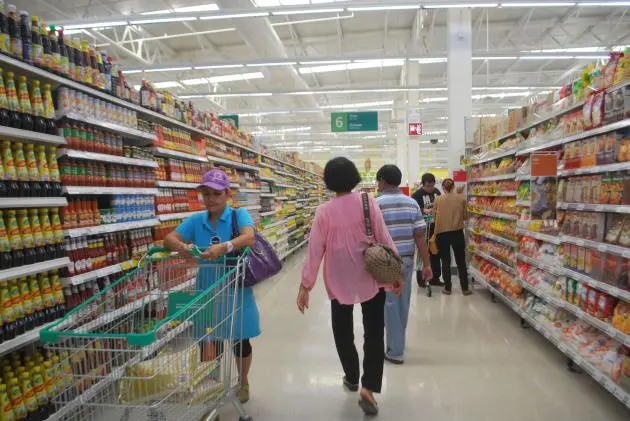
The healthiest zone is the food department, which is crowded and lively. The technological revolution has not erased man’s basic need to eat, and I guess any country that wants to manufacture and export pills that can replace steak or papaya salad will have to do so over a lot of dead bodies.
More importantly, food has variety, and the makers seem classier than their counterparts in other industries. Food-makers don’t just, say, add a bit more fish sauce every six months and claim, “Here’s a brand-new, earth-shattering dish. Try it. They don’t obscenely up the prices every time some more spices are thrown in. Makers of fried chicken that tastes similar don’t sue each other, either.
Life goes on, as they say. It also can end in various ways, as with many cases inside Tesco Lotus. If you are an economics lecturer, your students can get good lessons there. After all, great examples of both smart moves and not-so-clever business decisions are on offer aplenty.
