
Cabinet reshuffle won't resolve PM's first real crisis


Play
With the obvious decline in the popularity of the government, spurred by the controversial, populist rice price-pledging scheme, an overall sense of anxiety is hovering over the ruling Pheu Thai Party.
The fact that Pheu Thai leaders have been talking publicly about “attempts to overthrow the government” almost every day over the past few weeks indicates that things are heating up. Anything could happen. A major Cabinet reshuffle is on the drawing board. If that fails to pacify the public, a House dissolution to call new elections – an unlikely possibility only a few weeks ago – can’t be ruled out anymore.
Despite talk of imminent moves to push through constitutional amendments and an amnesty bill – two major schemes that would benefit ousted former premier Thaksin Shinawtra directly or otherwise – the ongoing political scenario could put the brakes on these sensitive issues.
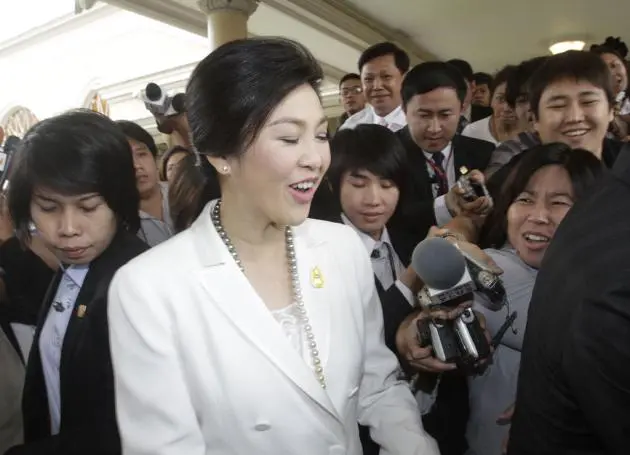
The top priority for Prime Minister Yingluck Shinawatra is to stem the tide of protests by farmers who have voiced strong opposition to the reduction of the guaranteed price of paddy from Bt15,000 to Bt12,000 per tonne, to cut down on the huge losses incurred under the project.
The issue threatens to put a serious dent in the premier’s so-far high popularity ratings. And she realises the controversy could make or break her premiership.
The premier was quoted as having told her close aides: “I have spent sleepless nights in the recent past. Only me and Boonsong [Taeriyapirom, the commerce minister] have come under such severe pressure.”
Obviously, she was referring to the rising tide of opinion against her and the commerce minister for having failed to account for the huge losses from the scheme in the last harvest season and the inability to project future losses.
The premier came under unprecedented pressure for a very simple reason: she had always thought that, by hanging on to this highly costly project, she could at least expect the farmers to stay on her side. She could always claim that the vocal, urban middle class, who have never supported the scheme, could never feel the pain and suffering of farmers – and that only her government could help lift rice farmers from their longstanding poverty.
Now, with farmers marching into Bangkok to express their discontent, the premier has lost her most effective political weapon.
The growing pressure has descended from all directions. Critics, including academics, opposition politicians and the urban middle class, say she has squandered huge sums of tax money without being able to prove that poor farmers have benefited from the massive financial input. She took a step back by reducing the pledge price only to face a huge protest from those who are supposed to benefit from it.
In the wake of this first real crisis of confidence, the premier feels isolated from her Cabinet members and close aides. She has complained that very few of the ministers concerned have stepped up to defend the policy that has been the mainstay of the government’s platform – and a major reason why the Pheu Thai Party won the last general election with a landslide.
The obvious option for the premier to cool things down is to reshuffle the Cabinet, kicking out ministers who she feels have failed her in this big battle. But simply reallocating Cabinet portfolios may not put an end to the slide. The rice price-pledging plan can’t be saved without major consequences. And if push comes to shove, the next choice will be to dissolve the House and call a new general election, hoping that the voters will offer the ruling party another big mandate.
That scenario – unlike the situation a few months ago – isn’t a foregone conclusion anymore.
In this context, it may be worth reminding all political pundits that most Thai governments in the past have fallen because of internal factors. Very few have been toppled by the opposition.
