
Training teachers well: a vital aspect of quality education


Play
IF THAILAND has problems over the quality of education, what are the root causes? And who should be held responsible - teachers, policy-makers or simply teacher-training colleges? No matter which way you look at it, all the aforementioned parties should
But there is hope on the horizon. Dr Jutarat Vibulphol, deputy dean of Department of Curriculum, Instruction, and Educational Technology at Chulalongkorn University's Education Facultyhas helped to identify areas that teacher-training colleges should tackle in order to deliver a better education to Thai children.
Firstly, have the teacher-training colleges ever asked schools and communities what kind of teachers they want? Should the top-down approach be phased out so colleges that train teachers spend more time thinking about the existing needs of schools and the communities in which they are located? Are the teacher-training colleges confident their students can meet the standards needed for teachers within the profession?
Teachers, according to much research, have had a huge influence on their students and their development. So, don’t forget that the performance of teacher-training colleges will greatly affect Thai children and Thailand’s future too.
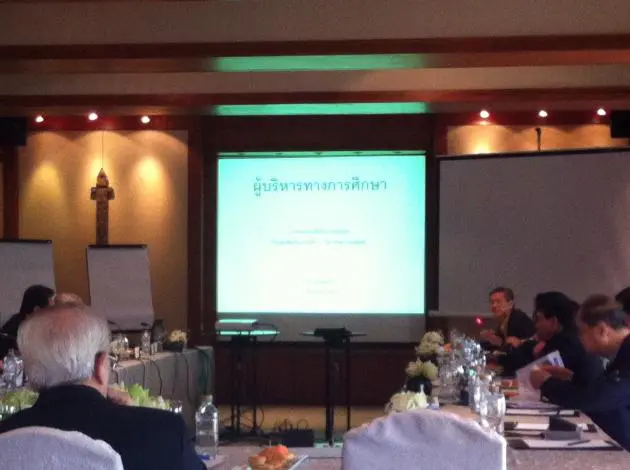
Speaking at a forum held by PICO last Thursday, Jutarat raised all the above questions. Answers will definitely provide us with clues as to how to improve the teacher-education programme.
In trying to bring attention to the needs of better teacher-education programmes, Jutarat said Thailand had previously focused on producing large numbers of teachers, rather than quality teachers. She said she often wondered how some universities could manage as many as 5,000 to 6,000 students each year. At her faculty, there were 100 teaching staff for 1,500 students.
The five-year teacher education programme has been in effect in Thailand since 2004 and relevant authorities hope it will elevate the teaching profession to higher standards.
Under the programme, Jutarat explained that lecturers at teacher-training colleges have to visit the schools where their fifth-year students were interns, twice a month. “Even with a ratio of one lecturer to five students, there is still so little time for lecturers to give advice to their students,” she noted.
She also highlighted that many lecturers at teacher-training colleges have never worked as teachers before, so it could be hard for them to coach their students. An educational degree and academic knowledge does not always guarantee that a particular person will work well as a teacher for the teachers-to-be, she said.
Jutarat said she was aware that her faculty – like other teacher-training colleges – would need to assess its performance and practices so it can improve its future teaching potential.
While Thailand has had a number of researchers who have studied the teaching profession, she said very few assessed teacher-education programmes.
In order to create a better future for Thailand’s education, Jutarat said she believed the “teachers’ spirit” must be instilled in students during teacher-education programmes.
She also encouraged the idea of equipping students in teacher-education with skills to develop themselves further as teachers. In Finland, where the quality of education is high, and where the teaching profession is as much respected as the medical profession, teachers have much autonomy to improve their own skills and shape efficient teaching methods.
Thai regulations, on the other hand, require teaching assistants to develop and demonstrate two years of good teaching skills and pass evaluations every six months. This sounds like an effective approach, but it has not really encouraged newcomers to create new and more efficient teaching techniques. “In Thailand, teaching assistants are prone to avoid thinking or stepping outside the box, because they are concerned that breaking the norm may hurt their chances of passing the performance assessments,” Jutarat explained.
Jutarat, who is deputy dean at one of Thailand’s most prestigious teacher-training colleges, shared her views at a forum entitled “The Way Forward”. If her voice successfully nudges teacher-producing institutes into making improvements, there is hope that the Thai education system will move forward.
And with improvement to the teacher-education programme, its graduates, who will teach Thai children across the country, should have a better set of skills to conduct classes and serve as role models for younger generations.
Chularat Saengpassa
