
Walls of misunderstanding


Play
Accused of inciting panic through a message posted on his Facebook page, veteran journalist Sermsuk Kasitipradit insists he has not violated any laws
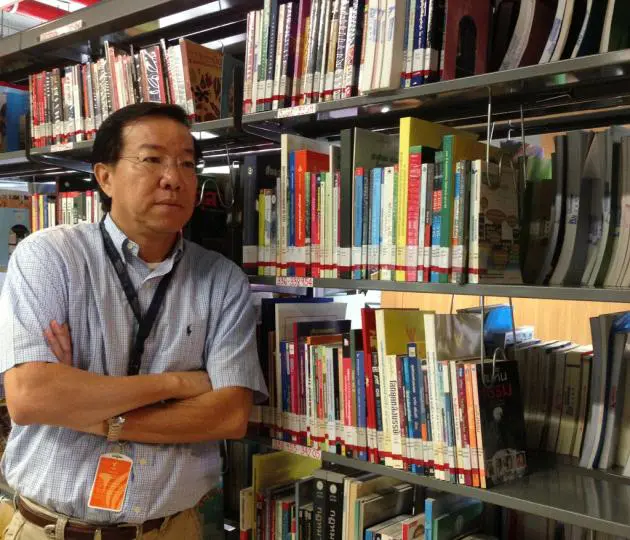
A former print journalist with a passion for digging up the truth, Sermsuk Kasitipradit admits to feeling disbelief and shock when he, along with three other social network users, was recently summoned by the police’s Technology Crime Suppression Division (TCSD) to explain messages he had posted on his Facebook page.
In those posts, all of them destined for his Facebook friends, the political and security editor of Thai PBS, allegedly warned of an impending coup and urged the public to hoard food and water.
In the eyes of the TCSD, such statements were likely to incite panic.
Sermsuk, however, insists that his post reflected his analysis of the current situation and made it clear that he didn’t believe the rumours about revolution.
“My friends and followers understood the objective of that post. I can only think [TCSD commander] Maj-General Pisit Pao didn’t read it properly, otherwise he would have understood too.
“What’s more, I am confident that I did not violate the law. My sincerity can be proved by the fact that I use my real name on my Facebook page.”
While no charges have yet been filed against him and the TCSD has stated that if there are no grounds to the accusation, charges will not be pursued, the newsman says the experience has left a bitter taste in his mouth.
“I always post information about current events on the social media and I believe that my Facebook page is somewhere where I should be able to talk freely with my friends,” he says, adding that his 5,000 Facebook friends and more than 7,000 followers come from all walks of life and political beliefs.
“This case caused considerable worry to my family. My older sister called me from the USA and told me to take care of myself,” he says.
The Thai Journalists Association, legal experts and a human rights commissioner have also questioned the police action.
Moreover, many social media users have voiced support for Sermsuk and openly opposed a police statement that simply clicking “Like” or “Share” on Facebook could be a crime.
TPBS managing director Somchai Suwanban has also issued a statement in response to the police’s move to summon Sermsuk to face charges for violating the Computer Crime Act.
The statement says Sermsuk made the comment with honest intention, a right guaranteed by the Constitution. If Sermsuk’s actions were in violation of any law, an investigation should be conducted in a fair manner without discrimination or hidden agenda.
Sermsuk adds that Somchai has told him to exercise caution in expressing his opinion via media channels and to be aware that his comments must not adversely affect either TPBS or his own credibility as a media professional.
“I’ve been using Facebook since 2010 and have regularly enlarged on information that time constraints prevent us from broadcasting on the TV news,” he says.
“But from now, even though my views have not changed, I will be cautious about the wording I use in my posts. As a media person, I know there’s a very thin line between what can and cannot be posted on Facebook and other social media.”
The coup rumour incident is not the first time Sermsuk has found himself in hot water.
In August 2005, while working as a reporter for the Bangkok Post, he wrote about cracks appearing in the runway at Suvarnabhumi Airport and was summarily dismissed for his trouble.
He sued his former employers through the Central Labour Court and won. The Post appealed and the case is now being considered by the Supreme Court.
His sacking notwithstanding, he was rewarded for his pursuit of the truth with an honorary reward from the Thai Journalists Association in 2006.
A graduate of Ramkhamhaeng University’s Faculty of Humanity, Sermsuk started his career as a proofreader for The Nation and was later promoted to reporter on the Indochina beat. He left after six years and moved to the Bangkok Post where he was assigned to report on security and related issues. He has also worked as news editor for Isara News Agency.
And while he may now be in the headlines for all the wrong reasons, Sermsuk will always be remembered by his colleagues for his efforts in revealing the truth behind a shooting of a villager by a military officer in Thailand restive south.
“When I heard about what had happened from a survivor of the event I knew immediately that I needed to go South and dig up the truth,” he says.
