
A thin line between 'set zero' and 'ground zero'


Play
Thaksin Shinawatra has no qualms about stating the obvious, but one part of his latest interview may have taken the cake. "I can't spell 'lose'," he told a Thai-language newspaper. Although that came in the don't-push-me context, it still sounded ex
I guess my proposal a few weeks ago – that all of his seized money went to charity – stands no chance now. Thaksin definitely wants it back, although the question of whether it was stolen from him or he had stolen it has all but torn the country apart. He told the interviewer he wanted the amnesty to go all the way, something the initial amnesty bill could not do. Let’s call it a “set zero [eestart]”, he said.
Whether Thailand can start over or go back to Square One should perhaps be the question for later. As of now, it has to be about two main technical points: Can a law be enacted to absolve political “crimes” of the past without contravening the present charter? And even if Thaksin is “pardoned” or covered by an “amnesty”, will that make him eligible to reclaim the seized money?
The answer to the first question has to do with the very top and very bottom of the present Constitution. Article 6 states that no law can breach or contradict the charter, and Article 309 endorses the legal clampdown on Thaksin and Co. in the wake of the 2006 coup. To be more specific, Article 309 protects legal action prescribed by and carried out under the 2006 (post-coup) interim Constitution.
How can a law undo the post-coup legal action without breaching the present Constitution? The simplest, but not necessarily easy, way is to abolish the current charter. That explains why Pheu Thai has been so keen about writing a brand-new charter. There’s one little problem, though, because drafting a new charter is a long process and no democratic country can function without a Constitution, at least on an interim basis.
Pheu Thai can pass the long-standing bill to set up an “independent” Constitution Drafting Assembly but the trick is how to get Article 309 out of the way when Thailand is under an interim Constitution. Common sense dictates that while Thailand awaits a new charter, the current one should serve as the interim highest law of the land.
Article 309 is the crux of the whole matter. Pheu Thai and Thaksin were a little shy in the beginning, so they took a lot of detours around that article for fear of criticism that the charter reform agenda was simply meant to help him. The need to pretend is giving way to political urgency.
If Thaksin wants to “reset” the amnesty bill, a constitutionally “safe” way to do it is to first erase Article 309 from the current Constitution. Considering he is no longer shy about his agenda, we may soon see that happening.
Now, the second question. Will amnesty give him the right to reclaim the money? Some experts say “absolutely”, because, legally speaking, when there is no A then there can be no B. The seizure of money is pretty much a “civil” action that follows a “criminal” conviction. When the conviction is no more, then there is no base for the civil action.
Others say it depends on the final wording of the amnesty bill if/when it becomes law. If Thaksin is “forgiven”, then allowing him to get back the money will be like allowing a pardoned thief to repossess what he had stolen from a bank at gunpoint. Moreover, if Thaksin allows himself to be “pardoned”, doesn’t that mean he effectively admits to committing the crime? That will be equivalent to the aforementioned robber saying, “Thank you. I’m extremely sorry for what I did, but can I get the loot now?”
One way to get around those headaches is to make the bill (or law) say no crime ever took place. The said legislation must comprehensively clear Thaksin. If he did nothing wrong, then taking his money was wrong. He or his party or his government can manoeuvre to get it back later once such a bill is passed.
This “no-crime-happened” bill will also find Article 309 standing in its way. Which brings us back to where we started. To add to the complexities, any bill alluding to the possibility of the money being returned could easily be classified as a “financial bill”, which would require Yingluck Shinawatra’s name on it.
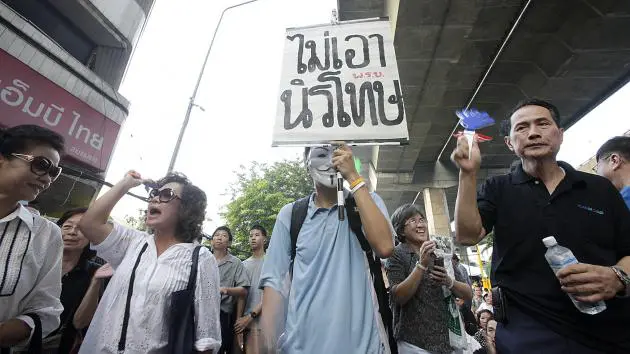
It’s a badly messed-up ball of string, and this is about legal technicality alone. When we throw in the Urupong rally, which could get fiercer and bigger, and some red shirts’ growing resistance to “forgiving the murderers”, resentment against Thaksin in the military and other political aspects, “setback” may sound more accurate than “set zero”.
