
A nation skating on super-thin ice


Play
If finding balance were easy, more tightrope walkers would roam the earth. This truth is so simple it's quickly forgotten. Balance is even trickier in politics, and yet more so in Thailand. Now, do you want to hear the good news? Such uneasy equilibrium
Thaksin Shinawatra, no matter how he tries, is still being kept out of a country where his youngest sister is prime minister and his political party controls the House of Representatives. We can thank the rule of law for the first bit and democracy for the latter. That makes Thailand a special place. Name any other country where a “criminal fugitive” is a close relative of the national leader and has virtually the entire ruling party devoted to him.
The rule of law is supposed to be an inseparable element of a healthy democracy. Here, the two things have been at each other’s throats and we have to make do with the knowledge that one side has not killed the other yet. It’s inconvenient. It keeps political tension high all the time. It makes “peace” seem so remote. But don’t you dare tilt the balance.
We Thais have been cursing our luck, but we can also try to look at the bright side. In another world, a political party that enjoyed the support of the people could have been crushed and sent into decades of wilderness, a la Myanmar’s National League for Democracy. In yet another world, a corrupt democracy may be wreaking havoc, with those who control the parliamentary majority making rules and laws as they see fit.
To be precise, though, the rule of law did not stop the Pheu Thai Party’s controversial amnesty bill. That was done by a national outrage triggered by signs that the rule of law was being ignored. “Democracy” overstepped its bounds, thus threatening the sensitive balance. The rule of law called for help and, within days, the awkward but crucial state of affairs was restored.
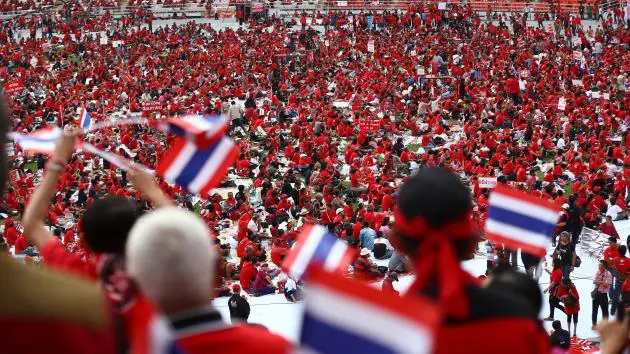
We know that “absolute power corrupts absolutely”, but we have never been taught how many ways absolute power can come about. Moreover, issuing a blanket amnesty law, based on an election promise to “bring peace and justice”, sounds like the right thing to do. It doesn’t seem like democracy was abusing its absolute power. But when tens of thousands of people took to streets, with perhaps millions sharing their anger at home, what was proclaimed as “right” was unlikely to be so.
You can believe the government’s claims that it’s an attempt to destroy democracy, or you might consider the possibility that our unhealthy democracy could unknowingly be putting itself in danger yet again. You can assume that “absolute power corrupts absolutely” is something coined to promote democracy, or you might suspect that it’s not only dictatorships that wield absolute power.
Now that the rule of law has been yanked from the jaws of peril, what about democracy? What about a government elected by the people which is being besieged by all kinds of trouble, some of which is “undemocratic”? If tens of thousands converging on Bangkok’s main streets symbolise the “right” conscience, what about the millions that voted the sponsors of the amnesty bill in to power?
Tricky, isn’t it? But it can be very simple, too. Democracy is not just a show of majority force. And as with other powers, democratic power comes with great responsibility. The ballot box is only one part of a system that is supposed to be open, fair and respectful to minority opinions. If an elected government is democracy’s baby, it’s supposed to be brought up to be a good person.
The inconvenient balance can tolerate a wayward government. Such an administration may be ridiculed or protested vehemently against, but it will be allowed to live and die through democratic means. The Pheu Thai government’s best hope is to be deemed a wayward, not malicious, product of democracy, and given a chance to rise or fall on to its own democratic merits. Just as the demise of the rule of law would be bad for the whole Thailand, Pheu Thai’s brutal death would also tip the delicate balance.
Do you see how we are becoming a nation of great political jugglers, sending democracy up with the right hand and catching the rule of law with the left? It’s not always entertaining, though. The fun will only continue if nothing falls and breaks. Of course, it’s not convenient, but keeping them all in the air is probably the best we can do at the moment.
