
'We are guilty of having very high expectations of Thailand'


Play
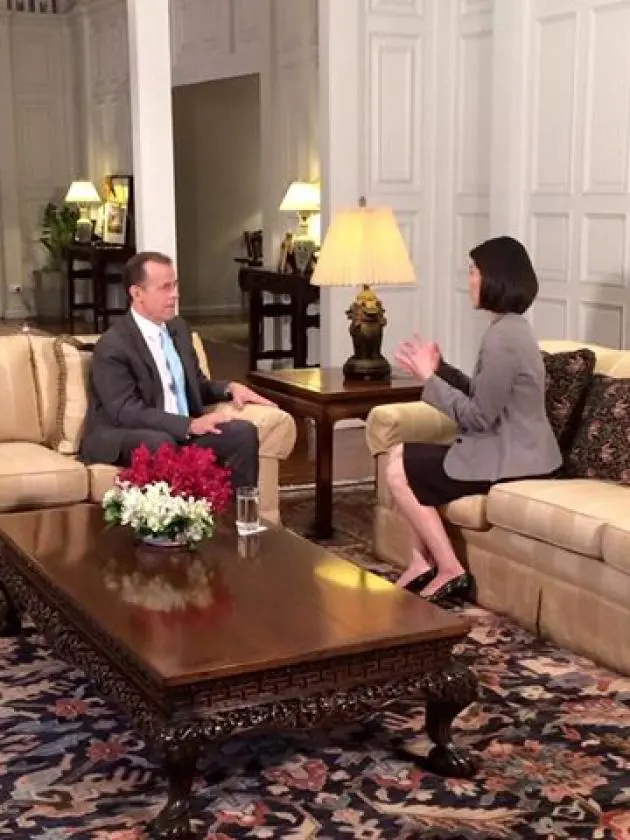
The concluding part of US Ambassador Glyn Townsend Davies's interview with the Nation Group's Veenarat Laohapakakul
Having met with Prime Minister General Prayuth Chan-o-cha on Thursday, new US Ambassador Glyn Townsend Davies will be closely watched on how he handles relations with Thailand from now on. During his interview, he insisted that he would listen to groups from across the political spectrum and will emphasise on positive relations with Thailand.
Is your biggest mission at this moment, – at a time when relations between our two countries are not as good as they should be – to mend relations?
My biggest mission here is to accentuate the positive in the relationship, to work on issues that are vital to Thailand and the US where our interests coincide. Thailand is a regional leader and is centrally located so as to be able to show to other Asean countries what can be done by a dynamic system. With the political problems that have arisen here, and challenges of the coup, and now trying to find a way back with a road map, Thailand is focusing on its internal issues. We understand that it is necessary but we want to see Thailand become a great regional beacon of stability and freedom and democracy that it deserves to be. We think it can get there through resolving political challenges and moving quickly along this path and finding a way back to election and civilian government. I know Thailand can do it. I am very positive. I hope that in the three or so years I have here, as a friend, I can help Thailand through this process. As an ally, as a friend, once again, we have in Thailand a regional leader who is able to look out, rather than dwelling on domestic political issues. It’s tough, we understand. We Americans are a bit impatient, and I apologise for that. That’s one of the reasons why we want to see the process move forward.
The case of Thailand is compared to that of Ukraine and Egypt, where there were protests and people called for the ouster of their elected presidents, and the US seems to support the will of the people there, but in Thailand it’s the other way around, so people view the US as applying double standards.
Do you think Thailand is Ukraine or Egypt?
The situations are more or less similar.
I don’t think so. I think making comparisons is very difficult because they are different situations. Thailand, in 1932, began the process of striving for democracy. Within your own unique context, how it is debated and done must be a Thai approach to that and we understand that. You have a King and we revere the King along with you. The point is, Thailand is not Ukraine or Egypt. You can do this. You have done this in the past. You’ve achieved these kinds of institutions. You’ve found ways to give voice to all the people of Thailand through democratic elections in the past. We have this high hope for you. You are an ally and a friend. Different cases, different places create different expectations. I suppose we are guilty of having very high expectations and really believing in Thailand and your future and in your ability to tackle this problem and create a bright future for your children and grandchildren. We know you can do it. I hope I can be a tiny part of that process, as a friend of Thailand.
Are you worried that Thailand might lean more towards China and maybe Russia?
I don’t think Thailand is a country that leans. I think Thailand is a country that, history proves, is independent, sovereign, and free of external entanglements except for the briefest period during the mid-20th century. Thailand never suffers from colonisation and we think the United States has played a positive role in that respect. I don’t fear Thailand becoming a colony of anybody. I don’t think that’s ever going to happen. I think Thailand is too strong. I think the people of Thailand are too proud. So that’s not a preoccupation for us. We don’t worry about Thailand falling into somebody else’s camp. We don’t want to dominate or colonise Thailand either. Thailand functions best when Thailand is strong, internally organised and is able to move forward.
The TIP [Trafficking In Persons] Report is viewed as biased and political because Malaysia, which has similar Rohinya trafficking issue like Thailand, has been moved up to Tier 2 while Thailand remains at Tier 3. And compared to other countries, some of them have worse human rights record than Thailand, but they have better rankings than Thailand. How can you say this report is an unbiased and professional report?
I think what’s important is for people to look at the facts and read the report and decide whether our case has been made properly. People can have different views on that. Thailand has shown a strong commitment to deal with this problem and that is to be respected, admired, and applauded. The US is very pleased to see the policy direction that is set out by the government of Thailand. The way the process works, the steps that Thailand has taken occurred after the end of the period that was covered by the report. But I reject the notion that it’s political. What we would like to see Thailand do is keep going. The arrests are important and the new mechanisms set up in the Justice Ministry are also very important. Now comes the hard process of turning those arrests into prosecution as well as establishing mechanisms and bodies to help the victims of trafficking.
The Trans-Pacific Partnership – are you
disappointed that Thailand has not decided yet about joining the TPP?
It’s not a question of being disappointed. We have 12 countries joining, with 40 per cent of the world’s economic strength. It’s not yet ratified, so there is a process to go through. What we hope is that Thailand does look at it and decides based on its own needs, economic situations, and its own vision of its future – does this mechanism make sense to Thailand? We are prepared to engage in a dialogue with Thailand about this, answer questions about the TPP process. If Thailand at the end of the day, decides that it is interested in being part of, then all 12 countries that are current members will look individually and decide whether it makes sense to have Thailand join us.
TPP is an economic bloc, but it does have a political agenda – to counter the influence of China economically – isn’t it?
No. TPP actually did not begin with the US, but with other countries. TPP is about business. TPP is about trade. It’s about a race to the top – how can we establish a high-standard agreement that will help all economies improve labour conditions, productivity, create more jobs, create more wealth, create a better future for their people. All of these standards, from environment to labour, and lowering tariffs, are so that trade can be freed up and more wealth created. There is no political component to this. This is about business.
The US recently sent warships to the disputed area claimed by China in the South China Sea. How is sending warships a constructive role on the part of the US?
I am not in the Pentagon and I am not in Washington at the State Department. I am here in Bangkok. We think what’s important in order to allow freedom of navigation is for all nations to have access to the sea lanes; when international law permits it, nations should be allowed to have their vessels go through in international waters. For many years, we have done this. We call it freedom of navigation and we do it to underscore a particular point, that transit on these waters should be a right of all nations and we seek to preserve that right. We don’t make any territorial claims in that part of the world, but other countries in Asean do. What we are hoping for is how can there be a peaceful resolution of these disputes and we are hoping that China engages forthrightly with all nations of Asean to achieve that result.
How much of social media are you going to use to talk to the people of Thailand?
I like social media. I think it’s really interesting. I am an old guy. I grew up before computers arrived, so I am a little slow at these stuffs. It’s a way to demonstrate to people that I have an interest in Thailand. I went to Chiang Mai and climbed up Doi Suthep. I tweeted about that. I was excited. I went to Koh Chang and saw the beauty of Thailand and I tweeted about that. These are the kinds of things that I think are useful to tweet about. But I also think the most important thing is talking to people face to face – looking at people in the eye and having this kind of conversation back and forth. For me, as an old-style diplomat, this will always be important. But I am going to keep trying on the social media.
You’ve been in Thailand for about a month. What do you like most about Thailand?
The people, the food, and the welcome we’ve received. Everyone has been so wonderful to my wife and me. We feel very much at home here. I feel that somewhere in my last 35 years in my career, I must have made enough merit to deserve this assignment. This is a wonderful assignment for an American diplomat towards the end of his or her career, to be able to come to this beautiful place, to work with wonderful Thai people and learn about its culture. We love everything about Thailand.
Watch this special interview on ‘Mong Rao Mong Lok’ programme this Sunday, November 1, 9-9.30am, on Nation TV.
