
‘Nothing is difficult. This is a human life’


Play
Germany’s open-door policy offers new hope to more than a million refugees fleeing war, but the capital Berlin is buckling under the weight of numbers
They each have different reasons for fleeing their conflict-torn homelands, but the refugees spilling into Europe have one thing in common. All are determined to build new lives in a strange land.
Many of them have spent their life savings on the journey, but they know the price is worth paying.
“I came here because I want a good life. The German government offered us a place. I want to live here for ever and don’t want to go back to Afghanistan,” said Attaullah Kanzada, a young man in his 20s from the northeast province of Kunar who spoke in fluent English.
Kanzada travelled to Germany with US$8,000 (Bt289,000) he said he got from friends. His journey – some of it made on foot – took him from Afghanistan through Iran, Turkey, Bulgaria, Croatia, Serbia and Hungary to Berlin, where he arrived two months after departing.
Kanzada’s family supported his decision to leave after his father, a high-ranking police office, was threatened by the Taleban.
Life in Afghanistan is difficult because of the prevalence of terrorism and guns, he explained.
Kanzada seems to have integrated quickly in his new cultural surroundings.
Just 40 days after arriving in the German capital, he began working as a volunteer translator for fellow Afghan refugees at Messe Berlin, an exhibition hall converted into a shelter.
“Nothing is difficult. I’m feeling well [with the new rules]. This is a human life,” he replied, when asked what was the most difficult thing about living in a foreign country.
“I’m happy to be here and very appreciative of the opportunity they [the German government] gave us. The rules in Afghanistan and Germany are very different, but we need to accept that,” he said.
“Here in Germany, it is freedom of rights, which differs from Islamic rules.”
Kanzada is hoping to enrol in school then university, before finding a job and settling in Berlin.
“I want to get asylum status, but if rejected I will go to another country, because I have spent a lot of money [on the journey from Afghanistan],” he said.
He also plans to bring his family here.
Fellow refugee Nazar al-Hamy, a 39-year-old man from Iraq, decided to seek sanctuary in Berlin after fleeing a war in his home country that claimed the life of his 6-year-old son and left his 19-year-old son Mustafa disabled after being caught in an explosion.
Al-Hamy made the journey with his wife and four children and now wants to get work as a driver in Berlin.
But war isn’t the only reason behind the migrant influx.
Over at emergency accommodation in the old Tempelhof Airport, a Pakistani boy explained he journeyed to Berlin because of family matters.
He spent $2,000 travelling from Iran to Turkey.
“All is good. They give me money, food and clothes. Yes, I have friends from Pakistan here so I can adapt [to life] here,” he said.
Every resident in the shelter receives around 109 euros (Bt4,250) per month from the government.
“I want to stay, work and settle here. But I don’t think Germany will give me the chance, because I’m from Pakistan,” explained the boy, who filed his application for asylum two months ago and says he will appeal if rejected and do everything he can in a bid to stay.
“Yes, I am happy. I have friends who have a house the [German] government gave to them. But I’m still in this camp and I want to live with them.”
Race against time
Phones started ringing to make arrangements for the flow of refugees immediately after German Chancellor Angela Merkel announced an open-door policy in late August for people fleeing war in Syria, Iraq and elsewhere.
The government was tasked with providing accommodation – houses, tents, army barracks, gyms, and old official buildings, explained Norbert Seitz, head of the Department of Migration at the Interior Ministry.
So far the government has succeeded in providing shelters for all the refugees, he said.
All empty flats were made available to refugees by an official directive, with the government paying rent of around 500 euros a month.
The government hired NGOs, charities and private companies to manage the accommodation, but chaos reigned over the early stage of the process.
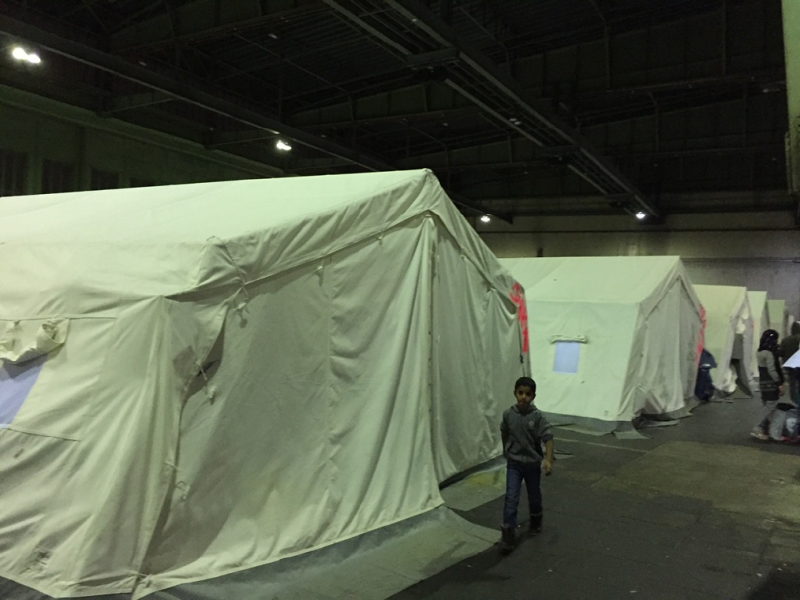
Among those roped in was Tamaja, a private company that runs refugee housing. It was given just three days in mid-November to set up a shelter in hangars at Tempelhof Airport.
The entire infrastructure had to be built overnight, explained Maria Kipp of Tamaja’s public relations department.
With the help of soldiers, tents with bunk beds were set up in a football field-sized hangar over the weekend.
As of December, 2,200 refugees were being sheltered in the three hangars –
one-third of them children. Asylum-seekers from Syria form the largest contingent here, at 36 per cent, followed by Afghans, Iraqis, Iranians and Pakistanis.
They were being cared for 24 hours a day by 45 relief workers working in shifts, though Tamaja aims eventually to have 45-50 for each hangar, excluding security and catering staff.
Local volunteers hold free German classes for the refugees. Funded by donations, other social activities include the chance for children to visit the cinema and also to watch matches at local football stadiums.
Residents are free to leave the Tempelhof shelter as long as they take proof of identity in the form of a special card.
One hitch in the first two months concerned the facilities.
A common problem at every shelter was limited private space in the hangars, which meant each resident had to respect others’ privacy.
Though there are 171 mobile toilets, a lack of showers meant that refugees at Tempelhof were initially driven by shuttle bus every other day to bathe at a special shower bus beyond the camp’s perimeter, Kipp said.
Emergency accommodation like Templehof normally houses refugees for two weeks before they are moved on, but in the face of such overwhelming numbers Tamaja has had to build infrastructure to serve on a longer-term basis.
However, the biggest challenge is to prevent people feeling like they are just a “number” and instead treat them like human beings, Kipp explained. “And [make them think] people are still taking care of their needs or demands,” she added.
Another problem was that people arrived with the expectation they would be staying only three weeks – four at the maximum, she said. The reality was more like three months.
“Nobody can tell us how long they will have to stay here. I think this really caused a lot of frustration.
“It would be different if we could say to them, okay, you are going to be here for two months and then you can move on. People would have hope.”
But the fact was that after a month here, they would go to the local authorities and then come back with a new paper, she said.
The registration procedure for asylum-seekers is muddied by the frequent change of policy, Kipp added.
That opinion was echoed by a representative of the charity Malteser Hilfsdienst, which runs a temporary shelter at the Messe Berlin fairgrounds in the west of the city.
Most challenging is the administration, because people staying here want to know what will happen next after their long and tiring journey, she said.
“They have reached Germany, been given shelter and food, but what’s next? They need to know if they can stay?” she said.
Once the refugees are recognised or given asylum, they have almost the same rights as German citizens, including access to public healthcare, housing, social benefits, education and jobs.
Yet the type of regular jobs open to them is still restricted, Kipp said, explaining that priority was given to German and EU citizens.
Hence, her company is trying to integrate people living at the shelter by creating job profiles that suit the refugees.
“For example, we announced that we needed translators and integration assistants. If any refugee can speak Arabic and English or other languages they can work for us as a translator.”
Europe-wide responsibility needed
Germany took in more than 1 million migrants last year.
As a result Berlin looks rather different than it did two years ago. Families of Middle Eastern origin, often asking for information or directions in broken English, are now a relatively common sight on the streets of the German capital.
Meanwhile the government has doubled the number of staff at immigration and refugee offices, but they are busier than ever.
“We increased staff numbers from 3,000 to 7,000 last year to deal with the refugee situation,” said the Department of Migration’s Seitz.
And this year, the government will provide 4 billion euros to federal states to cope with this huge challenge, he said.
Germany’s Foreign Ministry has reached out to potential refugees via the Net, both on Facebook and its own website, where it provides information and explains the difficulties so as to help them decide whether to flee their countries.
The ministry doesn’t want to deter migrants, but to raise awareness of the real conditions and the danger, explained a ministry official who asked not to be named. Objective information could help protect them from becoming victims of traffickers.
Despite the impressive mobilisation of official support, asylum seekers must still queue for hours to be registered at the State Office for Health and Social Affairs in downtown Berlin. This is the first contact point for newly arrived refugees, though many complain that postponed appointments mean they are still waiting in the evening after arriving in the morning.
Berlin’s handling of the refugee matter had been pretty good until things became difficult in the summer, noted Johanna Mantel, a German expert in asylum law with Amnesty International.
“Germany is known as a good administrator but now it’s very problematic,” she said.
In her opinion, what is being called a refugee crisis is actually a crisis of administration or politics.
“It’s all about political will. Politicians are afraid that many Germans who are concerned about refugees won’t vote for them anymore,” she said.
Many politicians have been manipulating the issue, she said, using words like “masses”, “flood” and “influx” – which scare people.
“They [politicians] should be the ones who stay calm and say we can do [handle] it,” she said.
For Seitz, he realised as soon as he got a phone call from his superior about the open-door policy that it would be a huge challenge. He also knows it won’t be possible to solve all the problems.
“We will not be able to provide opportunities to those people who come to Germany because they wanted to find better living conditions or better careers, but we will manage to provide protection to those who need actual protection,” the Migration Department chief said.
“More importantly, we expect the huge influx of people to become a European responsibility,” he said.
The second and concluding part of this article will be published tomorrow. The writer made her visit in mid-December at the invitation of the “Refugees/Migration/Integration in Germany” programme run by the German Foreign Office.
