
Developers to take debenture route


Play
Fund-raising by this method will cut the interest cost in a year when overall cost is expected to go up
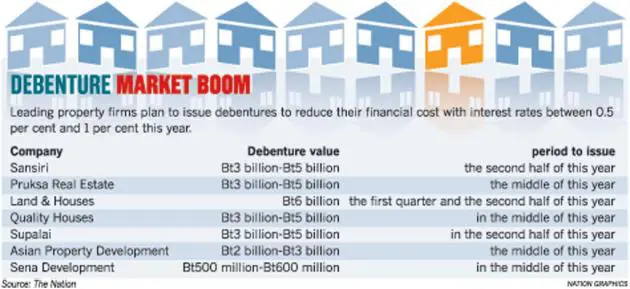
Leading property firms plan to issue debentures to reduce their financial cost by 0.5 to 1 per cent this year.
The firms have lined up investment plans worth more than Bt100 billion this year.
Among the big names are Sansiri, Pruksa Real Estate, Land & Houses, Quality Houses, Supalai, Asian Property Development and Sena Development.
Most of them plan to raise between Bt3 billion and Bt5 billion this year through the issue of debentures with interest rate of between 4-5 per cent, lower than the rate charged by commercial banks where minimum lending rates are between 6-7 per cent a year.
Land & Houses senior vice president Adisorn Thananun-Narapool said the company plans to issue debentures worth Bt6 billion this year –Bt4 billion in the first quarter of this year and Bt2 billion in the second half of the year. The company is likely to offer an interest rate of about 4 per cent. The debentures will have a three- or five-year term.
The move will help the company reduce its financial cost from an average 4.3 per cent to 4 per cent, he said.
“Funds from the new debentures will be utilised to repay Bt3 billion debentures that mature in the middle of this year, which pay interest at 6 per cent. This will help us cut our interest cost in the middle of this year,” he said.
Pruksa Real Estate chief financial officer Somboon Wasinchutchawal said the company plans to issue debentures worth between Bt3 billion and Bt5 billion in the first half of this year after it was delayed last year.
The funds will be used to support its investment plan worth Bt23 billion. Bt5 billion will used to buy undeveloped land, while Bt18 billion will be used for infrastructure and construction of its 49 new residential project this year, he said.
He added that the debenture funds will help the company reduce its financial cost from an average 4.5 per cent to 4 per cent.
The company also plans to ask its creditors and shareholders to lift its debt-to-equity ratio ceiling from 1.5:1 to 2:1 this year. This will help the company manage its cash flow when faced with accidents such as natural disasters and other crisis, he said.
“We asked for an increase in the debt-to-equity ratio ceiling but that does not mean we will increase our total debt. We want flexibility to manage our cash when income is delayed due to unpredictable situations,” he said.
When property firms issue debentures to cut their financial cost, it will help them manage their financial results to maintain a net-profit margin of between 10-16 per cent at a time when their operation costs are rising, especially labour cost that will go up after the daily minimum wage of Bt215 per day is hiked to Bt300 per day on April 1, 2012. Construction raw materials cost is also rising by 5-10 per cent, and land price will rise after Bangkok’s new city plan is unveiled in the first half of this year.
LPN Development managing director Opas Sripayak said that of all factors, labour cost, construction cost, and rising energy cost will push up the cost of construction by 8-10 per cent this year. However, the government policy to cut corporate income tax from 30 per cent to be 23 per cent will become effective this year. This measure will help property firms cope with rising cost by 6-8 per cent. That means property firms will face a cost increase of 2-3 per cent. This may impact the pricing of residential property by 2-3 per cent, depending on the location and competition, he said.
