
Property developers will face positive challenges in year ahead


Play
AEC set to drive Thai growth across market segments as more foreign developers eye local partners, say leading consultants
This year will be a challenging one for property developers in the positive sense, with foreign players interested in expanding their investment in the Thai real-estate sector via local joint ventures and direct investment as they prepare for the Asean Economic Community (AEC) coming fully into effect.
“Foreign investors from China, Japan, Singapore, the Middle East, Hong Kong and Europe are interested in expanding their investment in the property sector in Thailand by seeking local partners for joint investment in both condominium and hospitality projects,” said CB Richard Ellis (Thailand)’s managing director, Aliwassa Pathnadabutr.
With Thailand at the geographic centre of the region, foreign companies across many sectors want to set up head offices here in order to expand their business in Southeast Asia and, when they do so, they normally look for suitable housing for staff from their home country, she said.
This will boost demand for both office space and residential property, helping both segments to expand more than last year as a result, she added.
Following the market trend, major foreign property firms – especially from leading Asian economies such as Singapore, Hong Kong, China and Japan – have shown interest in expanding their investment in Thailand in the office, hospitality and residential segments, said the managing director.
“We have foreign investors asking us for more information, and also assigning us to find them partners to develop property projects in Thailand,” said Aliwassa.
Napatr Tienchutima, associate director at property consultancy Collier International (Thailand), said 10 developers from China, Hong Kong and the Middle East had expressed interest to the company in expanding their investment into the Thai real-estate sector for the first time.
“They need us to advise them to find local partners to develop residential projects in Thailand, especially in hospitality, office and residential. Five of them plan to invest in 2015 if they can find a partner,” she said.
She added that the AEC’s coming into full effect at the end of this year was the main reason that property companies from Japan were interested in investing in Thailand, having seen a number of Japanese manufacturing firms in the auto, electronics and other sectors planning to move their production bases from Japan to the Kingdom, which will also serve as their gateway to other Asean countries in the AEC era.
According to the Board of Investment, tax privileges for 48 Japanese companies planning to invest in manufacturing projects worth Bt211.34 billion were approved in the first nine months of last year.
This means that demand for offices, industrial-estate space and residences will rise when their new manufacturing operations commence, said Napatr.
Since 1997, several property firms from Singapore and Hong Kong have expanded their investment into Thailand by setting up joint-venture companies with local firms.
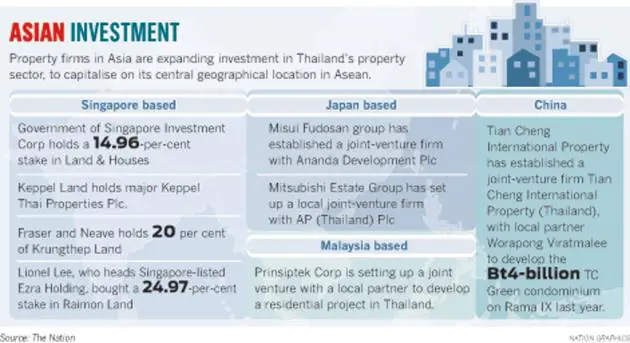
For example, the Government of Singapore Investment Corp holds a 14.96-per-cent stake in Land & Houses, while Singapore-based Keppel Land purchased a major stake in Five Start Property in 2003, with the local business now called Keppel Thai Properties.
Singapore’s CapitaLand Group, meanwhile, invested in Thailand in 2003 by establishing a joint venture with TCC Land Group, which is owned by beverage tycoon Charoen Sirivadhanabhakdi.
CapitaLand has, however, since sold its stake in TCC Capital Land to TCC Land Group.
Singapore-based Fraser and Neave has held 20 per cent of Krungthep Land’s shares since 2003. F&N has been majority owned by Charoen’s TCC Group since 2012.
Singaporean entrepreneur Lionel Lee, who heads Singapore-listed Ezra Holding, bought a 24.97-per-cent stake in Raimon Land in February 2013.
In 2013, Japanese property companies also expanded their investment in Thailand via joint ventures with local firms.
For example, Misui Fudosan group established a joint-venture firm with Ananda Development to develop residential projects worth more than Bt20.5 billion combined over the past two years.
Mitsubishi Estate Group set up a local joint-venture firm with AP (Thailand) to develop residential projects worth Bt10.5 billion
in 2014 and beyond.
Meanwhile, Prinsiptek Corp, which is listed in Malaysia’s stock market, expanded its investment
in Thailand’s property project in 2013 by setting up a joint venture with a local partner to develop a residential project worth Bt900 million.
The group will expand the investment this year.
Then there is China-based Tian Cheng International Property, which established a joint-venture company, Tian Cheng International Property (Thailand), with local partner Worapong Viratmalee to develop the Bt4-billion TC Green condominium on Rama IX last year.
Thai conglomerates diversifying
Not only are foreign investors expanding into the Thai property sector as part of plans to use the Kingdom as a gateway to other Asean countries, but Thai conglomerates have also been diversifying their investment into the real-estate sector after seeing the potential opportunity on offer when the AEC becomes fully effective.
For example, beverage giant Singha Group took over Rasa Property Development in the middle of last year with a view to developing office, retail and residential projects worth up to Bt100 billion from 2015 through 2019.
CP Land, the property arm of CP Group, has an aggressive investment programme worth Bt30 billion from 2015 to 2017 to develop residential, office, industrial estate, hotel and distribution centre projects around the country, in order to serve demand from both domestic and foreign investors expanding their investment in Thailand after the AEC takes full effect.
“The AEC is a [positive] challenge for Thailand’s property sector’s strong growth, not only residential but for all property segments, such as offices, retail, residential, hospitality, industrial estates, warehouses and distribution centres,” Aliwassa added.
