
Innovative home ideas for all
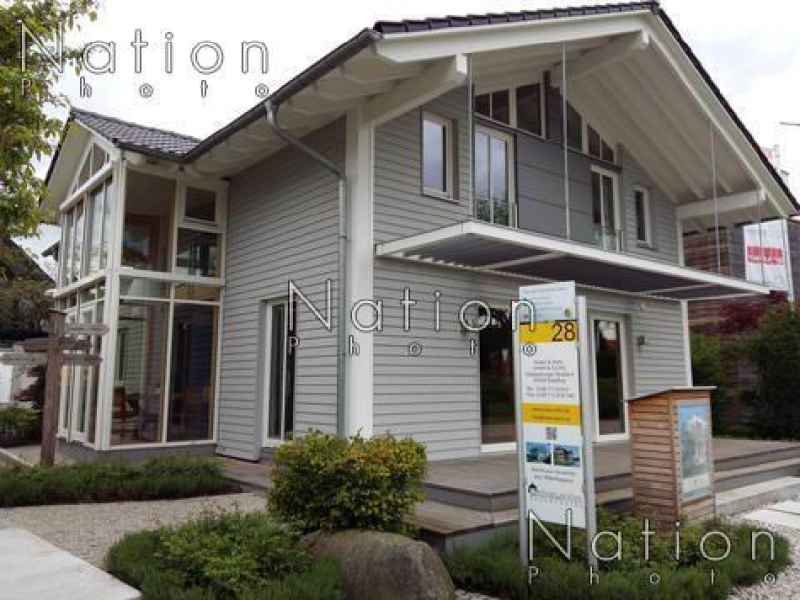


HOUSING is one of the four necessities of life, but in Germany housing can be more than that: It can be energy-efficient, smart and perfect for people of all ages.
All innovative ideas are displayed at the homes exhibition Bauzentrum Poing. Located within a 15-minute drive from the centre of Munich, the centre of innovative home ideas exhibits more than 55 houses, all fully fitted and furnished.
Visitors come here to find out about the latest technology and trends in construction and modern living, and to consult experts for one-to-one advice. According to the centre’s website, this display attracts around 80,000 visitors each year, and is as such Germany’s most popular show-homes exhibition.
Last week, a group of about 30 Thai journalists made a brief visit to the centre. The focus was a model next to the “Technology Pavilion” – which itself is a building that demonstrates the future for man, nature and technology.
At a glance, the model looks just like any other houses we see today. Yet it is constructed and equipped to demonstrate smart building, energy efficiency and multigenerational housing – three of four housing mega-trends.
“Houses can change the way we live,” said German architect Martin Schoch.
To reduce energy consumption, the two-storey house with some 150 square metres of usable space is designed with glass doors and windows, to let in sunlight. Solar panels are fitted to the roof, to help generate power for the house or sell to the electricity grid.
It is also equipped with an electronic system that is shown on a screen in the middle of the house. From there, pictures from closed-circuit cameras can be displayed, along with the keys to control air-conditioning and lighting. The system also allows remote control from electronic devices like mobile phones.
The house is also designed for dwellers of all ages, a key feature that should entice homebuyers across the world given the increasing number of elderly people. Except for the stairs, there are no steps in this house, whether you walk into the living room, the dining room or the bathroom. There is not even a step at the ground-level entrance.
As Choch Schoch shows, doors in the rooms are extra wide, at 1.20 metres, to allow wheelchair access. The bathroom is equipped with sliding doors to allow walk-in access to the shower.
To Schoch, this building is like a car that is fully equipped with all of the buyer’s specifications. As such, with all the systems and equipment, this house will cost the owner about 500,000 euros (Bt20 million). Unfurnished, the cost will be 300,000 euros.
Buyers can specify which features they do not need.
“Fifteen years ago, the first priority for the Germans was energy-saving. Now, like anywhere in the world, homes for the elderly [are] the priority. Everyone is getting old,” Schoch said.
Nearly all of the 55 houses displayed feature innovative ideas on energy, only 11 exhibit new ideas for the elderly.
There are plenty of ideas at |this centre. Fischerhaus’ model, |for instance, shows generous |living space on two floors. Built-in under the roof terrace is a disabled-friendly apartment for one or two users covering an area of about 50sqm. It allows older people to participate in the life of the young, without abandoning their own independence.
Schoch is now advising Pruksa Real Estate on a house model, as the Thai company wants to embrace innovative ideas to grow its business sustainably. A model is being constructed at The Plant Estique Pattanakarn, planned to win certification from DGNB, the German Sustainable Building Council. To be completed by the end of June, the model will focus on two mega-trends – multigenerational housing and energy efficiency.
He admitted that because of the different climate and housing regulations here, some of the features will be adjusted. Some automation technology may take about five years to be widely introduced in Thailand. However, one thing that a Thai house probably does not need is the security system, he said.
“Most Thai houses are in estates, which have good security systems. Well, in that sense, Thailand is more advanced to Germany.”
Pruksa’s house will also feature a solar roof, but the power generated will be retained in ice storage. The cool air will then be used to cool the house, to reduce the use of air-conditioners. While German designs permit a lot of sunlight, the Pruksa house will be equipped with shading devices to manage the home’s micro-climate.
The house is also designed to answer the needs of families with elderly members.
