
Thailand's Medicine Supply Lines Become a Geopolitical Battleground


As carbon border rules and ESG mandates rewrite global trade, Thailand's healthcare supply chains face a stark choice: adapt fast or lose access
- Thailand's medical supply chain is under pressure from new international trade rules, including the EU's carbon border tax and ESG mandates from global pharmaceutical buyers.
- Companies in the Thai healthcare sector must now provide verifiable data on their carbon emissions or risk losing contracts and access to key international markets.
- In response, major distributors are proactively measuring emissions and investing in sustainable logistics, such as reusable cold-chain packaging and automation, to remain competitive.
- A key vulnerability is that smaller suppliers often lack the resources to comply with these new sustainability demands, which could jeopardize the entire supply network's standing.
As carbon border rules and ESG mandates rewrite global trade, Thailand's healthcare supply chains face a stark choice: adapt fast or lose access.
Bangkok's hospitals do not run on optimism. They run on cold rooms holding to within two degrees Celsius, on trucks that cannot be late, and on paperwork that, until recently, nobody outside a compliance department bothered to read closely. That paperwork is now a matter of commercial survival.
A wave of new trade and disclosure regimes – the European Union's Carbon Border Adjustment Mechanism (CBAM), tightening Scope 3 emissions reporting, and a fast-growing list of environmental, social and governance (ESG) mandates from global pharmaceutical buyers – is quietly redrawing who gets to sell into which markets.
For Thailand's healthcare and medical-technology sector, a growing and strategically important pillar of the Kingdom's economy, the message from multinational clients has become blunt: show your carbon numbers, or lose the contract.

"Sustainability regulations and reporting standards are no longer a future trend," said Vorrapong Surachaikulwattana, vice president for supply chain management at DKSH Thailand, one of the country's largest healthcare distribution operators. "They are vital for setting clear, standardised baselines and metrics to measure sustainability progress consistently."
Clients, he said, are now asking pointed questions about where emissions originate, how products are transported, what packaging is used, and whether the underlying data can be verified — questions that, until a few years ago, rarely made it into a commercial negotiation.

This is the undercurrent running beneath Thailand's push toward a low-carbon healthcare supply chain, and it is the backdrop against which a coming sustainability roundtable, convened as part of a series examining how Thai industry is confronting these pressures, will pose an uncomfortable question to the country's business leadership: is sustainability compliance, or is it defence?
A region racing to keep up
The stakes are considerable. Asia-Pacific's medical devices market, valued at well over US$130 billion, is expanding faster than almost any other region in the world, with forecasts putting regional growth at roughly 8 per cent a year through the early 2030s.
Thailand sits inside a wider ASEAN medical technology and diagnostics landscape worth tens of billions of dollars, one that multinational device makers and pharmaceutical companies increasingly treat as a single, interconnected sourcing and distribution zone rather than ten separate national markets.

That regional ambition collides with a messier reality. Regulatory harmonisation across ASEAN's ten member states remains incomplete, with only a handful of countries — Thailand among them — having implemented the ASEAN Medical Device Directive in full.
Each market still runs its own approval timelines, classification systems and customs procedures, forcing distributors to absorb complexity that global manufacturers would rather not deal with directly. Historically, that complexity was Southeast Asia's toll for entry.
Now, layered on top of it, is a second toll: carbon accountability, demanded not by ASEAN regulators but by trading partners in Brussels and, increasingly, by the pharmaceutical multinationals themselves.

For a distributor sitting between global manufacturers and more than ten thousand hospitals, clinics and pharmacies – DKSH's claimed footprint in Thailand alone – that combination is not an abstract policy debate. It determines which contracts renew.
Betting on data before it is demanded
DKSH's response has been to attempt to get ahead of the demand rather than wait for it.
Working with UOB FinLab and Smart Tradzt, the company said it has measured Scope 3 emissions across its Thai healthcare supply chain and conducted a life-cycle analysis using recognised international methodologies — an exercise it frames less as a reporting exercise and more as insurance against being locked out of future tenders.
"Preparedness is about having the data early," Vorrapong said. "If a pharmaceutical or medical-device partner asks us today about the carbon footprint of part of their supply chain in Thailand, we want to be able to have a meaningful discussion based on actual operating data, not assumptions."
The most tangible product of that work sits in refrigerated trucks rather than spreadsheets.

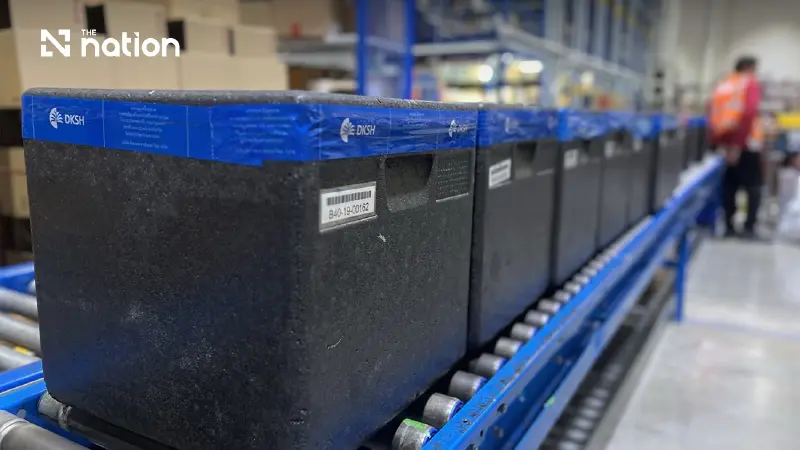
DKSH's reusable "B-Box" cold-chain packaging, used to move temperature-sensitive medicines and vaccines, has – according to the company's own life-cycle analysis against single-use polystyrene alternatives – avoided more than 1.8 million kilograms of CO₂-equivalent emissions across Thailand over five years.
Whether that figure holds up under third-party scrutiny as reporting standards tighten is a question the whole industry, not just one company, will eventually have to answer; for now, it is one of the more concrete data points Thai healthcare logistics can point to.
Automation is doing similar double duty, cutting costs while trimming environmental impact. At DKSH's Sripetch distribution centre, an "A-Frame" picking system is reported to have lifted productivity by around 40 per cent, while a packing system called "D-Pack" has cut plastic consumption by roughly 15 per cent.
A new Medical Device Distribution Centre under construction on Bangkok's Rama 3 Road, close to major hospitals, is being built around automated picking technology from the outset — a bet that the next generation of healthcare logistics infrastructure in Thailand will need to be low-carbon by design, not retrofitted later.

The gap that could break the system
None of this addresses what industry figures increasingly describe as the sector's real vulnerability: small and medium-sized suppliers who lack the balance sheets, the technical staff or the data systems to comply with any of it.
"The biggest bottleneck we observe is turning ambition into action across the entire value chain," Vorrapong said. "Large companies may have the resources and systems to set targets, but SMEs can face constraints in technology, expertise, investment and data."
That is not a peripheral concern. Global emissions-reporting frameworks increasingly assess a company's entire value chain, so a single unprepared supplier can undermine an otherwise compliant network.
In an industry as fragmented and multi-tiered as ASEAN healthcare distribution, one weak link has outsized consequences — a dynamic that turns sustainability from a matter of individual corporate virtue into one of collective economic security.
DKSH has begun applying a "Sustainability Partner Appreciation Award" and shared knowledge-transfer programmes with partners in Thailand, Vietnam and Hong Kong in response, though whether such voluntary, company-led schemes can scale to cover an entire regional supply base – rather than a curated list of preferred partners – remains untested.

An ageing population raises the pressure
Layered on top of the trade pressure is a demographic one. Thailand became an officially "aged society" in 2023, with more than a fifth of its population aged 60 or older; the country is projected to become a "super-aged society" by the early 2030s, with the elderly outnumbering children for the first time in its history.
That shift is already reshaping demand for healthcare logistics — more chronic disease management, more home-care devices, more temperature-sensitive medicines moving further into the provinces — at precisely the moment the sector is being asked to decarbonise the network delivering all of it.
A cold chain built for yesterday's demand curve, running on yesterday's packaging assumptions, is not obviously compatible with a country ageing this quickly.

Where the next generation fits in
The roundtable series has also pressed executives on a less comfortable question: what happens when the people managing this transition retire before it is finished? Vorrapong's answer leans away from token gestures.
"I would like to see more collaborations that go beyond one-off sponsorships and actually hand young people real skills and real problems to work on," he said, pointing to a partnership with the "UOB Wonder Lab" programme and to healthcare supply chains themselves as an underexplored career path for young Thais — a complex, technical, increasingly digital sector that rarely features in career fairs aimed at graduates drawn to finance or tech.
Whether that translates into a durable pipeline of talent, rather than a single cohort of programme participants, is precisely the kind of question the sector's leaders will need to answer as the workforce managing Thailand's healthcare logistics network approaches its own generational turnover.
What emerges from Thailand's healthcare logistics sector is not a tidy sustainability success story — it is a live test of whether an industry built on thin margins and complex, multi-country supply chains can adapt fast enough to keep its market access, protect its workforce pipeline, and absorb a demographic shift that gives it little room for delay.
Carbon border rules will not soften, ASEAN's regulatory patchwork will not resolve itself overnight, and the country's population will not stop ageing. The question is whether Thailand's healthcare supply chain treats that as a cost to be managed or as a race it can afford to lose only once.
This is the sixth article in a series exploring Thailand's sustainability transition ahead of a roundtable of business and policy leaders, convening in late September to discuss how the country can turn climate pressure into competitive advantage.
