
Thailand is ready to act — but the law is not, forum told
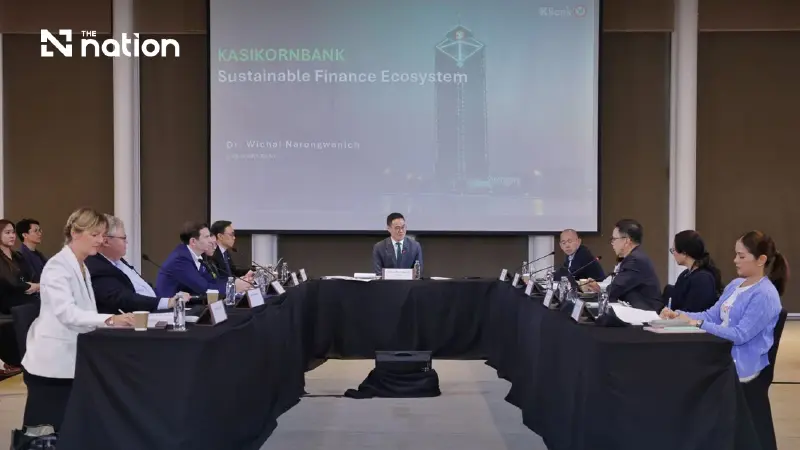


Experts, regulators, bankers and youth advocates agreed on the diagnosis at The Nation's roundtable: the bottleneck is no longer money or technology
- Experts at a forum concluded that Thailand possesses the necessary capital, technology, and corporate desire to pursue a sustainable economy, meaning resources are no longer the primary bottleneck.
- The main obstacle hindering progress is the lack of a clear legal, regulatory, and institutional framework to direct sustainability efforts and investments.
- Businesses expressed that their greatest fear is not strict rules but unclear ones, as ambiguity punishes proactive companies and stifles innovation.
- Specific legal gaps mentioned include the pending Climate Change Act, the absence of a central system for monitoring emissions, and fragmented governance with over 50 agencies managing water alone.
Experts, regulators, bankers, and youth advocates agreed on the diagnosis at The Nation's roundtable: the bottleneck is no longer money or technology.
Thailand has the capital, the technology and, increasingly, the corporate appetite to make its economy sustainable. What it lacks is the legal and institutional architecture to direct any of it.
That was the shared conclusion of the third Nation Visionary Club Roundtable, held under the theme 'Sustainable Thailand — No Choice Left, Ready to Stay in the Game' on Tuesday (15 September), which brought together experts, scientists, regulators, bankers, international agencies, business chambers and youth advocates for an afternoon of discussion moderated by Dr Theerathon Tharachai.
Opening the event, Aura-orn Akrasanee, managing director of The Nation, said sustainability had ceased to be an environmental concern alone.
"It has become an economic issue, a business issue, and increasingly a question of national competitiveness," she said.
For Thailand, the question is no longer whether to adapt, but how fast—and whether the country can move together.

Uncharted territory
The tone was set early by Dr Thon Thamrongnawasawat of Kasetsart University, who offered no comfort.
Every major international target since the Kyoto Protocol has been missed, he said, and the 1.5 Celsius degrees threshold once projected for 2100 now looks likely to be crossed within four or five years — roughly 17 years ahead of expectations.
"We are in uncharted territory," he said.

Scientific prediction depends on historical data, and there is no precedent for a world this hot. His particular frustration was that discussion of growth, GDP, and business rarely touches ecosystems and biodiversity—or the people outside the formal economy altogether.
"We don't talk about the people who will never be an SME," he said. "A local fisherman doesn't have a family business. He just wants something for his children to eat."
Those most exposed, he said, are the poorest rural farmers, outdoor workers with no access to cooling, and communities dependent on coral reefs and coastal tourism.

Niamh Collier-Smith, UNDP Resident Representative in Thailand, declined to accept a post-hope framing but identified three structural gaps: a valuation gap, in which nature is not priced despite around 75 per cent of the region's GDP depending on it; a data gap, in which information exists but does not translate into decisions; and a protection gap, in which the communities most in need of resilience—informal workers, outdoor laborers, and people with disabilities—are not identified or consulted.
In this region, she noted, 60 per cent of wildlife has disappeared within a single decade.

What is working?
Speakers were careful to credit progress. Dr Napaporn Tangtinthai said the Department of Climate Change and Environment, established only three years ago, has taken the Climate Change Act to the Council of State for review, with hopes it enters into force next year.

The Act would introduce carbon pricing instruments—an emissions trading scheme, a carbon tax, and carbon credits—with proceeds channelled into a climate fund supporting SMEs, likely through a fund-of-funds mechanism using commercial banks.
A Climate Change Information Centre is building provincial-level disaster risk maps.
Chananun Supadulya of the Bank of Thailand set out a sequenced approach to sustainable finance, arguing that Thailand's small economy, disaster exposure and SME-heavy structure rule out a direct leap.
"We need to move from brown to less brown first, then toward green," she said.

Dr Yunyong Thaicharoen of SCB reported that roughly two trillion baht in green financing has been raised since 2018, but only about 27.9 billion baht has gone to adaptation.
Dr Wichai Narongwanich described KBank's effort to build an "express way" bundling awareness, carbon accounting, advisory services and certification for clients.

Dr Kwanpadh Suddhi-Dhamakit of the World Bank outlined an aggregator model, developed with the Thai government and Krungthai Bank, designed to pool emission reductions so that smaller firms can finally access carbon finance.

KK Chong of Delta named energy efficiency as the non-negotiable requirement in global supply chains and said larger firms have an obligation to educate and support their SME suppliers rather than simply demand compliance.
Of the three ESG pillars, he said, governance matters most: "Without real governance and genuine belief in mitigating climate impact, everything else is just superficial."

Where it breaks down
The consensus fault line was regulation. Martin Venzky-Stalling of the Joint Foreign Chambers of Commerce in Thailand (JFCCT), representing 31 chambers and some 8,000 companies, said the business community's greatest fear is not strict rules but unclear ones.
Clarity, he argued, lets companies lead and innovate; ambiguity punishes those who act first.

Jerome Le Borgne of Veolia argued for reclassifying the problem entirely.
"Environmental security is national security," he said, urging that it be treated with the seriousness of defence.
Water, he added, is always the first victim of climate change, and Thailand's Eastern Economic Corridor will soon have to arbitrate between farming, manufacturing, petrochemicals and data centres.
"It will always be cheaper to act now than to act ten or twenty years from now."

Dr Saniwan Buaban of the People's Party gave the sharpest institutional diagnosis. Disaster management remains highly centralised, more than 50 agencies handle water alone without integrated data, and budgets are skewed towards large infrastructure whose design assumptions climate change no longer guarantees.
Asked directly what would stop Thailand from staying in the game, he answered, 'Law and information.'
Data centres have been government policy for two years without a regulatory framework; there is still no central legal system for monitoring, reporting and verifying emissions; and the country has too few accredited verification consultants.

Weenarin Lulitanonda of the Thailand Clean Air Network linked the failure to people. Bangkok ranks among the world's ten most vulnerable cities on climate and environmental degradation while serving as the country's economic engine.
"What growth are you talking about when you're not dealing with this?" she asked, warning that continued inaction would accelerate youth emigration.

The intergenerational test
That warning was answered directly by Kanrawee Sisandsaup of UNICEF Thailand Young People, the roundtable's youngest participant.
She described schools in northern Thailand closing after floods, deepening a learning crisis that pushes vulnerable children out of education and into work, with consequences for whole families.
Intergenerational equity, she said, "is not about handing down a gift to young people" but about handing over something that still functions.
She set out four components: building green skills and climate education, protecting young people's wellbeing from heat and disaster risk, ensuring a just energy transition, and meaningful participation in decision-making — "as equal partners, not as tokenistic figures."
Several speakers backed the point.
Weenarin said she had pushed back on drafting conventions that bar anyone under 35 from sitting on statutory committees, noting that much of the technology sector is run by people in their twenties.
Dr Napaporn said young people should be embedded in policy and law development rather than consulted afterwards. Collier-Smith pointed to youth entrepreneurship networks and called for more sandboxes and more seats at the table.

What must happen in 12 months
Asked what Thailand would lose first if it failed to adapt and what single action must begin within a year, the panel converged.
Dr Yunyong said competitiveness would go first and called for a mindset shift that treats sustainability as a competitiveness agenda to be executed collectively.
Dr Kwanpadh urged the country to look past GDP and ask how it will protect those already bearing climate impacts.

Dr Saniwan called for urgent movement on law, regulation and verification capacity.
Le Borgne said to start with water — master planning, monitoring and forward planning.
Venzky-Stalling called for transformational rather than incremental business innovation and for more empathy across Thai society.
Kanrawee's closing wish was simpler: "I want to see humans living in harmony with nature."
Closing the session, Dr Theerathon summarised the afternoon in a sentence. Climate risk is no longer distant and no longer a single-issue concern: "It's economic, it's social risk, and it impacts everybody."
