
Thailand faces mounting climate risks amid Clean Air Bill delay
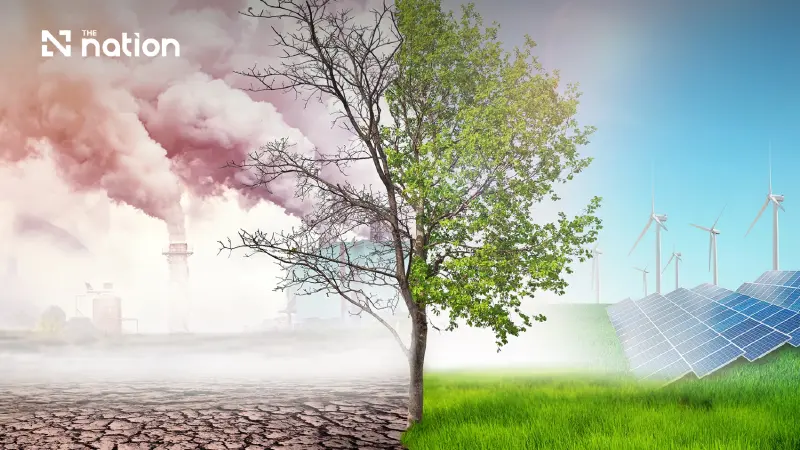


Experts warn Thailand’s climate and air risks are intensifying as DCCE advances climate legislation, climate-finance mechanisms and provincial risk planning.
- Thailand is facing growing climate change risks, including ecosystem collapse, hazardous air quality, and more intense natural disasters.
- A crucial, citizen-led Clean Air Bill has been stalled in parliament for years, with the Senate recently removing provisions considered essential by environmental experts.
- The delay is symptomatic of a wider slow legislative response, with a separate Climate Change Act not expected to be enacted until 2027.
- Experts warn that these climate shocks and policy delays disproportionately affect vulnerable communities, such as poor rural farmers and outdoor workers.
Thailand is entering increasingly uncertain climate territory as rising temperatures, ecosystem decline and hazardous air threaten communities, while legislation intended to tackle one of the country’s most immediate environmental dangers has taken years to move through Parliament.
Policymakers and environmental experts issued the warnings at The Nation’s roundtable, “Sustainable Thailand: No Choice Left—Ready to Stay in the Game?”, on Tuesday (September 15).

Climate change enters uncharted territory
Thon Thamrongnawasawat, deputy dean of the Faculty of Fisheries at Kasetsart University, warned that the world had repeatedly missed international climate targets and was entering conditions for which historical information could no longer provide reliable guidance.
“We found out that we will miss the Paris Agreement. We planned to limit warming to 1.5 degrees by 2100, but right now we are really close. We are talking about what we call uncharted territory. You cannot ask me or any scientist what will happen, because we don’t know.”
For Thailand, Thon identified ecosystem collapse and biodiversity loss as serious yet overlooked consequences.
“We are talking about big business. We are talking about SMEs. But we don’t talk about local fishermen who just have a family. Family, not SME. SME means that you would like to do business. Family means that you would like to get something for your children to eat.”

Clean-air threat highlights long legislative process
Weenarin Lulitanonda, co-founder of the Thailand Clean Air Network, said the citizen-led Clean Air Bill was submitted about four years ago.
“It took two years to draft. This is one of the most complex environmental issues. Air is invisible to the human eye. It is extremely difficult, and it’s multi-sectoral. It knows no national boundaries, so it’s very complex.”
After the legislation cleared the House of Representatives, the Senate removed provisions Weenarin regarded as critical. The House voted overwhelmingly against those changes on September 2, sending the disputed provisions to a joint House-Senate committee.
“It is very odd for something that affects all of us, because no matter who you are, whether you’re a businessman or work in government, wherever you are, we all breathe the same air.”
Weenarin outlined eight features she regarded as essential to an effective Clean Air Act:
- Improve the effectiveness of legal enforcement
- Establish co-management between the state and civil society
- Protect citizens’ right to breathe clean air
- Focus on both health and the environment
- Support systematic integration among state agencies, state bodies and civil society
- Provide localised solutions rather than a one-size-fits-all approach
- Use economic incentives and penalties
- Manage transboundary haze and shift responsibility towards polluters
“Those are the key premises of what’s in the legislation and what’s needed to deliver effective clean air. And the bulk of those provisions was removed by the Senate amendments,” she added.

Communities need a stronger role
Dr Saniwan Buaban, a former People’s Party MP, argued that climate change was making disaster management more difficult as hazards became more frequent and intense.
“We are in the climate-change era. Climate change can change the pattern of hazards in ways we have never seen before. We are seeing more frequent and more intense hazards. This makes prediction and forecasting more difficult.”
Thailand had a national disaster mitigation and reduction plan, she noted, but management remained centralised and information fragmented.
“Government agencies in Thailand work in silos, and each agency has its own data, but the data is not integrated. We need to integrate it and empower local communities so they can prepare local plans themselves, because each area has different geographical conditions and a different context.”

Climate shocks hit vulnerable groups hardest
Kwanpadh Suddhi-Dhamakit, World Bank Senior Country Officer, stressed that climate shocks did not affect everyone equally.
“When you talk about too much water or too little water, poorer rural farmers get hit first. When you talk about vulnerability, the ability to adapt and recover comes into play. If you’re poorer, when you get hit, your chances of recovering are much lower.”
He also pointed to health conditions, healthcare access and extreme heat as factors deepening vulnerability, particularly for outdoor workers.
“There are a lot of things you don’t know, and that’s the scarier part. We know who is going to be most impacted, but the way we handle and support them becomes quite important. Given digital technology, the efficiency and speed of the response have to improve through more innovative approaches.”

DCCE advances climate law and financing mechanisms
Dr Napaporn Tangtinthai, director of the Climate Finance and Investment Subdivision in the Strategy and International Cooperation Division at the Department of Climate Change and Environment (DCCE), acknowledged that adaptation continued to lag behind mitigation.
“Adaptation is moving quite slowly. It’s not only in Thailand; every developing country has the same problem. Most parties to the United Nations Framework Convention on Climate Change are more concerned about mitigation because it is easier to implement. But adaptation is harder, particularly when it comes to protecting people from the climate crisis.”
She said the proposed Climate Change Act was under review by the Council of State, with DCCE hoping it could enter into force in 2027.
“Once the act is fully operational, we will have mechanisms under it, such as carbon-pricing instruments, an emissions trading system, a carbon tax and carbon credits. These mechanisms can support a climate fund for SMEs, because we know SMEs are an important part of our economy.”
DCCE is also developing a fund-of-funds mechanism, has established a Climate Change Information Centre and is preparing provincial climate-risk maps.

UNDP identifies three gaps Thailand needs to close
Niamh Collier-Smith, United Nations Development Programme (UNDP) resident representative in Thailand, identified three gaps: how nature and adaptation are valued, how data is turned into useful information for economic decisions, and how information is used to protect vulnerable people.
The first was a “valuation gap”. She argued that adaptation needed greater priority in public budgets and that economic decisions should better recognise the value of nature. The second concerned “data to prosper”, or turning fragmented data into useful information.
“It’s not for a lack of data. We all, in our phones, have more data than we will ever know, or need, or use in our lifetime. It’s about how to turn that into information to drive decision-making. Right now, there’s too much data, and it’s not connected.”
Her third gap was “data to protect”, ensuring authorities know who is most exposed to climate shocks and what assistance they need. She highlighted informal and outdoor workers, people exposed to air pollution and people with disabilities.
“Resilience is the ability to adapt, to negotiate, to be in control, and to make sure that your family, as Dr Thon says, has the means to survive. We need to know where vulnerable people are and what help they need, informed by them, so that if disaster strikes, those with a duty of care can step in.”
The discussion pointed to a common challenge: Thailand has begun putting climate legislation, financing mechanisms and information systems in place, but speakers stressed that faster implementation, stronger local participation and protection of ecosystems and vulnerable families would determine whether those policies translate into genuine resilience.
