
Thailand's Plastics Giant Bets that Sustainability is the Only Business Plan Left Standing


Indorama Ventures' sustainability chief says carbon rules, recycling economics and youth talent will decide who survives the next decade of chemicals
- Thailand's plastics giant, Indorama Ventures (IVL), is rewriting its business model, viewing global sustainability rules and carbon regulations as strategic market opportunities rather than just compliance costs.
- A key pillar of this strategy is a major investment in PET recycling, positioning the company to meet rising demand for recycled content from multinational brands and gain a competitive edge.
- The company is embedding sustainability into its core operations by integrating climate risk into its enterprise management and using AI to optimize energy use and monitor emissions.
- IVL's bet on sustainability is driven by external pressures, including new European carbon rules, investor demands, and the need to overcome domestic challenges like low plastic recycling rates in Thailand.
Indorama Ventures' sustainability chief says carbon rules, recycling economics and youth talent will decide who survives the next decade of chemicals.
Thailand's petrochemical sector, the largest in Southeast Asia and a pillar worth nearly 7% of GDP, built its fortune on turning oil into plastic cheaply and at scale. That model is now under direct assault from Brussels, from boardrooms in Europe demanding recycled content, and from a domestic waste stream that the country still recycles at barely a fifth of its volume.
For Indorama Ventures (IVL), the Bangkok-based petrochemical group that is among the world's largest PET producers, the response has not been a sustainability department bolted onto the business. It has been a rewrite of the business itself.
That is the argument put forward by Anthony M. Watanabe, IVL's chief sustainability officer, in a wide-ranging written interview. His central claim is blunt: companies that still treat climate regulation as a compliance cost, rather than a signal about where markets are heading, are reading the moment wrong.
"We see the new global sustainability rules as both a business risk and a strategic opportunity," he said, arguing that the same rules driving up compliance costs are also "creating clearer market signals for lower-carbon and circular solutions".
Reading the rules as a market signal, not a tax
Watanabe's answer names Europe's new carbon architecture directly — the Carbon Border Adjustment Mechanism (CBAM) and the EU's Emissions Trading System among them.

CBAM becomes fully operational in 2026, and while its first phase targets steel, cement, aluminium and fertiliser rather than plastics, analysts at BloombergNEF and the Asian Development Bank have flagged that Southeast Asian exporters across carbon-intensive sectors will feel indirect pressure as carbon accounting becomes standard practice in trade with Europe, ASEAN's third-largest trading partner.
Thailand's own carbon levy, at roughly 200 baht a tonne, remains a fraction of the EU's carbon price — a gap that leaves Thai exporters exposed rather than shielded, since offset credits will offer only marginal relief once CBAM certificates are priced in.
IVL's response, as described by Watanabe, runs on three verbs: monitor, invest, and scale.
The company tracks transition risk — carbon pricing, shifting customer specifications — alongside physical risk, including flooding, heat stress and water stress at its production sites, through scenario analysis and site-level vulnerability assessments.
Crucially, he insists climate risk is "not treated as a standalone sustainability issue". Instead, he said, "climate-related risks are integrated into our enterprise risk management, business continuity planning and site-level risk assessments," a structure he credits with helping "inform investment priorities and strengthen long-term business resilience".
Whether that integration changes capital allocation decisions in ways external analysts can verify is a question the market, and increasingly bond and equity investors screening for climate exposure, will keep asking.

The economics of circularity, at scale
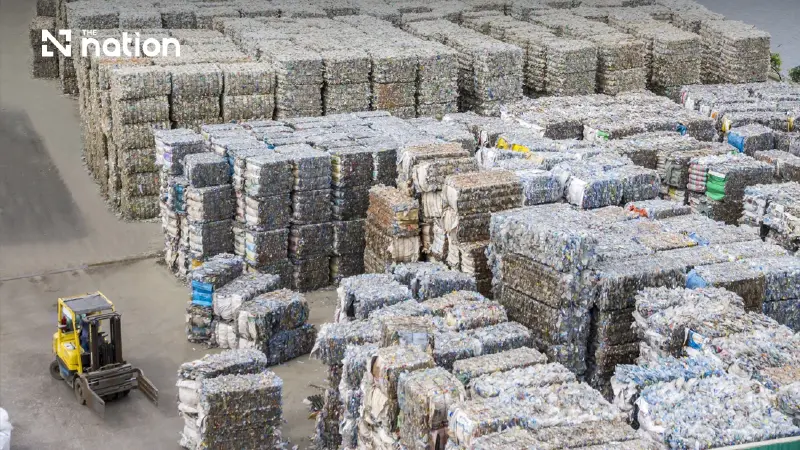
The clearest evidence of that strategy is IVL's recycling business, which Watanabe calls "a key focus", built around "circularity, particularly PET recycling, which creates measurable impact on plastic waste and resource efficiency".
Since entering the recycling business in 2011, the company says it has processed more than 180 billion post-consumer PET bottles. In 2025 alone, IVL reports recycling 30.57 billion bottles, drawing on about 458,500 tonnes of post-consumer PET bale input, against roughly 837,000 tonnes of installed recycling capacity.
Those numbers matter because PET recycling sits at the centre of a genuine global shift. Suntory PepsiCo launched Thailand's first 100%-recycled PET bottle in 2023; GlobalData estimates PET made up nearly 60% of soft-drink packaging volume in Thailand as recently as 2022.
Multinational consumer brands have made public commitments to recycled content that only companies with industrial-scale recycling capacity can credibly supply. Indorama's bet is that being the recycler, not merely the virgin-resin producer, gives it pricing power and regulatory cover as those commitments come due.

Yet the Thai market itself illustrates how far the domestic system lags the industrial capability that companies like IVL have built.
A 2021 World Bank study found that Thailand recycled just 17.6% of key plastic resins, undershooting the government's own 22% roadmap target, with roughly 2.88 million tonnes of plastic discarded rather than recovered each year.
Asia as a whole accounts for more than 80% of plastic leakage into the world's oceans, and Thailand ranks among the top contributors globally by some estimates—an uncomfortable statistic for a nation that is simultaneously home to one of the world's largest PET recyclers.
More recent evidence suggests the binding constraint is still not recycling technology alone but the systems that supply it.
A 2025 Asian Development Bank brief identifies a need for stronger economic measures — such as levies on virgin and single-use plastics, deposit-refund schemes, recycling incentives, and advanced recycling fees — to fund collection, sorting, and recovery while making circular packaging commercially viable.
Historically, regulatory friction compounded this shortfall. Until reforms in 2022, Thailand required food-grade bottles to be manufactured from 100% virgin plastic — a rule industry figures had long lobbied to relax to align with markets such as Japan, Australia, and the EU, which permit recycled content in food-contact packaging.
Watanabe's own responses point to policy, rather than technology, as the primary bottleneck — a tacit acknowledgement that Indorama's recycling capacity can outpace the regulatory and collection infrastructure upon which it depends.

Digital tools, and an unresolved supply-chain gap
Watanabe also describes artificial intelligence and advanced analytics as tools "helping Indorama Ventures accelerate sustainability across both our product portfolio and manufacturing operations". IVL is exploring AI to sharpen its Sustainability Product Classification system, aiming to identify which parts of its portfolio can shift toward lower-carbon and circular solutions faster.
On the plant floor, its Advanced Industrial Analytics programme, which Watanabe says expanded to 28 sites running 157 use cases in 2025, targets energy optimisation, emissions monitoring and predictive maintenance — work he says improves "both what we produce and how we produce it".
Where the interview turns more candid is on what Watanabe calls "a key bottleneck" in the industry's green transition: "the economics of the transition".
Large companies such as IVL can absorb the cost of supplier ESG assessments; small and medium-sized suppliers, he acknowledges, often cannot, given their "more limited resources, technical capabilities and access to sustainability data and financing".

His proposed fix leans heavily on policy — enabling frameworks for corporate renewable procurement such as virtual power purchase agreements and well-designed Extended Producer Responsibility schemes to strengthen "the economics of waste collection and recycling".
Rather than "simply passing requirements down the supply chain", he said, larger firms should help "through clear and practical expectations, capability building and knowledge sharing".
Even so, he stops short of committing IVL to underwrite that gap itself, framing the real fix as getting "the business case, policy environment and value-chain capabilities to move together".
Scope 3 emissions — the hardest category for any chemicals company to control — depend on whether that collaboration materialises.

Grooming talent as a sustainability strategy
The interview's final thread concerns people rather than plastic. Asked what collaboration between business and young people should look like, Watanabe said it "should move beyond sustainability awareness toward practical experience, shared problem-solving and real-world implementation".
IVL's Future Leaders Programme, launched in 2023 and now recruiting its third cohort, mixes mentoring and live business projects.
The company also runs Waste Hero, a circular-economy education initiative delivered with the Bangkok Metropolitan Administration, alongside internship pipelines that regularly bring students into its sustainability function directly.
Watanabe frames this as more than corporate citizenship: a deliberate pipeline for the technical and analytical skills — carbon accounting, circular design, data science — that he says can "turn education into action and accelerate Thailand's green transition" at a scale the country's universities are not yet producing alone.

The ratings scoreboard
On external validation, IVL points to a 2025 CSA score of 82 out of 100 from S&P Global, placing it in the top 10% of global chemical companies assessed and marking its seventh consecutive year on the DJSI World index.
It holds an AAA SET ESG rating, the Thai bourse's highest, and was the first chemical company in Thailand — and second in Southeast Asia — to become a TCFD supporter, back in 2020. Watanabe describes the overall picture as reflecting "continued focus on transparency, accountability and continuous improvement".
Ratings, though, measure disclosure and process more reliably than outcomes. The tougher test for Indorama, and for the wider Thai plastics sector it leads, is whether recycling capacity, digital tools and youth pipelines can scale fast enough to outrun both a domestic collection system stuck below target and a European regulatory clock that is no longer waiting for Southeast Asia to catch up.
This is the seventh article in a series exploring Thailand's sustainability transition ahead of a roundtable of business and policy leaders, convening in late September to discuss how the country can turn climate pressure into competitive advantage.
