
Lexus GS: fun to drive, more emotional


Play
Lexus, the luxury division of Toyota, is hoping that the new GS will win over customers from arch rivals BMW 5 Series and Mercedes-Benz E-Class.
After a 185-per-cent sales growth in 2011, the company wants to increase sales in Thailand by 20 per cent this year and had previously launched the CT200 that was expected to attract younger buyers.
The fourth-generation GS is initially available with two engine choices – a 3.5-litre and a 2.5-litre featured today.
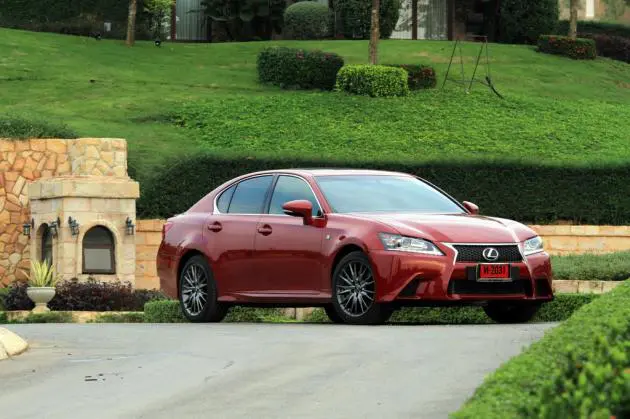
With the GS, Lexus wants to offer a midsized sedan that is more emotional and fun to drive, as well as more environmentally friendly.
The “L-Finesse” design theme has been incorporated in the GS, which boasts a low-resistance body shape with a Cd (drag coefficient) of just 0.26.
The trademark “slingshot” rear-window design of the GS is easily noticeable in the new model, but the rest has been redesigned and corresponds with main Lexus styling, such as the spindle-shaped front grille.
According to Lexus, the new GS has a larger cabin with more headroom (30mm more in front and 20mm more at the rear), which makes it easier for occupant entry and exit.
Control buttons and switches are located at positions that minimize the driver’s eye movement, while the GS also comes with a large 12.3-inch display screen. The interior also features white LED ambient lighting while the air-conditioning system has been developed to be compatible with S-FLOW (energy-saving airflow control) that determines the presence of an occupant and adjusts its operation accordingly. Meanwhile, a nano-e system discharges mildly acidic nanoe ions that are gentle on the skin and help capture bacteria or virus that cause a damp smell.
The luggage compartment is now 530 litres (up from 430 litres in the previous model) and is able to accommodate four golf bags.
Oh, and if you don’t close the doors properly, they will be automatically sucked into place just like in the Mercedes-Benz S-Class.
In terms of performance, the GS 250 is powered by a twin-cam 24-valve 2.5-litre V6 motor with Dual VVT-i that is capable of developing 207hp at 6,400rpm and 253Nm of torque at 4,800rpm.
The engine pumps out enough horsepower, but those seeking lots of torque may not be too happy with the GS 250, and would be better off with the GS 350, with its 312hp 3.5-litre engine being capable of pumping out a healthy 377Nm.
Having said that, I had a nice time redlining the GS 250’s V6 both on the highway to Khao Yai as well as through winding roads leading to the Muti Maya Resort.
The engine is mated to a 6-speed automatic gearbox that’s smooth-shifting, and the driver is able to select various driving modes – Eco, Normal , Sport and Sport S+. The system adjusts engine responsiveness, steering feel and suspension settings according to the drive mode, while a manual shift mode with paddle shifters is also available.
Lexus usually makes engines that are silent and silky smooth in operation, and in the past it was common for new Lexus drivers to restart an already running engine. However, the GS is supposed to be a sporty car, and Lexus has equipped the GS with an Engine/Muffler Sound Generator, which gives it a muffler-style sound at low engine speeds and an emotional roar as the engine revs shoot up.
Apart from the VGRS (Variable Gear Ratio Steering) for the front wheels and the Dynamic Rear Steering (DRS) for the rear wheels, the GS also comes with the LDH (Lexus Dynamic Handling System) which computes the optimum steering angles on all four wheels.
The front double wishbone and rear multi-link suspension offers a smooth and comfortable ride, and even in sport mode a good amount of comfort is still maintained.
There are plenty of safety, comfort and convenience features, such as 10 airbags, automatic bi-xenon headlights (auto-turning), daytime running lights, automatic windshield wipers, a moonroof, leather upholstery, a 16-way electrically adjustable driver’s seat (both front seats come with ventilation and heaters), a Head-Up Display, a Navigation System, a DVD player with 12 speakers, easy entry function, a tyre pressure monitor, Hill-Start Assist, Vehicle Dynamics and Traction Control, etc.
While the 5 Series and E-Class are both great midsized luxury cars, the Lexus GS represents another interesting choice for those looking for something different but one that still offers a high level of driver appeal.
Lexus also gains high marks in terms of quality and craftsmanship, as well as its outstanding track record for customer satisfaction.
Retail prices of the GS 250 range from Bt4.59 million – which is lower than the previous model due to its smaller engine size – to Bt5.09 million, depending on the trim level, while the GS 350 comes with a price tag of Bt6.69 million.
This month Lexus also launched the hybrid version of the GS – the GS 450h – priced at Bt7.79 million, increasing the number of choices for the GS line-up.
Lexus GS 250
F-Sport specs
Engine: V6 24-valve Dual VVT-i
Displacement: 2,500cc
Max power: 207hp/6,400rpm
Max torque: 254Nm/4,800rpm
Transmission: 6-speed automatic with manual mode
0-100km/h: 8.8 secs
Top speed: 230km/h
Average fuel consumption: 10.75km/l
Average CO2 emission: 217g/km
Suspension (f/r): double wishbone/multi-link
Steering: electrically powered rack-and-pinion
Turning circle: 10.6 metres
Brakes (f/r): vented discs/discs with ABS, EBD and BA
Dimensions (mm)
Length: 4,850
Width: 1,840
Height: 1,455
Wheelbase: 2,850
Track (f/r): 1,575/1,590
Weight: 1,720kgs
Wheels: 18” alloy
Tyres: 235/45R18
Price: Bt4.99 million
Distributor: Toyota Motor Thailand Co Ltd
