
DEBATE RAGES OVER TABLET POLICY


Play
Amid varied concerns, the government's ambitious project of using computers as educational tools in schools is set to take off
The long-awaited One Tablet Per Child (OTPC) project of the Pheu Thai government, one of its key election promises, finally took off with the signing of a contract for the first lot of 400,000 tablets to be delivered to Prathom-1 students throughout the country before July 10.
A total of 930,000 tablets will be used as education tools, with the second instalment of 530,000 units to be delivered to schools by August 10.
The Cabinet had approved a budget of about Bt1.9 billion for the project on February 22.
Though some people agree that tablets can be useful learning tools for children, there are many concerns about this project. There are questions about the readiness of teachers, students and parents who are all direct stakeholders in this scheme; the readiness of courseware and learning content, and the readiness of network infrastructure and service centres that will take care of device maintenance; and the negative effects of using technology and children’s ready access to the Internet.
On May 10, the Information and Communications Technology Ministry inked a tablet-computer supply contract with Chinese manufacturer Shenzhen Scope Scientific Development for the first batch of 400,000 tablets. The contract for the remaining 600,000 will be signed later. They will have the same price and must be delivered within 90 days.
The devices come in four colours – red, blue, silver and gold. Each costs $82 (about Bt2,500), with 2GHz CPU, 1GB RAM and a 3600 mAh battery. The tablets feature the Android 4.0 operating system with a built-in GPS for monitoring and tracking purposes. They also come with a two-year international standard warranty.
Government’s commitment
Information and Communications Technology Minister, Anudith Nakornthap, as the vice-chairman of the OTPC Committee, said at a seminar entitled “Tablet in Children’s hands: Remnants of Iron or Textbook?” hosted by the Information Technology Press Club (ITPC) last week that the government and all people in the committees involved with the project are as concerned about the effects as the parents of the children. Therefore, the committee, which consists of experts from several sectors – IT, education and social – has been working carefully to get the best device for the students.
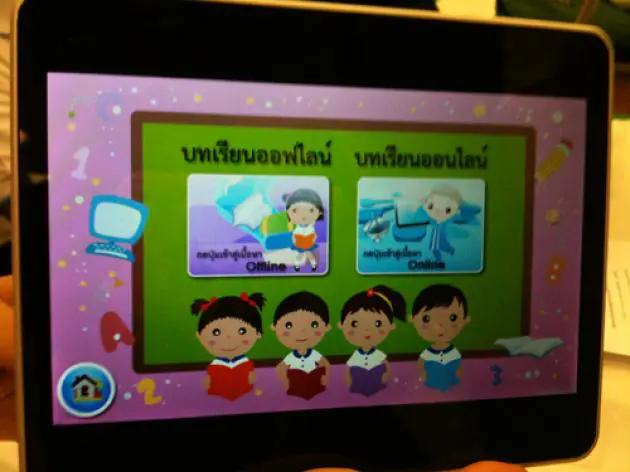
He added that the content and courseware cover 336 learning topics across five main subjects for Pathom 1. The Office of the Basic Education Commission (OBEC) said the subjects are Thai language, social subject, science, maths, and English language. They are preloaded in the devices. There are plans to add more subjects, apart from the five main subjects, to the government’s cloud for education. The private sector and schools who want to contribute to the e-courseware are welcome to join.
“We understand that parents are concerned about the quality of the device, the courseware inside, the ability to go online via the tablet, time spent on the device as well as the negative effects of using technology. We are well prepared to address these concerns. The courseware is ready for the new semester. The device itself is quite cheap at $82 but its specifications are high and as good as devices in the market having the same price tag. We could buy them at a low price because we purchased in bulk quantities and we dealt directly with the manufacturer,” said Anudith.
He also emphasised that all tablets for children are equipped with firmware to block students from accessing inappropriate websites. He urged parents to work closely with teachers in assisting the children to effectively use the tablet as a learning tool.
“Students can learn with the tablet online and offline. They can access courseware offline when they are at home. They can take the tablet home or leave it in the school, depending on each school’s policy. If the device is damaged during the warranty period, there is no cost. But if it is damaged and not under the warranty then the student’s parents will have to bear the maintenance cost,” said Anudith.
Are teachers and schools ready?
Rachawinit School’s Prathom-1 teacher, Nunnapus Sriprates, who was one of the pilot teachers trained for two months to use the tablet for teaching Prathom-1 students, said the students are happy and having fun when learning with tablet.
She confessed that in the early days, when she came to know that she had to use the tablet for teaching, she felt anxious about how she could teach the students when she herself had no experience with the tool. But after receiving training, she is confident of using the tablet as a learning tool and helping students learn with fun.
“Teachers have to adjust themselves and work hard to learn how to use and apply the device as a learning tool. We have to design learning courses so that the tablet can be perfectly a part of it. During the two months of trial, we allowed students to learn by using the tablet for a while during a subject period. We did not teach with the tablet for the whole day and not for an entire subject as students have to learn many skills like writing, drawing and calculating. We only use tablet as much as required or related to the subject matter we teach. How often or how much the tablet is used in teaching depends on the course outline that the teachers and schools design,” said Nunnaus.
She added that she had made a deal with the children to take care of the device so that they would have the discipline to do this on their own. She said parents are very important stakeholders to help schools take care of both the students and the device.
She added that she had encountered two different groups of parents from the time the OTPC was announced. Some were opposed to it and some were supportive. The parents who resisted were worried that their children might become addicted to games and not concentrate on learning. But these parents were told by the school that it will not allow the student to spend too much time using the tablet, and the device will be used only as a learning tool when required. It will teach students how technology can have good and bad effects.
Meanwhile, there are parents who are willing to get tablets. Some of them brought their own tablets to school to ask for the courseware and content to load into their devices in order to prepare their children to learn to work with the devices.
“Parents should help take care of the tablet, if the students take it home. And parents should spend time together with children using the tablet at home. They should not be scared of learning to use new technology as they can learn together with their child,” said the teacher.
Anek Rattapiyaphorn, director of the OBEC's Technology for Learning and Teaching Bureau, told The Nation that older teachers tend to be slower learners and a 50-minute training period may not be enough for them. Students might also be unimpressed with their teachers’ performance on the tablets, which may be inferior to theirs. About 70 per cent of the 450,000 teachers in primary and secondary schools are between 40 and 50 years old, and that could be a problem.
Parent urges for training:
Parents are still worried about the project because of lack of clarity on details of the project. The chairperson of Online Parent Network under the Internet Foundation for the Development of Thailand, Srida Tanta-atipanit, said the government should keep parents always updated about the details of the project rather than letting them depend on the newspaper for information.
The government should also provide training courses to parents on using the tablet as teachers alone cannot take care of the children. Parents can play a vital role in helping children learn to use the device and they should be trained to have equal knowledge as their kids.
“Many parents in our network of about 5,000 people are still worried about this scheme. We do not know what is inside the tablet that they will be putting in our kids’ hands,” said Srida.
She said there are so many levels of skill sets and knowledge about technology. Most of the parents are not familiar with technology and feel afraid to deal with technology. They are unhappy to know that their children will have to live with technology from as early as Pathom 1. Meanwhile, not all schools and not all teachers are ready. Therefore, the government should have a dedicated channel to communicate and to keep in touch with the parents in order to train them and keep them informed and updated.
Tablet for Prathom 4
According to research conducted last semester by Srinakharinwirot University (SWU), which studied the possible impact of tablet use on students in the previous semester, Prathom-4 students were more prepared to use tablets than Prathom-1 students. It also found that older students picked up lessons faster and were more creative while using the devices.
Asst Prof Chalermchai Boonyaleepun, president of SWU, told the press last week that as the government had already announced that it would distribute the devices to Prathom-1 students, it could divide the shipment between both levels.
The study also found that learning content created by the OBEC was not interesting enough for children, and called on relevant agencies to develop better content to hold students’ attention. The team also suggested that the government provide funding for at least one technical assistant per school.
“Using tablets for two classes per day is more than enough. And technical assistants are very important, especially while the policy is being implemented,” said Chalermchai.
However, as the debate rages, the OTPC project is going ahead with the first lot of 2,000 tablets to be delivered this week.
