
Virtual reality use ranges from weddings to outer space
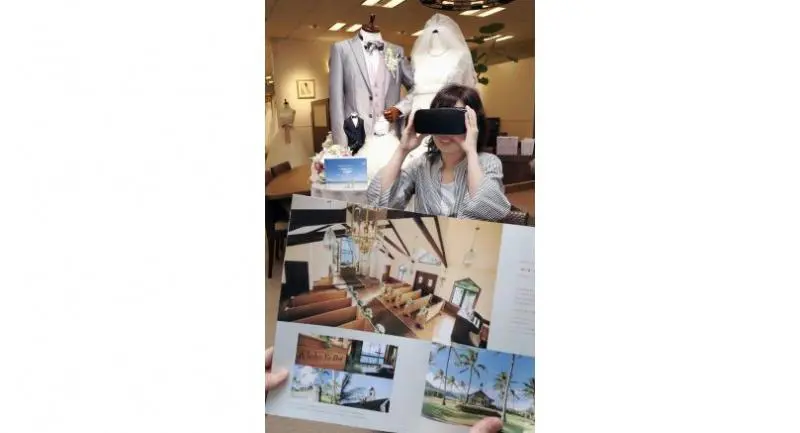


TOKYO - Virtual reality (VR) has been widely adopted for real-life use, with such applications as allowing people to rehearse wedding ceremonies and astronauts to train under realistic circumstances.
With the rapid progress in computer technology that creates imaginary worlds or images of distant locations, VR helps users feel like they are actually experiencing various activities. It is distinctly possible that VR could significantly change people’s lives in the future.
Experiencing virtual reality
“I feel like I’m in a wedding hall. I didn’t expect it to be so real,” said Misaki Araba at the office of Watabe Wedding Corp., a major wedding service company, in Tokyo’s Nihonbashi district. Araba, 30, of Koto Ward, Tokyo, will have her wedding ceremony in Hawaii. Using VR, she was able to view the venue in great detail and understand in advance how the ceremony would unfold.
Last year, the company launched a service in which customers could virtually experience their ceremonies through VR goggles. The technology enables users to view Hawaii’s picturesque scenery as they move their heads up and down or side to side. The company’s services enjoy a good reputation.
VR technology is said to have taken off globally in 2016, with Sony Corp. launching its PlayStation VR (PSVR) game console that year.
VR devices generally come in the form of goggle-style headsets. U.S. and foreign firms have also marketed various other VR products at reasonable prices.
U.S. firm Boeing Co., which develops manned spacecraft, announced in September that it would introduce VR programmes to train astronauts for spacecraft operations. The VR training system is expected to help astronauts learn how to dock spacecraft at the International Space Station.
The use of VR for watching sporting events is also likely to accelerate. Some events are expected to be broadcast live through VR at next year’s Winter Olympic Games in Pyeongchang, South Korea.
Likewise, viewers all over the world may be able to watch events at the 2020 Tokyo Olympics as if they were in the stadium.
Some companies have started offering virtual tours of their factories and facilities to promote their firms.
Normal line of sight
VR research is said to have started in the 1960s, but such devices did not proliferate as large equipment was necessary for the technology.
The feeling of reality, an important factor in VR, has dramatically improved as advances in imaging technology have allowed users to view images at angles close to those of normal human sight.
By moving their heads up and down and side to side, users can neatly adjust their line of sight. Due to technical advances in information processing equipment and sensors that detect head movements, the time lag between body movements and the appearance of images has diminished. Advanced high definition technology also enables the smooth projection of 3-D images.
¥3 trillion market
The declining cost of VR headsets will likely increase the household use of such devices. Sony has ramped up mass production of the PSVR, which previously experienced supply shortages. Fujitsu Ltd. also plans to begin sales of VR goggles in November, allowing users to enjoy games and movies on personal computers at home.
Sony’s PSVR and the Fujitsu device cost about ¥50,000, an affordable price for consumers.
Fuji Chimera Research Institute Inc. forecasts that the global market for image-display devices utilizing VR and augmented reality (AR) — technology that processes digital information from the real world — will rise to about ¥3 trillion in 2025, five times the current market size.
“Research and development of taste- and odor-sensitive VR technology has also progressed. There is a strong possibility that VR could change society and people’s lives,” said Hirohiko Nakamura of Mitsubishi Research Institute Inc.
