
Models of support for start-ups that go beyond corporate joint ventures
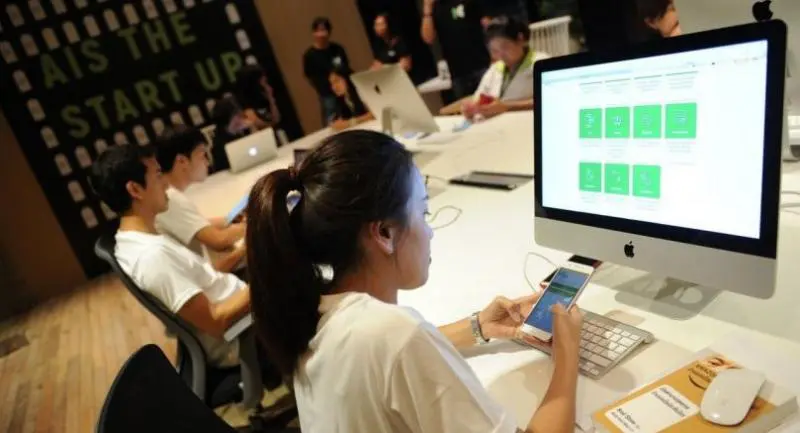


FROM 2011 to 2013, Thailand's telecommunication companies made history for the country's digital economy. They realised the significance of newly launched tech start-ups for the future of the Thai economy. They stepped up as the industry leaders to promote and push forward the start-ups to grow into the new gears of the economy.
Less than a half-decade later, we witness an increasing number of large corporates that similarly understand the significance of start-up promotion. They are from almost the full range of industry including tourism, finance, investment, agriculture, construction, food and others.
Established companies' popular model of support, as commonly seen on media, is an investment in the start-up in return for shares. For example, InVent is a corporate venture capital arm of Intouch. Meanwhile, AddVenture and Beacon Venture are of SCG and Kasikorn Bank respectively. The large companies, however, possess many other internal resources beyond capital. These capabilities can offer multidimensional assistance for start-up companies.
Establishment of the open technology service model
Commonly, the technological infrastructure of a large corporate is a closed system with high complexity. As a result, an instant connection with external technology is unlikely and full of limitations such as data security and regulations governing business alliance agreements. Every single integration of internal and external technology requires new permissions and approval. Consideration could take a long time while start-ups are fast-moving businesses. This approach is not start-up friendly.
Several big corporates in foreign countries have invested in building an "open technology" system in which an instant online automatic integration between the inside and the outside is realistic. The open technology optimises the likelihood of advanced functions being built into a start-up's products by the utilisation of big corporate's technology. This delivers ultimate benefits for their shared customer base.
Corporate-start-up business alliance model
One of the challenges start-ups face is limited accessibility to a customer base and an ineffective market interaction. On the other hand, the integrated business approach of large corporates leads to a state of monopoly in a market and this interrupts the complete development of a business ecosystem. Many corporates have faith in the power of the ecosystem and so make policy to connect alliances with their customer base. The policy invites small companies whose product or service fit in the corporate's business plan to jointly build creative interaction with shared markets and customers.
"One plus one equals two," is a necessary truth in mathematics but adding alliances into the business formula does not give a fixed result. Collaboration between a big corporate and a start-up create a possibility of a hundred-times or even a thousand-times greater result in marketing. In fact, it is unnecessary to always adopt the one-to-one partnership as it can instead be done in multilateral form.
AIS has a long-standing commitment to build business partnership. In 2016, for example, AIS collaborated with JS100 radio station and Dreamaker (www.dreamaker.co.th), one of AIS The Startup family members. The three companies jointly launched PUNFUN project, aiming to be a centre of online donations to buy wheelchairs for vulnerable persons in need. In 2017, big corporates AIS and Kasikorn Bank partnered with Foodstory and Flowaccount to kick off the first complete restaurant management solution in Thailand.
Becoming customer of start-up's product model
Lack of financial liquidity is another obstacle for start-ups, forcing them to run fundraising by giving funders their companies' shares in return. In reality, the best capital for start-ups is generated by purchases by their own customers. What investors expect from their investment is to get capital back later plus extra profits from selling the shares in the future. Customers, on the contrary, pay money to a start-up and never think of taking it back. Their expectation is all about getting a good service.
Large corporate can create, for the start-up, a sustainable source of capital inflow by purchasing its service for internal use. More than that, having a large corporate as a customer advantages the start-up as it opens the door for learning professionalism while working with the big one.
This model of support also exists in AIS. Take ZipEvent as an example. It is a Thai-based start-up and a leader in event management in the country. It is granted an opportunity to manage a system and events of AIS DC, a community of creative people.
AIS continues offering its supports to new entrepreneurs. Those interested to be part of AIS The Startup can drop their portfolio around the clock at www.ais.co.th/thestartup
