
Over the hills and far away


Play
Famed for their tea, Sri Lanka's highland resorts of Nuwara Eliya and Matale are also ideal for a tranquil break
Ranga, our talkative Sri Lankan driver, is keen to tell us the differences between his elephants and those who live in Africa. Apparently, there are many, and he starts naming them one by one in great detail. I tune out after five minutes. Ranga quickly notices that his well-prepared lecture is falling on deaf ears and shouts, “name the differences!” glaring at us from his rear view mirror. We laugh and say that while we’re interested in elephants, we would much rather have tea.
The country formerly known as Ceylon is reputed to offer the best and cleanest tea in the world.
It is also spectacularly beautiful, with sandy beaches along its coast, jungles teeming with wildlife and well-preserved temples.
For tea fans, none of that matters very much.
They focus on the central highland districts of Nuwara Eliya, Matale and Kandy and the misty peaks rising to more than 2,500 metres above sea level.
These rolling hills experience the cool temperatures and abundant rainfall that are ideal for planting tea.
In addition, Sri Lanka’s abundant labour force can shoulder the backbreaking chore of picking leaves, completing the perfect storm of factors that make it a leading international tea exporter.
Although the Sri Lankan tea industry has only been in existence for about 150 years, its product enjoys a solid reputation for its high quality and crisp taste.
Ceylon white tea is a prized commodity that is hand-rolled and left to dry in the sun, resulting in a delicately golden flavour – and an equally extravagant price tag.
After winding our way north from Nuwara Eliya, we arrive at Mackwoods in Labookellie.
This tea factory was founded in 1841 by British naval officer Captain William Mackwood and is an impressive property surrounded by 10,927 hectares of plantations.
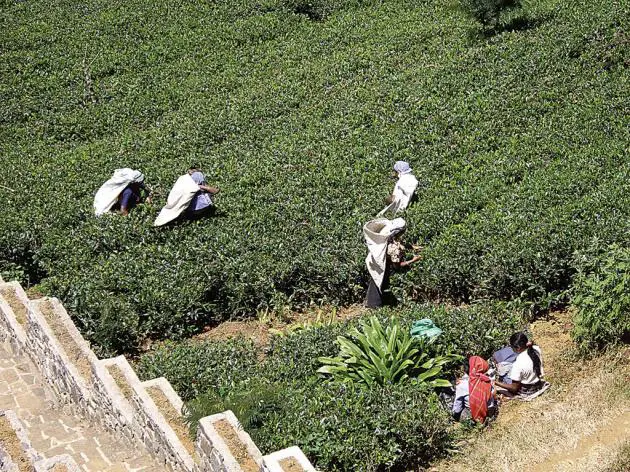
Plenty of colourfully clad women ranging from teenagers to grannies dot the hillside, efficiently plucking away.
Our guide explains that at Mackwoods, only the top three leaves from every branch of a tea plant are picked to ensure the freshest produce.
The leaves then go through a drying process before being packaged into loose tea canisters or tea bags.
We sample a pot of brew at the end of the visit on genteel wrought iron white lawn furnishings that overlook the plantations.
The taste lingers with light, pure tannins and a mildly malty finish.
Touring a tea factory is one thing, but staying in one is unique.
Our home for the night is one such factory.
Upon arrival, we’re greeted with a drink that blends Ceylon tea with aromatic spices and vanilla essence that give it a sweet and spicy kick.
Heritance Tea Factory Hotel is a former working tea facility and is surrounded by 10 hectares of green plantations high up near Nuwara Eliya, about 200 kilometres from Colombo.
It is steeped in the ambience of an industry that has dominated the country, and there is a museum in the basement that chronicles the history of the factory’s operations. A small tea bar at one end of the lobby offers tastings that you can enjoy while relaxing near a wood burning stove.
What really stands out about the Tea Factory Hotel is its signature restaurant: the TCK 6685.
During the glory days of train travel in the early 20th century, the burgeoning tea trade had its own rail to transport the precious commodity from the highlands.
In 1903, Hill Tramway’s Commission opened a line from Nanuoya to Kandapola via Nuwara Eliya and operated passenger and freight trains for almost 50 years.
To give diners a nostalgic blast from the past, a full-size replica of the train’s third-class carriage sits at one end of the property.
We soon learn that this is the pride of the property. A smiling attendant smartly decked out in a conductor’s uniform and cap shouts, “all aboard!” before leading us into the car.
We have a choice of four polished wooden banquettes to sit on, and are pleasantly surprised to find ourselves the only diners that evening.
The menu reflects the 1930s glamour of our surrounds, with a seven-course menu that rivals the best restaurants in Europe.
Hading northwards beyond Matale towards the Dambulla Cave Temple, design hotel fans will find themselves spending more time at the amazing Heritance Kandalama.
Sri Lanka’ celebrated homegrown architect, the late Geoffrey Bawa, created this hotel on the edge of a lake to blend in seamlessly with its natural environment, and it is a textbook example of his tropical modern style.
The open reception area is anchored by a long concrete desk set against a hand-stencilled traditional tile wall.
We are led to a lounge via a corridor set against a giant boulder, and realise that much of the hotel is carved out of the landscape with trees and rocks allowed to remain in situ instead of being blasted away.
The hotel is a series of layered green terraces, with jungle vines forming natural screens outside bathrooms that boast pretty views of the lake. The deep balconies are embellished by a rustic art collection including contemporary animal sculpture.
Of course, creature comforts such as a Six Senses Spa and signature fine dining restaurant Kalu Diya with its friendly barefoot wait staff are not wanting.
The hotel even offers a private dining experience inside a cave. Spending a morning swimming out to the landscape in the infinity-edged pool, we congratulate ourselves on an excellent cultural retreat despite Ranga's driving.
If you go
AirAsia flies from/to Bangkok and Colombo. Visit www.AirAsia.com.
