
Fires in the sky


Play
Isaan folk have traditionally sent rockets into the sky to ask for rain for their crops. Kalasin gives the rite a new spin with its amazing, if unpredictable, 'spaceships'
Thailand’s Rocket Festival pleads with the gods to render the earth fertile by bringing the rains. It’s an ancient rite that is as scientific as it is spiritual, sporting home-made missiles that are both fabulous and frightening.
Like the hundreds of other spectators here in the Northeastern province of Kalasin, I watch the two men, each holding a blazing torch in his hand, kneel down on the ground and bow their heads to the imaginative guardians of the Earth.
Behind me the crowd, made up of inspectors, vendors and the occasional tourist, all of us 500 metres away from the action, holds its collective breath.
“Spin! It’s spinning and spinning,” the local commentator exclaims, as the “torch-men” fire the fuse and run for their lives. The circular object, measuring six metres in diameter, is suddenly engulfed in white fumes and exhaust gases. It chokes rather nastily, spins a few more times and then lifts, shooting off up into the sky.
“Spectacular,” the commentator confirms, as the crowd cheers. “Up, up and up. This flying rocket can go beyond the clouds.”
Rubbing shoulders with Kalasin folk in the empty rice paddies, I can’t disagree with the commentator’s reasoning. Fuelled by burning gun powder and hot gases, the flying object leaves four smoky spiral tails twisting in the air like a giant DNA formation. I stare at it for a good two minutes before it disappears beyond the clouds.
The rocket festival is literally a “burning issue” for Isaan folks.
“The rocket festival is pretty much about rice cultivation”, says 72-year-old rocket master, Phisada Champhon. “It marks the pre-monsoon season.”
Long before man set foot on the moon, the Lord Buddha in his bodhisatta incarnation as the Toad King (Phaya Khang Khaak) angered the God of Rain (Phaya Thaen) by drawing so many people to his sermons. The God of Rain responded by withholding the rains. Fed up with the parched earth, the Toad king’s army declared war on the Rain God’s army and won its battle, demanding that in future the God of Rain send the rainfall on time.
“Whenever you see flying rockets, that’s when the rain must fall,” the Toad King told the God of Rain.
Rockets have been sent into the sky ever since from all around northeastern Thailand during the pre-monsoon season (May and June). Some of the festivals feature teams of monks and local “rocket scientists”, who work day and night to complete their rocket projects. Once the rockets are ready and good to fly, the community throws a pre-launch party with colourful parades, dancing and food and fanfares. Yasothon’s famous “Bung Fai” festival draws 50,000 spectators every year.
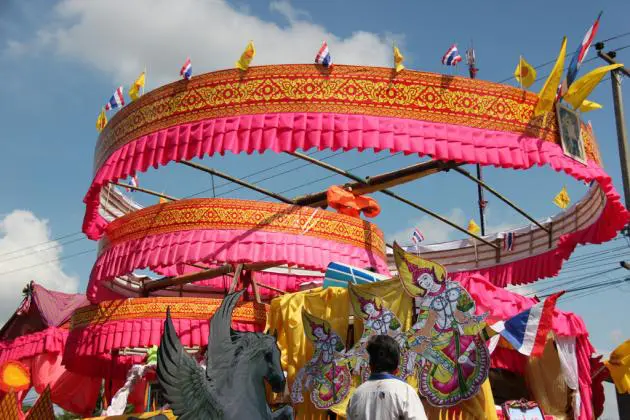
Unlike the rockets in Yasothon and elsewhere in Isaan – where the missiles are long, pointy and decidedly hostile – Kalasin’s version is unique in design and performance. Strictly speaking, it’s more a kind of spaceship. The solid iron tube, measuring six metres in length and 15 centimetres in diameter, is carefully loaded with gunpowder. The tube is then equipped with a thin, circular wing made of bamboo sheets. A parachute – the recovery system perhaps – is carefully attached to the solid tube to bring the rocket smoothly back to earth.
Think of a giant “O” shape with a straight line going through the centre and you have the Kalasin rocket.
“We’ve come up with the design spin off because the traditional rockets are obvious and dangerous,” says local rocket master Duangchan Wannaya. “Our rocket is more complicated but much safer than the traditional form used elsewhere.”
Safer? Two spinning rockets have me running for cover. The first blows up in mid-air. The other changes direction, spinning and flying furiously as it makes it way downwards.
“The rocket sometimes chooses its own destination,” says the commentator, trying to laugh the malfunction off. “I’m not going to tell you again what to do. You can see a rocket heading towards us. Just run for your life.”
Fortunately, the festival goes off without any major hitches and spectators are once again treated to the true colours of the Isaan region.
Away from the launch pad. the sweet, mellifluous sound of the khaen mingles with the air. Here and there, local folk can be spotted placing bets on which rockets will fly the highest. Vendors, with double-yoked baskets hanging from their shoulders, offers rice wine, papaya salad and deep-fried crickets and silk worms.
More than 50 rockets, big and small, are sent skywards this year. Surely that’s enough to force the God of Rain to make good on his promise.
