
Where has all the flour gone?


Play
Visitors can find the answer at Wittenburg's sack museum
Strolling along the beach in Dubai one day, Volmar Wywiol, head of a worldwide company dealing in flour additives, came upon a washed-up synthetic-fibre sack. That event triggered what has since been 15 years of a passionate hobby.
The sack bore the name “Emigrain” on it – a flour manufacturer in the Emirates and, as it turned out, one of Wywiol’s customers.
He took the sack, rips in it and all, back home to Ahrensburg, outside the city of Hamburg, and hung it on a wall in his office.
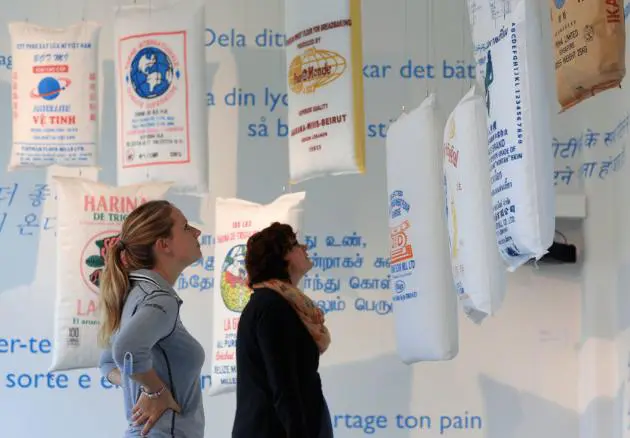
Very quickly, more sacks were added, the result of Wywiol asking customers to bring them to him. Today, his collection of flour sacks has burgeoned to 2,700, from more than 120 countries.
Wywiol established a museum for them, the Flour Art Museum, in the town of Wittenburg, where Wywiol’s company, Muehlenchemie, has a plant.
The museum’s guest book reflects an international following, with visitors from Europe, the United States, Africa and Asia having toured the collection an hour’s drive east of Hamburg. Wywiol’s managers often take customers on a tour.
A curator has arranged the flour sacks in 400 square metres of space in such a way that they tell stories. There is, for example, a linen sack from 1943 that was restitched many times over and bears the German name “Hoffstaedter Muehle”
The story behind it is that hungry German soldiers on leave from battle often purchased flour from the couple operating the mill in what is now part of Poland and would pay for it with genuine army-issue coffee beans.
The mill operator’s wife had one request: that the soldiers return her flour sacks – in effect, expressing her hope for the soldiers’ safety. One German soldier took the request so seriously that years after the war, he managed to locate the couple who had started life again in West Germany - and sent them back their flour sack.
The museum drives home the message of how important wheat flour is worldwide as a food staple.
In poorer countries, flour is seen as a source of strength, and this can be seen in the symbols printed on the sacks – elephants (Ghana, Ivory Coast), bulls (Jamaica, Gambia), lions (Philippines, Guatemala) and bears (Kazakhstan).
Symbolising the purity of refined white flour, sacks will have polar bears, snow-covered mountain peaks and even Snow White on them.
“In the less-developed countries the flour-milling industry is the epitome of progress and so that’s why you’ll often see gears printed on the sacks,” says Melanie Nikschat, a personal assistant at Wywiol’s who knows every nook and cranny of the museum.
She then takes a sack with starch in it and starts to noisily crumple it with her hands.
“This is how for films, they create the sound effect of snow crunching underfoot,” she says.
The museum has a “myths room” taking visitors on an excursion through the cultural history of milling.
Behind glass there is a statuette from the year 2450 BC of an Egyptian maidservant grinding corn. Elsewhere, multi-media special effects make the museum tour a fascinating one.
Yet this now five-year-old museum is open so rarely – for the general public, just on the first Sunday of the month. About 1,000 visitors come each year.
“The exhibition is still too small to open it more often,” Nikschat explains. The next step planned by 79-year-old Wywiol is to expand the upper floor exhibition space by a further 400 square metres. There, the focus will be on flour and means of processing it.
Anja Schaluschke, managing director of the German Museums Confederation, likes initiatives such as this one: “It’s a nice example of how private museums can liven things up,” she says. Throughout Germany there are several hundred museums run by private citizens.
