
Over the hills and far away


Play
Remote, majestic and often breathtakingly beautiful, Ladakh is the perfect place to spend a holiday
As the aircraft approaches Leh in India’s far north and we start to descend, I express a silent prayer of thanks that my travel companions insisted I pack warm clothes. I’ve always thought of India as a hot country like Thailand but the snow on the mountains below tells me I couldn’t be more wrong.
Gasps of surprise ring out as we land and take in the strangest landscape I have never seen.
Landing at Leh’s Kushok Bakula Rimpochhee Airport is probably like landing on the moon. Spectacularly jagged and arid mountains stretch out as far as the eye can see and the altitude makes breathing a little difficult.
Sprawled across the dry Indus Valley, Leh district is like a huge canvas plastered in shades of brown. The landscape gives new meaning to the word extreme. The soulless yet majestic peaks of snow-topped mountains soar into the azure sky. Perched at an altitude of 3,524 metres, this highland of Ladakh is surely the bridge between earth and heaven.
Tucked away in northern India, Ladakh forms part of the state of Jammu and Kashmir.
Back in the days when it was an ancient Himalayan kingdom, Ladakh was known by many names among the travellers who navigated its tiny paths between mountains.
The nomads and ancient trader caravans marked Ladakh on their mental maps as the “land below the mountain passes”. Tibetan and Buddhist pilgrims knew it as the land of the lama. In the West, Ladakh was sometimes referred to as the Moon City.
To the “modern nomads”, the backpackers, Ladakh is a special place, part fantasy and part reality. Here they can munch on a slice of pizza Margherita on the roof of mud-bricked guesthouse, watch colourful prayer flags flutter in the air as they spread their spiritual messages from Leh Palace and listen to the azan call to Muslim prayers.
Our group has a week to explore Ladakh so after the first chilly night in Leh, we head north to Nubra – a tri-armed valley on the border of India and China – a mere 120 kilometres from Leh but a journey of three to four hours.
Breathtaking as it’s dangerous, the ribbon of road reels its way around the mountain before sweeping down into a fascinating valley. Matchbox dwellings, a mud-brick monastery and the ruins of a cathedral run in and out of our vision like a slide show.
From time to time we stop to catch our breath and take photos and each time it’s difficult to persuade everyone to get back in the car. The panoramic view is too beautiful to leave behind but time presses and we must continue on our way.
The road becomes even more extreme as we approach Khardung La, at 5,359 metres, the world’s highest vehicle-accessible pass, which is roughly midway between the Leh and Nubra valleys. To negotiate the high and slippery road, the drivers must hug the cliff face and fix chains on the wheels. There’s a collective sigh of relief when we finally arrive at Nubra Valley.
The isolated valley lies on the old Silk Road that connects South with Central Asia.
The ancient traders and their caravans used to travel this route from Ladakh and Kashmir to Yarkand and Baltistan in Central Asia. Today, the ancient horse path has been replaced by paved road, and the valley itself draws visitors interested in experiencing the high altitude cold desert and Tibetan monasteries, sand dunes and double hump camels.
A couple of days later, we wave goodbye to the valley and head south to Pangong Lake – a V-shaped saltwater lake with one arm in India and another in Tibet.
The 150-kilometre road from Nubra to Pangong Lake is long and winding, making progress considerably slower than our previous journey. While the landscape is beautiful in an extreme way, the high altitude is beginning to affect us, necessitating frequent stops and the unexpected benefits of photo calls with marmots, eagles, sheep and shepherds.
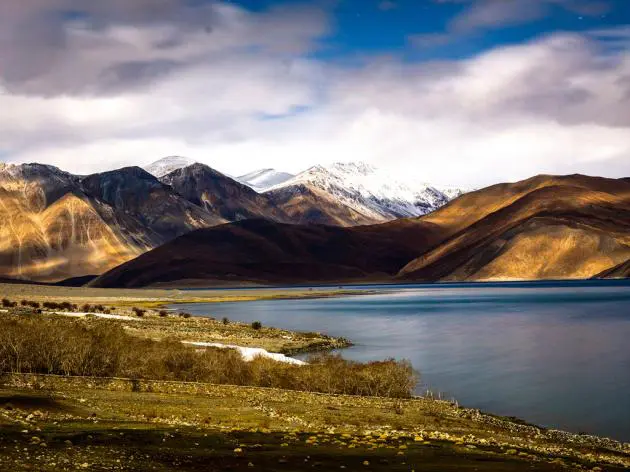
The sight of Pangong Lake provides an immediate cure for our ills. Sitting at the roof of the world, the blue water is furthered deepened by the azure sky and a backdrop of snow-capped mountains.
As we linger by the land-locked lake completely cut off from civilisation and Wi-Fi connectivity, we make our own connection … this time with Mother Nature and her ability to conjure up pure beauty.
IF YOU GO
<
