
Sleeping with History


Play
A look at Indonesia's top seven hotels
The latest data from the Central Statistics Agency (BPS) counted 1,996 starred hotels currently operating in Indonesia. The rise of Indonesia as a travel destination in the past decades has certainly fuelled hotel development in the country, as the number has doubled since 2004.
Among these luxurious new lodgings, however, only few stand out as hotels with historical significance. Those hotels were built decades ago and are now part of the country’s cultural heritage.
Aside from impeccable comfort, historic hotels offer added value as they played a role in the nation’s past, whether during Dutch colonial time, Indonesia’s war of independence, or the early post-independence years.
ROYAL AMBARRUKMO, YOGYAKARTA
Built during the late 1850s, the Ambarrukmo was initially a residential complex for the royal family. It also functioned as the royal meeting hall during the Dutch colonial era.
The building was reconstructed as a hotel in the 1960s by order of then president Soekarno and King Hamengkubuwono IX. It has been one of Yogyakarta’s finest hotels since that time while still preserving many of its important historical aspects.
The complex still boasts a museum and an old pavilion that are home to many of ancient artefacts.
Interesting parts of the hotel are the Bale Kambang bathing pool area and the Gadri dining room, which were considered sacred and only accessible by the royal family.
HOTEL MAJAPAHIT, SURABAYA
Built by a Dutch family in 1910, the Hotel Majapahit was originally known as Hotel Oranje. It was later seized by the Japanese during their occupation and renamed the Yamato Hoteru.
After the Dutch returned to the country in 1945, they again took control of the hotel and raised a Dutch flag over the roof of the building. This triggered the historical “flag-ripping incident”, when Surabaya youth stormed the place and ripped the blue stripe off the flag, leaving only the red and white, the colours of the Indonesian nation.
The name was changed again to Hotel Majapahit in 1969 when a local business bought the hotel. It continues operating today. Despite having undergone many renovations, the hotel has maintained its classic design.
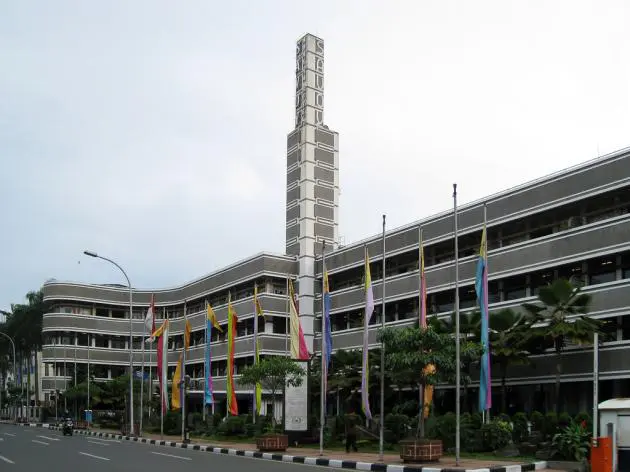
SAVOY-HOMANN BIDAKARA, BANDUNG
This hotel started operating before the dawn of the 20th century, but is best known as the hotel that hosted VIP guests of the first Asia-Africa Conference in 1955.
Figures like Soekarno, Ho Chi Minh, Pandit Jawaharlal Nehru, U Nu and Gamal Abdul Nasser, stayed in the hotel during the event in their own “Asia-Africa Wing”. Charlie Chaplin also spent a night here during his visit to Indonesia.
The Savoy-Homann kept the majority of the structures that were built in 1939. The old Savoy-Homann and the current building are almost identical.
HOTEL INDONESIA KEMPINSKI, JAKARTA
One of the first five-star hotels to be built in the country, this graceful facility was inaugurated in 1962 on the orders of then president Soekarno.
Its location at Indonesia’s iconic traffic circle has allowed it to become the background for the monumental events that took place there – many of them large protests.
The hotel went into a hiatus from 2004 to 2009 as it underwent major interior changes under its new owner, Kempinski Group.
HOTEL SALAK THE HERITAGE, BOGOR
Built by a Dutch family in 1856 , the Salak was originally known as the Bellevue-Dibbets Hotel.
The war of independence saw the hotel used as the headquarters of the Japanese military police in Indonesia. Only after 1948 did the establishment gain its current name, referring to its location at the foot of Mount Salak.
Like Hotel Indonesia, this hotel was also closed for several years, from 1991 to 1998, to undergo renovations.
INNA GRAND BALI BEACH, BALI
Bali’s first hotel with international standards, the Inna Grand was built in 1966 and was the only high-rise building, defying the local Hindu rule that a building should not be any taller than a sacred temple. It prompted a rule that banned buildings from being any taller than a coconut tree – although the rule is no longer in effect today.
HOTEL TJAMPUHAN & SPA, BALI
A former exclusive guesthouse owned by the royal family of Ubud village, the Hotel Tjampuhan first opened its doors to the public in the 1970s.
Walter Spies, a famous German painter and an important figure in the development of Balinese art, resided here as the guest of the royal family. His room is now one of the luxury suites available for rent.
