
Rhythms of Rio


Play
As Brazil goes nuts for the Olympics, we take a walk around the streets and check out the sights
Rio de Janeiro is famous for many things, among them the bossa nova jazz number “The Girl from Ipanema”, the statue of Cristo Redentor, Copacabana Beach and, of course, the Rio Carnival.
Now Brazil’s second largest city is adding the Rio 2016 Olympics to its portfolio of attractions.
The games, which kicked off in style last Friday with a ceremony at the city’s Maracana Stadium, and continue through August 21, followed by the Paralympics from September 7 to 18, have drawn hundreds of thousands of visitors to Rio.
With 37 beaches surrounded by mountains and streets that seethe with sensuality, Rio has more than its fair share of beauty to share. And even without the Olympics, it vibrates with sports.
The Cariocas – as Rio’s residents are called – bring sport from the stadiums to the beaches, mixing action with leisure and even business.
Along the four-kilometre strip of sand that makes up Copacabana Beach, Brazilian boys from favelas show off their skills at beach football. Young men and women, with surfboards attached to their bicycles, cruise along the promenade in search of good waves to ride.
Back in the 1800s, way before the arrival of the athletes last week, the Portuguese led by their Prince Regent sailed to Rio de Janeiro to escape Napoleon's march on Lisbon. The Portuguese gave the city (and the country) its religion and language, while the locals shaped the city with music, dance and cuisine.
As soon as the prince, who later become known as Dom Joao VI, set foot in Rio, the Cariocas threw a wild party with dancing in the streets.
Rio experienced its Golden Age between the 1920s and the 1950s. The construction of luxurious hotels turned the city into a haven for Hollywood celebrities and hi-so A-listers who came here for the beach and samba.
Copacabana is still Rio’s most famous beach – a place where tourists chill out on the hot white sand and sip Caipirinha, Brazilian’s unofficial national cocktail.
Ipanema Beach is more fashionable and infinitely hipper than Copacabana and was immortalised in the worldwide hit “The Girl from Ipanema”. Inspired by Helo Pinheiro, a true beauty who lived in the fasionable seaside neighbourhood during the ’60s, the song was an international hit for Astrud Gilberto and Stan Getz back in 1964. It was featured in last Friday’s opening ceremony, with supermodel Gisele Bundchen portraying the girl from Ipanema.
Rio de Janeiro today is really two cities – one for the rich, the other for the poor. The rich and the middle classes live along the Atlantic coastline in Ipanema, Copacabana and Leme. The poor and powerless inhabit the shantytowns – favelas – covering the steep hillsides around the city.
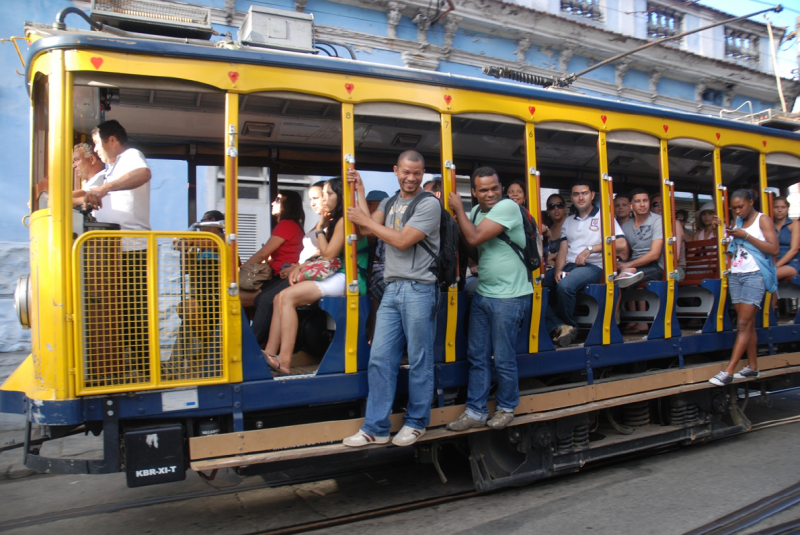
Santa Teresa, which is perched on a hill overlooking the city, is Rio’s answer to Montmartre in Paris and connects with the city centre via an old tramline. It is a far cry from the glitz and glamour of Copacabana and Ipanema, yet captures the heart and imagination of many visitors, myself included.
A Bohemian hideout that’s home to musicians, novelist-wannabes, daydreamers and ne’er-do-well junkies, this neighbourhood also has a thriving broken hearts club.
“When lovers are dumped by their significant others, they come here,” the guide tells me.
Oh to be a romantic loser!
