
Chadchart explains 600-baht fine in BMA fitness-equipment graft case
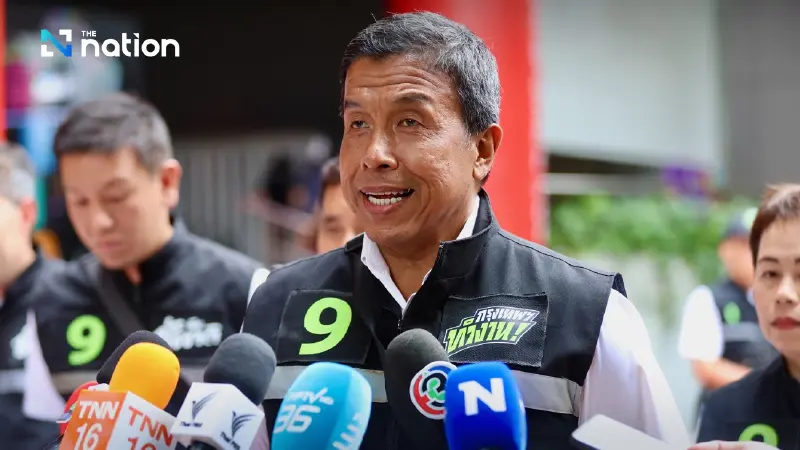


Chadchart Sittipunt says the BMA fitness-equipment corruption case is not over, with disciplinary penalties under review and NACC checks continuing.
Chadchart Sittipunt, a Bangkok governor candidate and former Bangkok governor, held a press conference on Tuesday to clarify progress in the Bangkok Metropolitan Administration’s investigation into alleged corruption in the procurement of fitness equipment.
The case has led to disciplinary action against 32 officials.
Chadchart said he was not angry about public criticism, adding that it was positive for society to pay close attention to corruption during an election period. He said such scrutiny could help push the BMA towards concrete reform.
He stressed that the case had not been concluded and remained under process in three main areas.
The first is the BMA’s internal investigation, which is still being considered by the Bangkok Metropolitan Civil Service Commission. Chadchart said the executive side had already ordered a review of the disciplinary outcome. The initial penalties were only part of the official administrative process and were not the final conclusion.
The second area is the investigation by the National Anti-Corruption Commission (NACC), which is examining financial trails in detail. Chadchart said the NACC had the authority to investigate financial transactions and vendors, which was beyond the BMA’s own powers.
Addressing criticism that some accused officials had received only minor penalties, including a 600-baht fine, Chadchart said Thailand’s bureaucratic system was designed with checks and balances. The Bangkok governor does not have direct authority to punish or dismiss civil servants.
He said the investigation committee had been appointed by the Bangkok permanent secretary under the chain of command. However, he insisted that he did not agree with the initial disciplinary outcome and had used his authority to order a full review of the investigation.
The matter will now be considered by the Bangkok Metropolitan Civil Service Commission from broader perspectives. If clear evidence or facts are found, the commission has the authority to increase penalties, including dismissal or removal from office.
Chadchart said the case had not ended and that the 600-baht fine had been imposed first because an order and disciplinary penalty had already been issued. The permanent secretary and related agencies, including the director of the relevant Culture Department, which oversees the officials involved, had proceeded with the fine because an investigation committee had already reported its findings.
“But this matter is not over. It is still ongoing,” he said.
“I did not approve this disciplinary order. We thought it did not look severe enough, so I ordered a new investigation. But I cannot directly instruct the committee myself because the bureaucratic system requires checks and balances. Otherwise, a governor could simply order the permanent secretary to punish everyone. This committee also changes over time,” Chadchart said.
Asked about bidding through the Comptroller General’s Department’s e-Bidding system, Chadchart said the system had built-in checks. If bid specifications are found to have been written to favour certain suppliers, complaints can be filed.
He said the problem in this case stemmed from the lack of an appropriate reference price and the wide variation in equipment specifications. The BMA will need to tighten control over how reference prices are set.
Asked whether the investigation would be expanded to other projects, Chadchart said it would not stop with the first seven projects or the 17 projects raised by critics. Information had already been sent to the NACC, and the BMA would expand checks to every project based on the same procurement approach.
He said this would also include the 2020 case involving alleged fictitious vehicle-repair claims, in which the same group of wrongdoers was found to be involved.
On leadership responsibility, Chadchart said that as team leader, he had to be responsible for everyone. If any team member was found to be dishonest or to have performed poorly, he would be ready to remove that person immediately.
Chadchart reiterated that corruption was something he found unacceptable and deeply repugnant. He said he could not accept being accused of involvement in corruption.
If elected Bangkok governor for another term, he said he would pursue the matter to the end and expand the investigation to cover every related project. If the problem is not dealt with decisively, he said, it will become a burden for future generations.
At the end of the press conference, Chadchart thanked Suphanat Minchaiynunt, a Bangkok MP from the People’s Party, for raising the issue for scrutiny. He said he hoped the matter would be pushed as a long-term agenda, not only as an election-period trend.
