
Robotic surgery now free for three cancer types
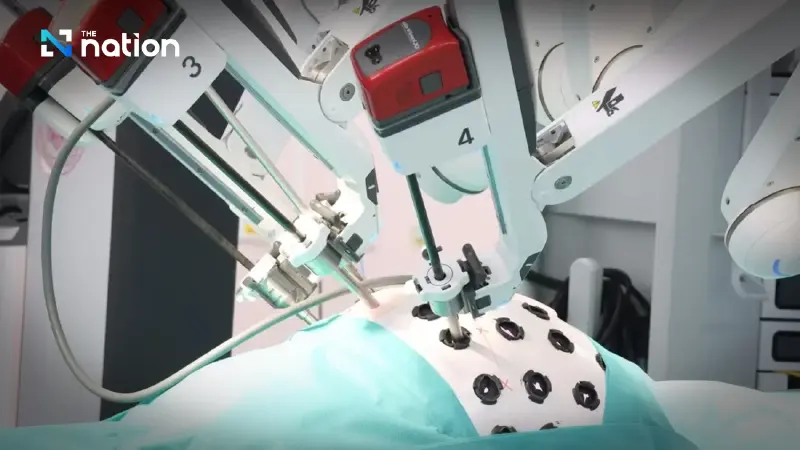


Patients with three types of cancer are now eligible for free robotic surgery under all public health insurance schemes. The Ministry of Public Health also plans to expand robotic-surgery capability across its network of hospitals, to offer services in all 12 health regions nationwide.
One of the major milestones for Thai medicine, reflecting both the country’s technological capability and the expertise of its surgeons in reaching international standards, is the adoption of robot-assisted surgery designed for minimally invasive procedures with smaller incisions, less pain and faster recovery.
Rajavithi Hospital has been a national pioneer in robotic surgery since 2020. To date, it has performed more than 1,100 procedures, the highest number in Thailand, covering a wide range of diseases across multiple specialities. The technology enables surgeons to treat complex conditions with high precision and efficiency, reducing side effects, lowering complication rates and improving patient safety.
The hospital is now preparing to expand this capability to four additional hospitals in Bangkok in the first half of 2026, alongside establishing a training centre for specialists from regional hospitals. The aim is to provide at least one robotic-surgery service centre in each of Thailand’s 12 health regions.

Rajavithi leads the nation in robotic surgery.
On November 18, 2025, at Rajavithi Hospital, Dr Natthapong Wongwiwat, Director-General of the Department of Medical Services, presided over the opening of the “Grand Opening & Celebration Rajavithi Robotic Surgery Centre”, under the theme RAJAVITHI 1,100 ROBOTIC CASES — THE FUTURE OPERATES HERE. He noted that Rajavithi is the department’s flagship institution in robotic surgery and the first Ministry of Public Health hospital to adopt this technology when it launched the programme in 2020.
The hospital has now performed more than 1,100 robotic procedures, more than any other institution in Thailand, and is preparing to introduce a second surgical robot to further increase capacity.
Three cancer surgeries are now free of charge
In its early phase, Rajavithi’s robotic-surgery programme received essential support from the Rajavithi Hospital Foundation, which funded surgical instruments and disposable equipment, costing hundreds of thousands of baht per case. These expenses were not covered by the main public health insurance schemes: the Universal Coverage Scheme, Social Security Scheme or Civil Servant Medical Benefit Scheme.
“The success of Rajavithi’s robotic surgery programme became the basis for pushing the inclusion of robotic surgery into the benefit packages of national health insurance schemes,” Dr Natthapong said. “Today, patients pay no out-of-pocket costs for robotic surgery for prostate cancer, pancreatic cancer and colorectal cancer.”

Aiming for full coverage across all 12 health regions
Dr Natthapong added that this achievement has become the starting point - and the first model - for the Ministry of Public Health’s new policy direction. The Minister and Permanent Secretary of Public Health have instructed the Department of Medical Services to bring its most advanced technologies to the regions. The main goals are to expand knowledge transfer, strengthen medical training and ensure that patients nationwide have access to high-quality, high-technology medical services. Many people in provincial areas still face significant barriers to accessing specialised treatments that rely on advanced medical technology.
Rajavithi Hospital has therefore been designated as the Ministry of Public Health’s national training centre for robotic surgery, offering specialised courses for medical personnel from regional hospitals. This follows the Permanent Secretary’s policy to establish robotic-surgery services in all major regional hospitals, ensuring full coverage across Thailand’s 12 health regions.
Rajavithi is fully equipped in terms of personnel, with senior clinicians and multidisciplinary teams experienced in a wide range of robotic procedures. Its programme covers almost every organ system, and several of its trainers are regarded as among the leading specialists in Southeast Asia. The centre also plans to invite expert instructors from abroad—including Europe, the United States and China—to assist in teaching complex or emerging procedures.
Four more hospitals in Bangkok to adopt robotic surgery
The Department of Medical Services also plans to expand robotic-surgery capabilities to additional hospitals under its supervision, including Nopparat Rajathanee Hospital, the Thoracic Disease Institute and Lerdsin Hospital. All newly installed robots will include integrated training modules. By the first half of 2026, four more department hospitals in Bangkok, the Priest Hospital, Nopparat Rajathanee Hospital, Lerdsin Hospital and the Thoracic Disease Institute, are expected to be fully equipped with robotic-surgery systems, significantly increasing patient capacity.
Pushing for broader free-treatment coverage
At present, Thailand’s three public health insurance schemes provide full coverage for robotic surgery in three cancers. However, for other highly specialised procedures—such as thoracic, urological or gynaecological surgeries—patients must still pay additional costs.
A proposal is now being prepared to extend benefits to include surgeries for conditions such as lung diseases and gynaecological cancers. The aim is to broaden access to advanced robotic surgery nationwide, in line with global medical trends where robotic procedures have become essential in modern surgical care.

Advantages of robotic surgery
Dr Jinda Rojanamatin, Director of Rajavithi Hospital, said that medical technology continues to advance to improve patients’ quality of life. Robotic-assisted surgery, designed for minimally invasive operations with smaller incisions, less pain and faster recovery, enables surgeons to treat complex conditions with exceptional precision and efficiency. This reduces side-effects and complications, enhancing patient safety and outcomes.
Rajavithi Hospital remains the Ministry of Public Health’s flagship institution for robotic surgery and was the first ministry hospital to launch a robotic-surgery programme in 2020.
Two procedures now most performed in ASEAN
Rajavithi Hospital has successfully carried out more than 1,100 robotic procedures to date—the highest number in Thailand. Its robotic-surgery services cover both cancer treatment and complex operations across multiple specialties.
These include urological diseases such as prostate cancer; ENT conditions including tonsillar disease and cancers at the base of the tongue; gynaecological conditions such as uterine tumours; as well as cardiothoracic surgery, liver cancer and colorectal cancer.
The hospital has also performed more than 200 robotic surgeries for pancreatic disease and duodenal conditions, marking the highest volume of such procedures in Southeast Asia.
“Today’s 1,100 cases represent only the beginning of Thailand’s journey into the future of medicine,” Dr Jinda said. “Rajavithi Hospital will continue to drive innovation and develop the next generation of medical professionals, ensuring Thai patients receive world-class treatment using cutting-edge technology.”
