
Are ICJ rulings legally binding, and enforceable?
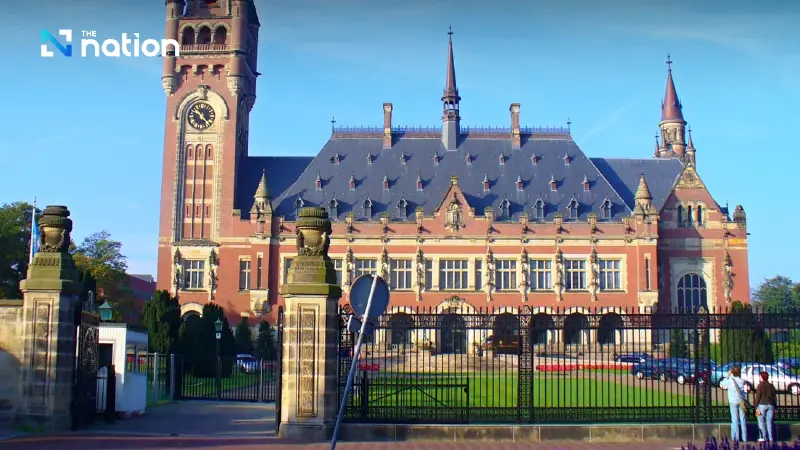


If Thailand rejects ICJ jurisdiction, must it still comply? The Preah Vihear case offers insight into maps, border disputes, and legal obligations.
Following the Sixth Thai–Cambodian Joint Boundary Commission (JBC) meeting held in Phnom Penh on June 14–15, 2025, Cambodia’s Secretariat of State for Border Affairs issued a statement claiming that the two sides had discussed a proposal to refer four disputed areas to the International Court of Justice (ICJ).
The areas mentioned were the Emerald Triangle, Ta Muen Thom Temple, Ta Muen Toch Temple, and Ta Kwai Temple.
The Cambodian statement also claimed that both parties had agreed to adopt the 1:200,000-scale map as a common reference.
However, late in the night of June 15, Thailand’s Ministry of Foreign Affairs issued a formal response refuting both claims. The ministry insisted that there was no discussion of referring the dispute to the ICJ, nor any agreement on the use of the 1:200,000 map during the JBC meeting.
In its statement, the Thai Foreign Ministry expressed disappointment over Cambodia’s lack of cooperation in easing tensions and resolving the issue constructively.
There can be only one version of the truth from the JBC meeting, suggesting that stronger retaliatory measures from both sides may soon follow.
Cambodia’s push to escalate the dispute by seeking an ICJ ruling on the four sites has raised critical questions within Thailand over whether such a move would place the country at a legal disadvantage, and what the long-term implications may be.
Thailand maintains firm stance: ICJ has no jurisdiction
On June 14, during the JBC meeting, Nikorndej Balankura, Director-General of the Department of Information and spokesman for the Ministry of Foreign Affairs, reiterated Thailand’s firm stance: it does not recognise the jurisdiction of the International Court of Justice in this matter. This position has been consistently upheld by both the Prime Minister and the Foreign Minister.
Historically, Cambodia submitted a request to the ICJ in 1959 to determine the boundary north of Preah Vihear Temple. In 1962, the ICJ ruled in favour of Cambodia in a 9–3 vote, stating that the temple belonged to Cambodia. A second ruling (7–5) ordered Thailand to return cultural artefacts taken from the site. However, the court did not address the boundary line shown in the 1:200,000-scale “Dangrek map”.
On 3 July 1962, Thailand issued a statement disagreeing with the ruling but confirmed it would comply with its obligations as a UN member state by returning only the temple structure, not by recognising the border shown on the map.
1997: The Thai–Cambodian Joint Boundary Commission (JBC) was established as the main mechanism for bilateral negotiations, land surveys, and demarcation of the land boundary between Thailand and Cambodia.
2000: The two governments signed the 2000 Memorandum of Understanding (MOU) on the survey and demarcation of the land boundary. It outlined the legal basis for the negotiation process, including which documents could be used. However, the MOU did not imply that either party recognised the documents as legally binding on themselves.

2007: Cambodia unilaterally applied to list Preah Vihear Temple as a UNESCO World Heritage Site, which led to overlapping territorial claims covering an area of 4.6 square kilometres. Thailand’s Ministry of Foreign Affairs noted that Cambodia’s claim relied on the 1:200,000 map, which differed from the boundary line referred to in Cambodia’s earlier case before the International Court of Justice (ICJ) in 1962, thus creating a new border dispute.
2008–2011: Several military clashes occurred along the Thai–Cambodian border, particularly around Preah Vihear, amid growing tension over the World Heritage listing.
June 18, 2008: Thai Foreign Minister Noppadon Pattama signed a joint communiqué with Cambodia and UNESCO supporting Cambodia’s application. This move prompted mass protests led by the People’s Alliance for Democracy (PAD), calling for his resignation.
June 24, 2008: PAD representatives filed a petition with the Administrative Court, requesting an injunction against the Cabinet’s resolution endorsing the joint communiqué. On June 28, 2008, the court issued a temporary injunction, suspending all related actions pending a final ruling.
July 8, 2008: UNESCO officially listed Preah Vihear Temple as a World Heritage Site, based solely on Cambodia’s application.
2011: Cambodia submitted a request to the International Court of Justice (ICJ) to reinterpret its 1962 judgment on the Preah Vihear case. Thailand argued that Cambodia’s interpretation expanded territorial claims into Thai territory.
At that time, Thailand’s Ministry of Foreign Affairs clarified that Thailand had previously accepted the ICJ’s jurisdiction through a declaration dated May 20, 1950, valid for 10 years. However, since the 1962 Preah Vihear ruling, Thailand has not recognised the ICJ’s jurisdiction in subsequent cases.
July 18, 2011: The ICJ issued provisional measures ordering both Thailand and Cambodia to withdraw military forces from a newly established temporary demilitarised zone.
In 2013, the ICJ issued a final ruling confirming Cambodia’s sovereignty over the area immediately surrounding Preah Vihear Temple but declined to rule on the full 4.6 square kilometre disputed zone. The court did not recognise the 1:200,000 map as binding on Thailand and acknowledged that adjacent land, such as Phu Makhua, was outside the core ruling.
ICJ rulings are not directly enforceable; parties must appeal to the UNSC
The news agency Isra News once published an analysis by Borwornsak Uwanno, a Fellow of the Royal Society and Secretary-General of the King Prajadhipok's Institute, titled “The Preah Vihear Case: Behind the Scenes and the Path to Resolution.” In it, he notes that rulings by the ICJ are final and binding by nature, in accordance with Article 60 of the ICJ Statute.
However, the ICJ has no enforcement mechanism to ensure compliance with its judgments. If one party fails to comply, the other party may submit the matter to the United Nations Security Council (UNSC), which may decide to recommend or impose measures to enforce the ruling under Article 94 of the UN Charter, which states:
Each member of the United Nations undertakes to comply with the decision of the ICJ in any case to which it is a party.
If any party fails to perform the obligations incumbent upon it under a judgment, the other party may bring the matter to the Security Council, which may, if it deems necessary, make recommendations or decide upon measures to give effect to the judgment.
It is therefore clear that non-compliance with an ICJ ruling is no longer merely a legal issue, but a matter of international politics, subject to the discretionary authority of the Security Council in determining any enforcement measures.
When Thailand lost the Preah Vihear case in 1962, it protested the ruling, but ultimately complied with the judgment in its capacity as a UN member state, obligated under Article 94 of the UN Charter.
Can a country defy an ICJ ruling?
Is it possible for a country to refuse to comply with a ruling of the ICJ? The answer is yes—it has occurred in several notable cases:
United States vs. Iran
In the case involving the seizure of American diplomats and consular staff in Tehran, the ICJ ruled in favour of the United States. However, Iran refused to comply with the ruling.
Nicaragua vs. United States
Nicaragua brought a case to the ICJ accusing the United States of supporting Contra rebels and placing naval mines in Nicaraguan waters. The US challenged the Court’s jurisdiction, but the ICJ rejected the objection. The US then withdrew from the proceedings.
Ultimately, the ICJ ruled that the US had violated both treaty obligations and customary international law by interfering in the sovereignty of another state and ordered the US to pay reparations.
However, the US refused to comply. Nicaragua took the matter to the UNSC. In a vote by UNSC members, 11 nations supported upholding international law. But the United States used its veto power as a permanent member to block any action. Three countries abstained.
Only major powers can defy the ICJ with impunity
This demonstrates that enforcing ICJ rulings becomes impossible when a powerful country with UNSC veto rights refuses to comply. Even when the UN General Assembly voted overwhelmingly—94 to 3—to call for US compliance, the US still refused. Eventually, Nicaragua withdrew its petition in 1992.
This case illustrates how great powers with veto rights in the Security Council can evade accountability, even in the face of global consensus. It is also notable that such countries are often major financial contributors to the UN system.
As legal scholar Borwornsak pointed out, Thailand is not a global power. Therefore, it would be extremely difficult for Thailand to avoid complying with an ICJ ruling, unlike powerful nations with the ability to block enforcement through the UNSC.
