
Cambodian politics under spotlight as border war subsides
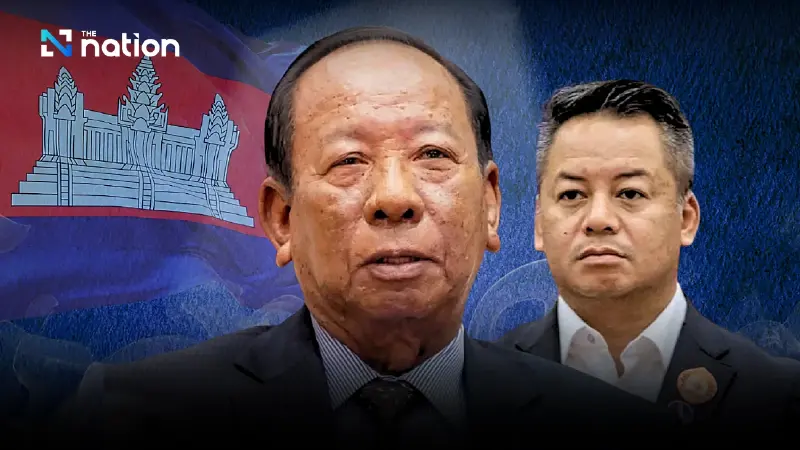


Opponents of the Hun family are closely watching for shifts in power, with the Tea family — particularly Tea Banh and his son Tea Seiha — in sharp focus.
At dawn on July 26, the Royal Thai Navy launched "Operation Trat Strike 1", pushing back Cambodian forces in the Chamrak border area of Muang district, Trat province — directly opposite Thmor Da in Veal Veng district, Pursat province.
Shortly after the operation began, Cambodian Defence Minister Gen Tea Seiha issued a statement via his official Facebook page urging calm in the provinces bordering Thailand — namely Koh Kong, Pursat, Battambang, Pailin, Poipet, and Banteay Meanchey.
“I ask our fellow citizens in these provinces to maintain peace, avoid any disturbances, and strictly follow instructions from local authorities,” the post read.
It is well known that Cambodia’s eastern provinces are political strongholds of the influential Tea family, particularly in Pailin, Pursat, and Koh Kong.
Koh Kong is the birthplace of Gen Tea Banh, the former defence minister, as well as Ly Yong Phat — also known as Phat Suphaphar — a tycoon dubbed the "King of Koh Kong."
Today, the governor of Koh Kong is Mithona Phouthorng, the daughter of Yuth Phouthorng, a political heavyweight in the province.
As the border clashes de-escalate, attention is turning to what could become the beginning of a new phase of political conflict within Cambodia, with factions from Koh Kong expected to come under close scrutiny.
Meanwhile, Sam Rainsy, the exiled opposition leader, has mobilised demonstrations of Cambodians abroad — in the US, Australia, South Korea, and Japan — under the banner of national pride and resistance to Thai aggression.
However, his show of patriotism does not imply support for the continuation of the Hun Sen regime.
Political observers largely agree that the exiled opposition lacks the strength to topple Hun Sen’s ruling system alone — and that any real threat to the regime must come from fractures within Cambodia’s ruling elite.
Cambodia's dynastic politics
Political power in Cambodia is largely shaped by dynastic succession, with two dominant families — the Huns and the Teas — emerging as key players in what many observers describe as bloodline politics.
For over four decades, former Prime Minister Hun Sen’s chief political rivals came from two powerful households: the Sar Kheng and Tea Banh families.
Hun Sen handed the premiership to his eldest son, Hun Manet, and appointed his younger son, Hun Mani, as deputy prime minister.

In parallel, Sar Kheng — former deputy prime minister and interior minister — passed both positions to his son, Sar Sokha, now a rising figure in Cambodia’s security and governance apparatus.
Likewise, Tea Banh, the long-serving deputy prime minister and defence minister, handed those roles to his son, Tea Seiha. The Tea family’s influence extends further into the military: Tea Banh’s brother, Tea Vinh, served as navy commander for years before the role was transferred to his son, Tea Sokha.
Independent Southeast Asia analyst Supalak Kanjanakhundee notes that this dynastic structure ensures short- to medium-term political stability in Cambodia, primarily due to these families’ control of key state institutions, access to resources, strong international alliances, and well-orchestrated succession plans.
Power play behind Cambodia’s generational handover
Before Cambodia’s elite class underwent a formal generational transition in 2023, the political landscape was rife with speculation and rumours of a power struggle between the Hun and Tea families.
Exiled Cambodian opposition groups helped fuel talk of a rift between former Prime Minister Hun Sen and long-time ally Gen Tea Banh. Thai influencers critical of the Hun dynasty also fanned claims of a “silent coup” unfolding in Phnom Penh.
Yet in the end, the ruling elite — Hun Sen, Sar Kheng, and Tea Banh — struck a pragmatic power-sharing deal that allowed each faction to retain influence under the new leadership framework.
Hun Sen emerged with the upper hand. With three sons positioned in key institutions, he demonstrated dynastic depth that his counterparts lacked.
Though Hun Manet had to step down from his military command to become prime minister, another son, Hun Manith, moved up to deputy army chief while continuing to lead the country’s powerful intelligence agency.

Initially, Tea Banh appeared to lack a successor suitable for the defence minister post, as his son Tea Seiha was then serving as governor of Siem Reap — a position considered more civil than military.
But a compromise was reached. Tea Seiha, who once held the military rank of maj gen, was appointed as defence minister and granted the full general rank upon his promotion.
Unlike Hun Manet, however, he took over the post without a military command, raising questions over his real clout — some observers dubbed him a “general without an army”.
For now, the anti-Hun bloc will likely watch closely how Cambodia’s internal politics evolve after the current ceasefire negotiations with Thailand.
Cambodia’s poor military performance and territorial losses in recent clashes may begin to erode the aura of invincibility long associated with Hun Sen — potentially shaking his political legitimacy at home.
