
Cambodia sees black, Thailand sees white: When the truth is torn in two
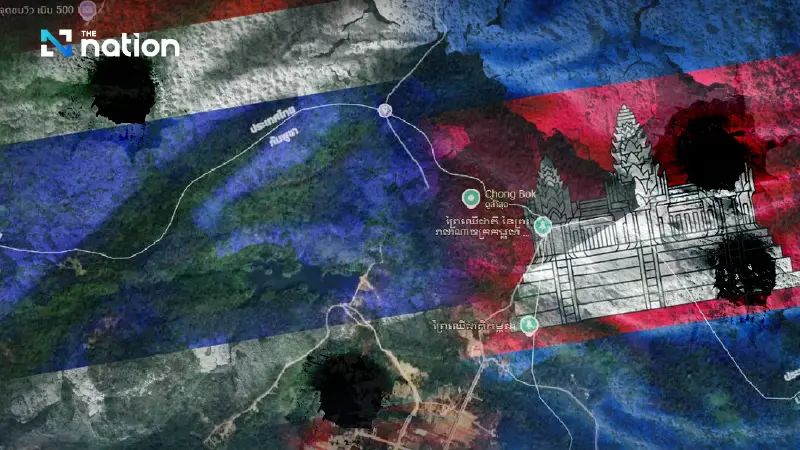


The conflict between Thailand and Cambodia is far from over. While the use of heavy weaponry seems to have decreased following the agreement reached at the Malaysia meeting, incidents like landmine planting, drone surveillance, fake news, and falsified evidence continue to occur regularly.
- The conflict between Thailand and Cambodia has evolved into an intense "information war," where fake news and propaganda are used as key weapons by both sides.
- Despite a ceasefire agreement that included refraining from spreading misinformation, the article accuses Cambodia of continuing to circulate fake news, such as a false report of an imminent Thai military attack.
- The article frames the situation as two conflicting realities, portraying Cambodia as using deceptive tactics and breaking promises, while Thailand is presented as responding professionally with evidence.
- This "cyberwar" is fueled by social media, where a flood of real news, fake news, and distortions from both state and civilian sources makes it difficult to distinguish truth from falsehood.
The conflict between Thailand and Cambodia is far from over. While the use of heavy weaponry seems to have decreased following the agreement reached at the Malaysia meeting, incidents like landmine planting, drone surveillance, fake news, and falsified evidence continue to occur regularly.
Therefore, we cannot trust Cambodia, even for a single moment, to refrain from using further deceptive tactics against us, as is their nature.
From this clash, the Thai people have learned many lessons. We have witnessed the injury and loss of life among both civilians and soldiers. We have seen homes, schools, hospitals, and shops destroyed by gunfire coming from the Cambodian side, driven by a war-hungry leadership, causing hundreds of thousands to flee in fear for their lives.
We have also seen Thailand’s immediate, professional, and well-coordinated responses on land, sea, and air, adhering to the standards of military conduct.
We have witnessed the overwhelming compassion and solidarity among the Thai people, and we have also seen the true nature of certain politicians, who not only failed to contribute anything positive to the country but also sowed confusion during a time of war and even insulted the military. It has been widely discussed on social media that while a country may do without politicians, it cannot do without soldiers.
Alongside the physical battlefield, both the Thai and Cambodian people have witnessed a fierce information war, with news, both true and false, distorting and spreading across media platforms, fueled by both the state and civilians of the two countries.
With smartphones in hand, the flow of real news, fake news, distortions, memes, and conspiracy theories has flooded social media like never before. This has created a parallel cyberwar, just as intense as the fighting on the ground, which continues to rage on.
The Identity of Fake News
In an era where anyone can spread information, ideas, and opinions they want the public to hear through social media, many people seize the opportunity to use this easily accessible platform for their benefit.
This often includes spreading misinformation, creating confusion, and misleading others for personal gain. This includes generating content for political purposes, seeking views for fame, or even accepting payment to distort the truth for financial profit.
This type of information is commonly known as fake news, which generally refers to "the intentional dissemination of false or misleading information designed to deceive others, presented in a way that makes people believe it is true." Some writers argue that fake news and propaganda are interchangeable terms.
Thus, anyone on the internet and social media has a chance of encountering fake news. It is important to note that fake news does not originate from credible media sources. The creators of fake news are not professional journalists who report actual news to the public, but instead, they deliberately craft false reports.
What distinguishes fake news from real media is the intent behind it. Professional media aim to uncover and present the truth, whereas fake news is created solely for deception.
Fake News from Cambodia
After the General Border Committee (GBC) Meeting between Thailand and Cambodia in Malaysia, the two countries agreed to a 13-point ceasefire, one of which was to refrain from spreading false information or fake news to reduce tension, alleviate negative public sentiment, and promote a peaceful negotiating environment.
However, despite this agreement, fake news from Cambodia continued to circulate. For example, the Cambodian news outlet Fresh News published a headline reading, "Breaking: The Thai Army prepares for another attack on Cambodia, possibly on the night of August 13 and the morning of August 14!" The report claimed that Thailand had ordered the closure of schools and the evacuation of civilians from Ban Dan, Dan subdistrict, Kap Choeng district, Surin Province, in preparation for an attack on Cambodia. The Thai military promptly debunked this baseless claim, calling it false information.
The fake news from Cambodia is just one example of the constant flow of misinformation after the clashes, including staged incidents designed to falsely blame Thailand. This situation is difficult to believe in a society described by scholars as an Evidentiary Society, where Thailand can provide evidence to counter all the fabricated claims.
This event demonstrates that Cambodia disregards visible evidence and has never kept its promises, regardless of whether third-party witnesses are present.
Fake News as a Weapon of War
Throughout history, fake news has been used as a weapon of war, becoming a central tactic in many conflicts. The propaganda strategies used by authoritarian leaders across different countries have often mirrored each other. These leaders typically employ the following strategies:
- Using fake news or propaganda to persuade the public to believe their leader’s narrative.
- Controlling the media entirely to spread their version of the truth.
- Exploiting pre-existing beliefs and vulnerabilities in the public to increase the effectiveness of fake news.
- Repeating the same false information multiple times to solidify it in people's minds.
Among the world’s leaders, Adolf Hitler is often mentioned first when it comes to propaganda. The methods he used became infamous, and some key principles he followed can still be seen as effective tools for manipulation. These principles include:
- Never allow the public space to remain quiet.
- Never admit fault or wrongdoing.
- Never acknowledge that the enemy has any advantages over you.
- Don’t leave room for alternatives.
- Never accept blame or condemnation.
- Focus attention on one enemy at a time and blame them for everything that goes wrong.
- People are more likely to believe big lies than small ones, and if the big lie is repeated enough, they will eventually believe it.
Repetition, as Napoleon famously understood, is a powerful tool. He recognised that one of the most potent forms of rhetoric was repetition, which aligns with modern research showing that repeating a lie doesn’t just convince people of something they were uncertain about, it can even make them accept the lie even when they know the truth.
An important aspect of propaganda that cannot be overlooked is the attempt to erase the truth. The truth is the arch-nemesis of propagandists. One of the most common techniques for erasing the truth involves flooding the information space with massive quantities of content, spreading it through multiple channels, and maintaining a constant and relentless pace of dissemination. This strategy, often referred to as the Russian Firehose in American discourse, confuses recipients of information and makes it nearly impossible to distinguish falsehoods from the truth.
Beyond this, silencing dissent is another crucial method for erasing the truth in authoritarian regimes. Dictators use this strategy to maintain their power and ensure their growth, both in the pre-social media era and today, in the age where smartphones and social media are in the hands of everyone. Even though social media provides a platform where people can freely access news and express opinions, in a country where the media is entirely controlled by a dictatorial regime, even social media is not spared. Dissenting voices are often suppressed, threatened, or silenced in some way.
It is likely that the Cambodian people, too, are silenced under Hun Sen’s regime. Despite having access to smartphones and social media, expressing dissenting opinions is dangerous, as one could be accused of treason or betrayal of their country.
Pansak Arpakajorn
An independent scholar specialising in technology and communications
