
Defence ministry claims Cambodia is using lobbyists to sway global opinion
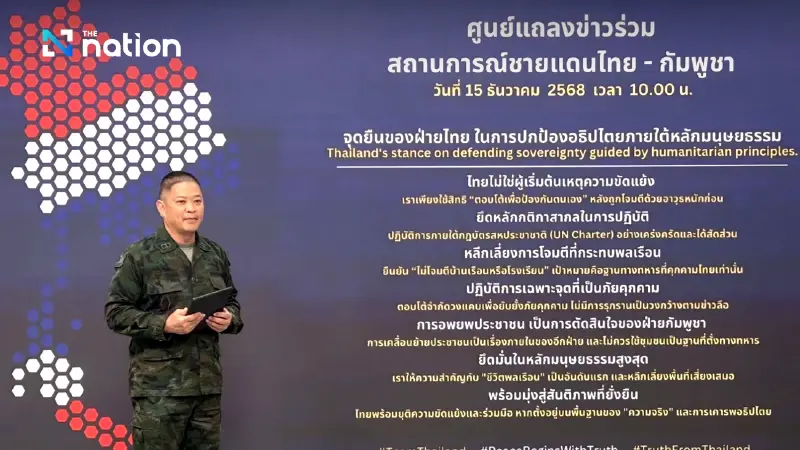


Thailand’s defence ministry says Cambodia has hired lobbyists and is spreading misinformation to shape international opinion, urging public to treat such claims with caution.
- Thailand's Ministry of Defence alleges that Cambodia is using lobbying networks as part of an "information warfare" campaign.
- A ministry spokesperson cited the appearance of Westerners in photos and videos calling for action from within Cambodia as evidence of this effort.
- The ministry described this activity as an attempt to "stage-manage" images and narratives to generate international sympathy for Cambodia's position in the border conflict.
At the Joint Press Centre on the Thailand–Cambodia situation, RAdm Surasant Kongsiri, spokesperson for the Ministry of Defence, said on Tuesday (December 16), the current border conflict is being played out across three main fronts.
The first is the diplomatic front, where the Ministry of Foreign Affairs has taken a firm approach, repeatedly and clearly setting out Thailand’s position to the international community.
The second is the information front, the arena of information warfare, involving fake news, disinformation and attempts to provoke public reaction via media and social platforms, which the spokesperson said have been driven by the Cambodian side.
He described this as an especially important battleground.
The third is the military-operational front along the border.
Thailand does not want to see losses, whether among troops on either side or civilians in border areas, but operations have become necessary, he said, due to what he described as Cambodian provocations and attempts to manufacture incidents.
Surasant also addressed reports that Cambodia has been using lobbyists to amplify its messaging internationally, saying Thailand has observed the use of lobbying networks.
He said this could be seen in the emergence of foreign nationals, particularly Westerners, calling for action in photos and videos filmed at locations across Cambodia.
He described such activity as an attempt to stage-manage images and narratives to generate sympathy for Cambodia internationally, insisting that Thailand’s military operations are narrowly targeted and have no intention of striking civilians.
He urged Thai people to exercise judgment when consuming information and to be cautious about reports originating from Cambodia, adding that “the facts and the truth come from one source, the truth from Thailand”.
Thailand, he said, would continue to manage all three fronts carefully, with a single goal: achieving lasting peace and stability in the border area.
Meanwhile, AM Chakkrit Thammavichai, spokesperson for the Royal Thai Air Force, responded to what he called Cambodia’s false claims that Thai air operations had caused large numbers of deaths and injuries in Cambodia.
He reaffirmed that Thai air strikes target only military objectives, and that each operation is subjected to multiple layers of careful assessment before action is taken.
He said the latest strike, against what he called Target “Class 5”, described as a storage site for weapons, ammunition and explosives, aimed to prevent Cambodia from using those weapons to attack Thai forces and Thai civilians.
Chakkris said all targets were hit using high-precision guided munitions to ensure there would be no impact on nearby communities, and he insisted the operation was highly successful, significantly degrading Cambodia’s military capabilities.
He reiterated that civilian safety remains the top priority in every strike, particularly when targets are located near populated areas or residential zones.
Addressing claims that earlier operations had failed, he said the Thai military proceeds step by step and reports only results that can be clearly verified.
Based on an assessment of yesterday’s missions, he said, many BM-21 rockets were destroyed.
While the air force could not confirm the exact number of vehicles destroyed, it could confirm that key Cambodian weapons systems had been significantly damaged.
