
From gold to bargain, fans dive into durian frenzy in Malaysia as prices bottom out
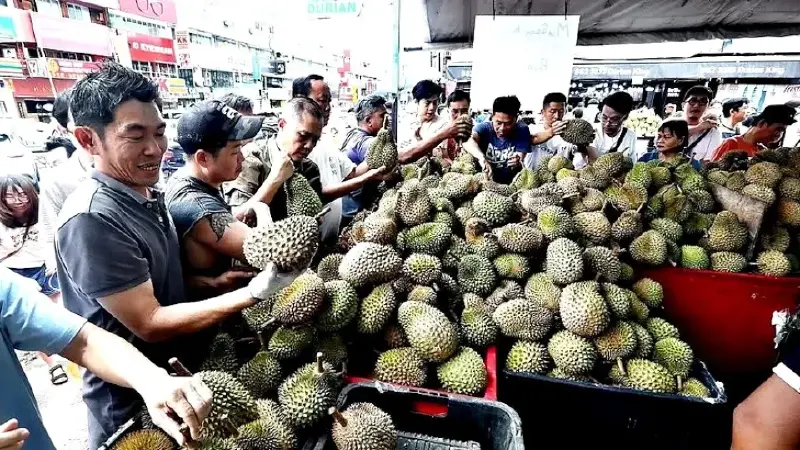


To attract customers, vendors in Petaling Jaya have rolled out competitive deals, including: four Musang King durians for RM99, buy four and get one free, RM133 for one bag of Musang King durians, RM100 for one bag of mixed durians (excluding Musang King and Black Thorn).
A full bag of Musang King durians for just RM133!(US$33)
Durian stalls in Petaling Jaya’s SS2 are seeing a massive buying frenzy!
With a bumper harvest season, the price of Musang King has dropped significantly.
Most stalls at the popular SS2 durian hub have launched various promotions, drawing huge crowds of consumers eager to feast on the “King of Fruits.”
To attract customers, vendors have rolled out competitive deals, including: four Musang King durians for RM99, buy four and get one free, RM133 for one bag of Musang King durians, RM100 for one bag of mixed durians (excluding Musang King and Black Thorn).
Among them, one stall has even introduced a “fill-the-bag” Musang King package.
For just RM133, customers are given a large plastic bag and are allowed to pick their own durians from a designated crate until the bag is full.
It is estimated that a single bag can hold up to 15 kg of the fruit, sparking a chaotic scramble as customers rush to get the best value for their money.
Durian farmers refer the good harvest but sluggish price as a durian “tsunami” where farm gate price hit a 10-year low to RM10 per kg.
Industry insiders admit that durian prices are unlikely to rebound and the “glory days” of RM80 per kg are gone for good.
In some parts of Pahang, the average farm gate price for Musang King has even fallen below RM10 per kg.
The sudden collapse has caught durian farmers and large-scale wholesalers off guard, leaving new plantation owners who have just begun their first harvests reeling in distress.

He believes a price point of RM35 to RM40 per kg for Musang King is currently optimal, as it is a level acceptable to both domestic and international consumers.
However, the total planting area has since expanded fivefold, leading to an abundance of durians everywhere.
He further noted that the economic slowdown in China has led to dampened demand for Malaysian durians.
While many Chinese consumers are still willing to spend, their tolerance for premium durians has significantly diminished compared to the past.
“The Chinese market is sluggish; consumers simply cannot accept prices of RM50 or higher. Our exports are priced according to market demand,” he said.
Tan pointed out that durians used to be a seasonal crop. During the peak months of June and July, locals would crave a taste regardless of the price.
“Now, it feels like durian production never stops; it stretches from June all the way to February or March the following year.
“When you see something every day, you lose the intense desire for it,” he said.
Tan noted that durian industry players are currently collaborating with the Ministry of Agriculture and Food Security to implement new measures aimed at stabilising prices for the next season.
This includes working with state governments to implement a traceability system that clearly marks the origin of the fruit, distinguishing Malaysian Musang King from those produced in other countries.
Eric Chan, president of the Malaysia Durian Processors Association, noted that the end-of-year period is packed with festivities, leading domestic consumers to spend their money on travel or celebrations rather than durians.
“July is usually a prime time for consumption because there are fewer major holidays then, and people are more willing to spend on durians.
“But at year-end, people are budgeting for Christmas parties, year-end dinners and company annual banquets.”
Chan pointed out that December is typically not a peak season for durian, but the current low prices are a win for consumers, providing an opportunity to promote Musang King to a wider audience.
He anticipates that the situation will change in about a week, as production is expected to gradually decrease, which will help prices stabilise.

Asia News Network
