
Anwar backs 10-year, two-term cap for Malaysian PMs
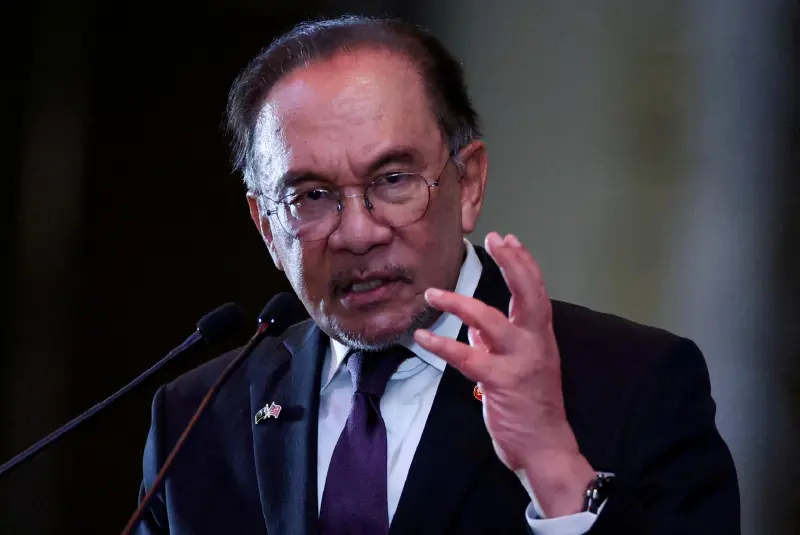


Malaysia’s Prime Minister Anwar Ibrahim on Monday (January 5) announced a series of reforms, including a two-term limit for the premiership, in an attempt to win back urban votes ahead of the next general election.
Speaking before ministers and hundreds of civil servants in the federal administrative capital after a Cabinet meeting, Anwar said leaders should implement reforms during their term and not overstay their welcome.
The series of announcements was made amid dwindling support for Anwar’s administration among urban and Chinese voters, and a rejuvenated opposition, as Perikatan Nasional (PN) aims to change its leadership.
“Everybody has their limits. The chief secretary to the government cannot stay for decades. This applies to everyone, including the prime minister.
“The prime minister’s term limit would be no more than 10 years, or two full terms,” he said during his 2026 New Year speech at the Prime Minister’s Department.
Anwar’s Pakatan Harapan (PH) had pledged a term limit for the prime minister in its manifesto for the 2022 general election, aiming to curb the “damage” caused by Dr Mahathir Mohamad, who had stayed in power for 22 years till 2003, before continuing for a second stint of 22 months, from 2018 to 2020, the longest tenure in Malaysian history.
Under the Malaysian Constitution, the prime minister serves as long as he commands the majority support of the Lower House of Parliament.
Other measures include separating the offices of the Attorney-General and the Public Prosecutor, the Ombudsman Bill, and the Freedom of Information Bill, which will all be tabled in Parliament in January.
These have been major issues for Mr Anwar’s critics, who previously highlighted his slow pace of reforms.
In the November 2025 Sabah state election, the PH coalition led by Anwar managed to win only a single seat. Its key ally, the Democratic Action Party (DAP), was completely wiped out, compared with the six seats it held in the 2020 state election.
Meanwhile, opposition pact PN is set to be led by the Islamist Parti Islam SeMalaysia (PAS), after Parti Pribumi Bersatu Malaysia president Muhyiddin Yassin quit as chairman on Dec 30, 2025.
Another RM100 handout for all Malaysians
Besides the reforms, Anwar also announced several moves aimed at addressing the rising cost of living, and the concerns of small and medium-sized enterprises (SMEs).
He announced a new round of one-off cash handout of RM100 (US$24.6) which will be disbursed to 22 million Malaysians above 18 on Feb 9, ahead of the Chinese New Year and Ramadan.
A similar one-off aid amounting to RM2.1 billion was disbursed in August 2025. Anwar said that the RM150 million of funds that was not claimed by Malaysians before the Dec 31, 2025, deadline will now be channelled to programmes such as protection for victims of domestic violence, assistance for students with special needs and persons with disabilities, medical support for poor patients, and food banks for underprivileged university students.
He also promised to speed up outstanding tax refunds for the business community, aiming to settle arrears for tax year 2023 in the first quarter of 2026, and for tax year 2024 by the end of 2026.
“This is a legacy issue. In 2025, we settled arrears worth RM22.5 billion across 3.7 million cases for tax year 2022 and earlier.
“It is difficult for small and medium-sized enterprises to have more than RM500,000 tied up, as it affects their cash flow,” Anwar said.
Meanwhile, the implementation of e-invoicing for businesses with an annual sales turnover of between RM1 million and RM5 million has been delayed to January 2027 from the original deadline of January 2026, to address SMEs’ concerns over high preparation costs.
Tax refunds and e-invoicing have been key issues troubling Malaysia’s business community, impacting cash flow.
Anwar also increased the facility upgrade fund for Chinese-language vernacular primary schools to RM80 million, up from the initial budget of RM50 million, and allocated RM50 million for Tamil ones.
Lee Heng Guie, executive director of think-tank Socio-Economic Research Centre (SERC), welcomed Anwar’s announcement to ease the burden of operating costs on businesses.
“While the Malaysian economy has performed comparatively better than others in the region, headwinds remain,” Lee told The Straits Times.
“At least, the government is lowering the service tax on rental from 8 to 6 per cent, and raising the exemption threshold for sales and service tax on rental to RM1.5 million annual sales, which will relieve many micro enterprises and SMEs.”
SERC is the think-tank of Associated Chinese Chambers of Commerce and Industry of Malaysia.
But Phoon Wing Keong, head of the Huayan Policy Institute, suggested that the delay in tax refunds and the inconsistent implementation of e-invoicing indicate lower government efficiency.
“The government needs to reduce red tape and curb the unhealthy competition caused by the influx of Chinese capital,” he told ST.
On institutional reform, Mr Phoon said the initiative should have been undertaken earlier, before the PH setback in the urban Chinese seats in the Sabah election.
“But voters still want to see the legislative process completed within the current parliamentary term,” he added.
The next Malaysian general election is scheduled to be held by February 2028, but three state assemblies – Melaka, Sarawak and Johor – will expire sooner than the federal legislature, potentially testing PH’s popularity.
Following the 2022 general election, which produced a hung Parliament for the first time, PH and UMNO-led Barisan Nasional – once political rivals – joined forces to form a unity government.
However, UMNO’s youth wing on Jan 3 urged the party to quit the Anwar-led government, and revive the short-lived pact with PAS instead.
Lu Wei Hoong
The Straits Times
Asia News Network
