
World’s oldest cave art discovered in Indonesia


The art, found on Sulawesi island, offers clues about how humans migrated to Australia, possibly via Indonesian islands to Papua New Guinea.
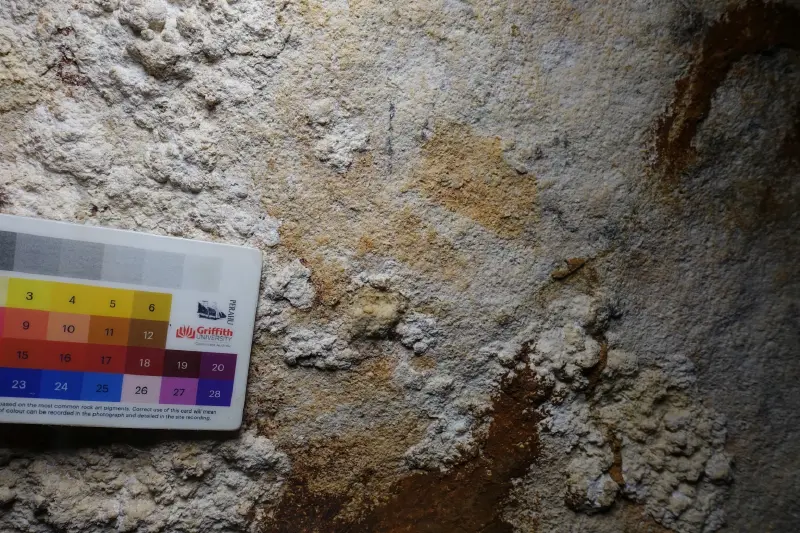
A faint, red hand outline painted on a cave wall on Indonesia’s Muna Island has been dated to at least 67,800 years old, making it the earliest known example of rock art, according to a new study.
The image, a stencilled silhouette of a human hand, is now badly faded and difficult to see.
Even so, the researchers say it points to sophisticated symbolic behaviour among early humans moving through Southeast Asia after dispersing from Africa, with groups that may later have continued towards Australia.
Found on Muna, near Sulawesi
The stencil was identified in Liang Metanduno, a limestone cave on Muna, a small island off the south-eastern arm of Sulawesi, east of Borneo.
To establish its minimum age, the team measured traces of uranium in mineral layers that formed over the pigment over time.
The stencil and similar finds in the area appear to have been made by placing a hand against the rock and blowing pigment around it, leaving an outline.

A distinctive style
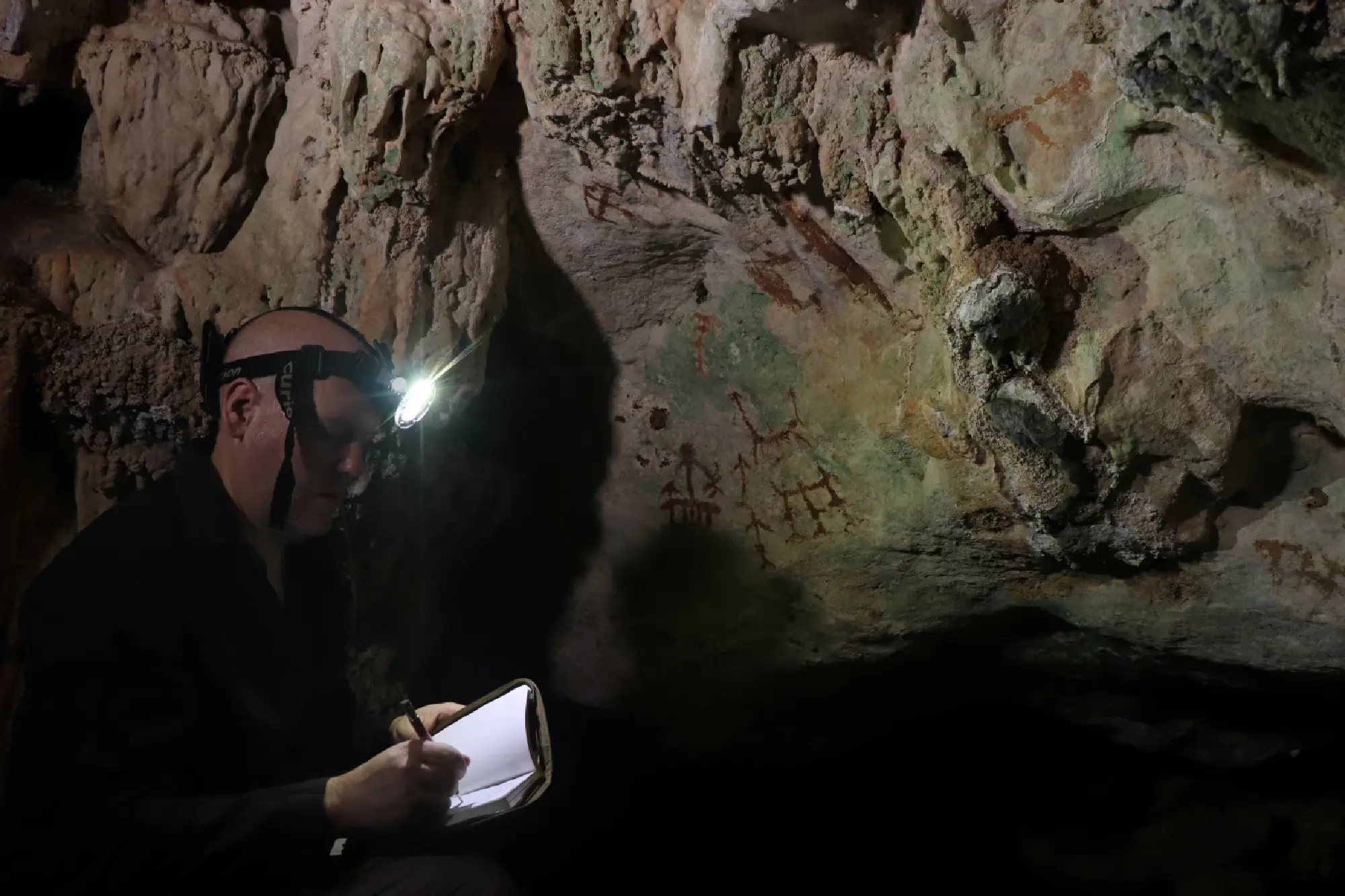
Maxime Aubert, an archaeological science specialist at Griffith University in Australia and a co-leader of the research published on Wednesday in Nature, said the Muna hand stencil stands out because it matches a style seen only in Sulawesi, with fingertips intentionally altered to look pointed.
“It was almost as if they were deliberately trying to transform this image of a human hand into something else, an animal claw perhaps,” said Adam Brumm, a Griffith University archaeologist and co-author.
He added that the motif likely carried cultural meaning, though its significance is unknown.
Older than other famous cave art
The newly dated hand stencil predates a Sulawesi cave painting showing three human-like figures interacting with a pig, previously dated to at least 51,200 years ago at the Leang Karampuang site in south-western Sulawesi.
It is also older than the well-known hand stencil at Maltravieso in Spain, dated to around 64,000 years ago and attributed to Neanderthals.
Although the Liang Metanduno stencil is now barely discernible, the researchers said they found near-identical examples in better condition elsewhere nearby, suggesting the design was repeated rather than a one-off.
Earlier work in Sulawesi has also documented human figures with animal-like traits dated to at least 48,000 years ago.
Clues to the peopling of Australia
Liang Metanduno is already a tourist destination, largely visited for its larger and much more recent paintings, which researchers attribute to Austronesian-speaking farmers who arrived in the region about 4,000 years ago.
The team said the new dating may also help clarify when Homo sapiens first reached Australia.
Aubert noted that researchers have long debated a “short chronology”, placing arrival around 50,000 years ago, versus a “long chronology”, proposing an earlier movement roughly 60,000–65,000 years ago.
He said the newly dated rock art is the oldest direct evidence of modern humans in the region, and that recent genetic studies also align more closely with an earlier settlement timeline.
Taken together, Aubert argued, the archaeological and genetic evidence increasingly supports the “long chronology”, suggesting the ancestors of Indigenous Australians were moving through Southeast Asia, and producing symbolic art, as they travelled.
Reuters
