
Japanese, African leaders reaffirm importance of multilateral trade
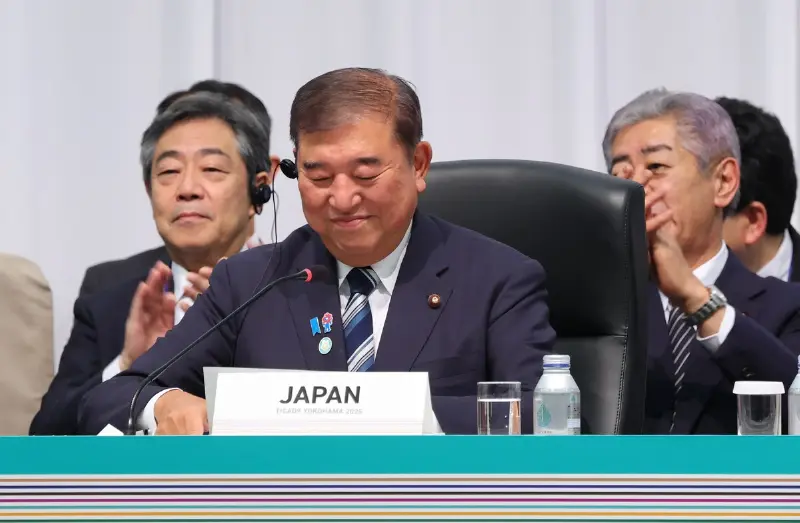


Japanese and African leaders ended a three-day summit near Tokyo on Friday by adopting a joint communique that reaffirms the importance of multilateral trade to counter global protectionist moves.
The Yokohama Declaration to wrap up the Ninth Tokyo International Conference on African Development, or TICAD 9, included a plan to strengthen links between Africa and the Indo-Pacific region, in line with a new economic initiative Prime Minister Shigeru Ishiba put forward on Wednesday.
The communique emphasised proposals to solve problems facing African states, apparently reflecting Japan's wish to highlight a different approach to that of China, which has expanded its influence in Africa.
The conference, co-hosted by the Japanese government and global organisations such as the United Nations, started in Yokohama, Kanagawa Prefecture, on Wednesday to discuss measures to support African states.
"We will work further to expand investments for the future of Africa, enhance industrial cooperation and develop human resources," Ishiba, who served as co-chair, said at a joint press conference.
"We want to contribute to the regional integration of the continent and its industrial development together with countries in the Indo-Pacific region," the prime minister said of his initiative.
The high tariff policies of the administration of US President Donald Trump have impacted African countries. "We reaffirm the importance of the rules-based and open multilateral trading system with the World Trade Organisation (WTO) at its core," the declaration emphasised. It also highlighted the need to boost cooperation for the success of the WTO ministerial conference to be held in Cameroon in 2026.
"We also stress the importance of connectivity with other regions such as the Indo-Pacific region," while continuing "to promote regional integration and connectivity through the African Continental Free Trade Area," the leaders said in the declaration.
"We take good note of the initiative of a Free and Open Indo-Pacific as announced by Japan," they added.
In consideration of China's "debt trap" strategy of increasing its influence by saddling developing countries with huge debts, the declaration said that "we note with deep concern the significant increase in Africa's total debt stocks over the past decade."
The leaders also underlined "the need for strengthening debt management capacity and enhancing debt transparency."
"We recognise the importance of co-creating an enabling environment to drive the digital transformation of Africa and stress the need for effective and responsible governance and utilisation of digital and emerging technologies, including artificial intelligence," it said.
"We also support strengthening access to quality education for all," the declaration said, regarding the development of human resources. It said that "good governance, democracy and the rule of law are foundational pillars for Africa's sustainable development, peace and stability."
Compared with the past rounds of the conference, TICAD 9 "put importance on the relationship between Japan and African countries in solving social challenges facing them," an official at the Japanese Foreign Ministry said. "This session can be said as a very important turning point in the history of TICAD," which started in 1993, he stated.
TICAD 9 was attended by representatives from 49 African countries. The next session will be held in Africa.
Risk Reduction Key to Boosting Japanese Investment in Africa
Reducing business risks in Africa appears to be key for Japan to shift its focus from assistance to investment in African nations at a time when China and Russia are trying to increase their presence on the continent.
At the Ninth Tokyo International Conference on African Development, or TICAD 9, which ended Friday, Japan promised to help African states develop 300,000 workers in cooperation with Japanese firms and to urge its companies to make investments and expand into the continent.
At the three-day conference discussing ways to support African states, Japan also decided to set up a framework to allow the Japan International Cooperation Agency to provide loans for private funds, considering investments in businesses offering uncertainty but also possible high returns.
"The Japanese government has long wanted more Japanese firms to enter and develop African markets in a bid to make full use of its official development aid from the beginning of the conference," which started in 1993, Sadaharu Kataoka, an expert in Japan-African relations at Waseda University, explained.
The number of bases set up by Japanese corporations advancing into the continent nearly doubled from 520 in 2010 to 948 in 2023, according to the Japanese Foreign Ministry. Meanwhile, Chinese firms running businesses in Africa are estimated to have prepared more than 10,000 bases.
Russia, which continues its invasion of Ukraine, is also strengthening its influence in Africa using military cooperation as leverage to create an international environment advantageous to itself.
Japan is "the shop of long standing," an official at the Japanese Foreign Ministry said, noting that Japan launched an international conference to support Africa earlier than other countries did.
Japanese firms, however, "have been far behind Chinese companies," Kataoka pointed out. "Many of them still hesitate to run businesses in the market as they are afraid of risks linked to political instability and low predictability," such as losses of assets or failures in business operations due to wars and social disorder.
African states have difficulties in maintaining stable governance due to their large populations and many local tribes, Kataoka said. The United Nations expects the continent's population to grow to some 2.5 billion in 2050, or a quarter of the future global population.
"Benefits and risks in the continent are two sides of the same coin," as the growing population will produce giant markets, he explained, "Japanese firms have hoped for more active measures to lower the risks facing them."
The Japanese government has made efforts to some extent, revising the Self-Defence Forces law twice, in 2015 and 2022, to allow the SDF to rescue nationals abroad safely and quickly in the event of emergencies such as wars. The framework set up by the government at TICAD 9 is seen as meeting the needs of the firms to diminish financial risks.
Through the nine rounds of the conference, Japan "has expanded support for its firms gradually," Kataoka said. "A close watch will be needed after TICAD 9" to see whether the efforts made so far will be enough to encourage firms to enter the continent.

[Copyright The Jiji Press, Ltd.]
