
Asia accelerates stablecoin regulations as US passes crypto legislation
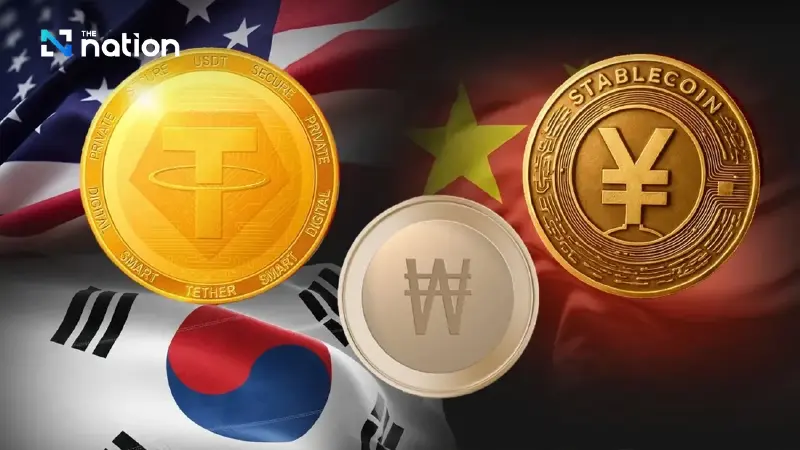


As cryptocurrency shifts from speculation to a new role, ‘stablecoins’ are becoming a game-changer in global finance. Sparked by the US, the trend has spread to Asia, with several countries rapidly developing digital coins backed by real assets, aiming to bridge traditional financial systems with the booming crypto world.
Earlier this week, Japan, one of the world’s largest financial markets, made headlines in the finance and investment community with the approval of the first "stablecoin" pegged to the Japanese yen. This move marked a significant step for the country in the digital asset space.
Shortly after, reports emerged indicating that China is also considering launching a "yuan-pegged" stablecoin.
If this becomes a reality, it would represent a major "U-turn" in China’s digital asset policy, which has been tightly regulated for years. It would also signify that large global financial markets are increasingly leaning towards stablecoins, following the lead of the United States.
According to Bloomberg, Asian capital markets are rapidly adjusting their regulations concerning stablecoins, particularly after the Trump administration in the US formally recognized digital assets pegged to the US dollar through clear legislation.
This has prompted a sense of "urgency" among various Asian countries to adapt to these developments.
The latest trends in South Korea, Hong Kong, Malaysia, Thailand, and the Philippines highlight the growing adoption of stablecoins pegged to Asian currencies, despite concerns from regulators about capital outflows (capital mobility).
The US Sparks a Game-Changing Shift in Stablecoin Market
Although the US White House had signaled its intention to prioritize stablecoins back in January, during President Trump’s first month in office, the real driving force behind the global stablecoin movement has been the creation of clear "legal and regulatory frameworks" in the United States.
In July, the US Congress passed three cryptocurrency bills, which President Trump has now signed into law. One of these is the Genius Act, aimed at creating a regulatory framework for stablecoins in the US.
This law mandates that tokens pegged to the US dollar on a 1:1 basis must be backed by highly liquid assets, such as dollars and short-term debt instruments. It also requires issuers to disclose the composition of their reserves to the public on a monthly basis.
Benjamin Grolimund, an executive from the digital asset exchange platform Flipster, commented, "The 'Genius Act' has become a major turning point, as it has accelerated the adoption and use of stablecoins. Whether you support or oppose them, stablecoins are now unavoidable."
The passing of this legislation led to a historic surge in the cryptocurrency market, with its total market value surpassing $4 trillion for the first time ever the following week.
Analysts at Citigroup predict that, as a result of the US legislation, the market value of stablecoins could grow to $3.7 trillion by 2030, up from its current value of about $265 billion.
According to a report by RWA.xyz, which tracks the conversion of real-world assets into tokens, stablecoins pegged to the "US dollar" dominate the market. The total market value of all stablecoins stands at $266.7 billion, with dollar-pegged stablecoins accounting for 99.8% of the total market, amounting to $266.3 billion.
How Asia is Responding
Japan
Japan is stepping into a new era of digital finance, with the Financial Services Agency (FSA) set to approve the issuance of the country’s first yen-pegged stablecoin this fall. Japanese fintech company JPYC will be responsible for issuing the coin, after the company registers as a money transfer business in August.
The new stablecoin, named JPYC, will be pegged 1:1 to the Japanese yen and backed by highly liquid assets, such as deposits and government bonds, to ensure trust among holders. Once registered, the JPYC coin will be available for purchase within a few weeks, accessible to individuals, private companies, and institutional investors for use in electronic wallets.
In June 2023, Japan amended its laws, officially recognizing stablecoins as "assets valued in currency." This legal status is significant as it clarifies the role of stablecoins, differentiating them from other digital assets.
Additionally, the new law permits trusted financial institutions, such as banks, trust companies, and money transfer businesses, to issue stablecoins legally, further enhancing credibility and security for users.
South Korea
South Korea already has a strong market for stablecoins pegged to the US dollar. According to Yonhap News, the transaction volume of USDT, USDC, and USDS, three major stablecoins on local exchanges, totaled 57 trillion Korean won (approximately $41 billion) in the first quarter, according to data from the Bank of Korea (BOK).
In June, lawmakers clashed with the central bank over pushing for the BOK to allow South Korean companies to issue stablecoins pegged to the Korean won.
President Lee Jae-myung’s Democratic Party proposed the Digital Asset Basic Act, a bill aimed at creating a framework that would allow local companies to issue their own stablecoins.
However, just two weeks later, BOK Senior Deputy Governor Ryu Sang-dae warned that stablecoins could force South Korea to rethink its long-standing policies on "capital liberalization" and making the Korean won a global currency.
BOK Governor Lee Chang-yong issued an even stronger warning, stating that stablecoins issued by non-banking institutions could "cause massive turmoil, like in the 19th century" when private currencies flooded the market.
The Financial Services Commission (FSC) is preparing to propose significant legislation, expected to be presented to the National Assembly around October.
The bill will provide comprehensive guidelines on the issuance of stablecoins, digital coin collateral management, and necessary internal controls for service providers.
China
Historically, China has maintained a firm stance against the cryptocurrency world, implementing a ban on both cryptocurrency trading and mining since 2021 due to concerns over the potential impact on the stability of the financial system.
However, with the growing momentum of President Trump’s cryptocurrency push, which is linked to the dollar in the global financial system, it appears that China may be considering a major policy shift.
Reuters recently reported, citing sources close to the matter, that the Chinese government is deliberating the potential approval of the world’s first "yuan-backed stablecoin."
This move is aimed at boosting the global recognition of the Chinese yuan. A study session on the proposal is expected to be held by the end of August.
China has long desired to elevate the yuan to the status of a "global currency," similar to the US dollar or the euro, reflecting its role as the world’s second-largest economy.
In addition to the Chinese government, major regional Chinese companies like JD.com and Ant Group also see business opportunities in the growing stablecoin trend and are preparing to seek approval for issuing their own stablecoins.
Capital Control Challenges
According to Bloomberg, one of the key challenges hindering Asia’s adoption of stablecoins is concerns over capital controls. Yoann Turpin, co-founder of the crypto market maker Wintermute, stated that "capital control" remains a significant challenge, but stablecoins can create an on-chain system that has been verified and is more efficient.
Le Shi, Managing Director at the Hong Kong-based crypto market maker Auros, noted that establishing such systems could enhance the liquidity of arbitrage trading between platforms or markets without being constrained by the opening and closing times of exchange markets.
"Stablecoins pegged to local currencies have real use cases, particularly to provide liquidity during weekends and make capital movement smoother," he added.
