
Bangkok Sets Rigid Conditions for Peace as Border Crisis Reaches Diplomatic Crossroads
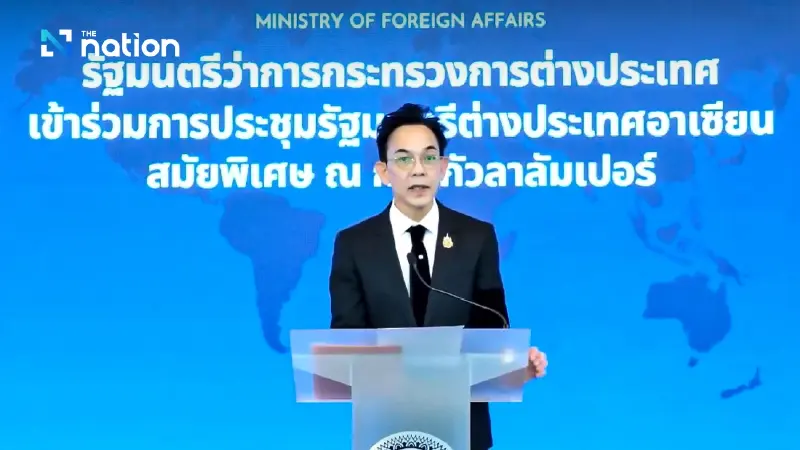


Thailand demands Cambodia initiate a "genuine" ceasefire and end landmine warfare as military commanders prepare for high-stakes GBC talks in Chanthaburi
- Thailand has issued a three-point ultimatum to Cambodia, demanding it unilaterally declare a genuine and verifiable ceasefire as a precondition for peace.
- A key condition is that Cambodia must cease its use of anti-personnel landmines and commit to joint demining operations, following recent Thai casualties.
- Bangkok has launched a diplomatic offensive, lodging a formal protest with Phnom Penh and reporting Cambodia's alleged violations to the UN and the Ottawa Convention.
- Military commanders from both nations are preparing for high-stakes General Border Committee (GBC) talks to negotiate the technical implementation of a ceasefire.
Thailand demands Cambodia initiate a "genuine" ceasefire and end landmine warfare as military commanders prepare for high-stakes GBC talks in Chanthaburi.
The Thai Ministry of Foreign Affairs has laid down a definitive three-point ultimatum to Phnom Penh, asserting that any lasting peace must be built on "concrete actions rather than paper promises."
Speaking at a press conference on Tuesday following the Special ASEAN Foreign Ministers’ Meeting in Kuala Lumpur, Ministry spokesperson Nikorndej Balankura revealed that Thailand has set strict conditions for de-escalation after months of deteriorating relations and renewed border skirmishes.
Nikorndej outlined Thailand’s non-negotiable requirements for returning to the status quo:
Unilateral Declaration: Cambodia must be the party to declare a ceasefire first.
Verifiable Sincerity: The ceasefire must be genuine, sustained, and verified by military personnel based on the actual situation on the ground.
Humanitarian Demining: Cambodia must demonstrate a sincere commitment to joint demining operations with Thai authorities.
"Thailand has exercised utmost restraint," Nikorndej stated, noting that the Joint Declaration was intended as a pathway to peace, yet its effectiveness had been undermined by repeated violations. "Sustainable peace must come with security and the safety of the Thai people. It cannot be merely a piece of paper."
The spokesperson delivered a stinging rebuke of Cambodia’s recent military conduct, specifically the use of anti-personnel landmines.
He confirmed that on 21 December, a Thai marine became the eighth casualty to lose a limb due to "newly planted" mines.
In response, Bangkok has launched a multi-pronged diplomatic offensive:
A formal protest letter lodged with Phnom Penh.
An urgent appeal to Zambia, the current President of the 23rd Meeting of State Parties to the Ottawa Convention, to initiate treaty mechanisms against Cambodia.
A formal report to the UN Secretary-General regarding Cambodia's alleged violations of international humanitarian law.
Regarding the next steps, the spokesperson clarified the status of the General Border Committee (GBC) meeting scheduled for tomorrow, 24 December.
While there is a strong intent to meet, Nikorndej emphasised that the venue has not yet been finalised.
Thailand’s defence authorities have formally proposed Chanthaburi province as the host location.
The spokesperson explained that it is Thailand’s turn to host the proceedings, as the previous session took place on the Cambodian side of the border.
However, he explicitly stated that the "venue is being discussed right now as we speak" and advised the media to "wait a little bit" for a formal declaration once a final agreement is reached by both militaries.

Regardless of the eventual location, the primary objective of the GBC meeting remains clear: to allow military representatives from both sides to negotiate the technical implementation of a ceasefire and finalise the details regarding the ASEAN Observer Team (AOT).
Meanwhile, the spokesperson emphasized that the criteria for success involve the safe return of over 400,000 displaced Thai civilians.
"We need the military to talk. There must be assurance... involving the movement of heavy artillery that can reach the Thai border," he added.
The briefing also touched upon the roles of regional and global powers. Thailand expressed appreciation for China’s stance of non-interference and neutrality, following a meeting between the Chinese Ambassador and the Thai Prime Minister.
Furthermore, the Philippines, as the incoming ASEAN Chair, has expressed readiness to act as a mediator and participate in the AOT if requested by both parties.
"All 11 ASEAN members now understand that peace must begin with security discussions," Nikorndej concluded. "Thailand desires peace, but it must be a peace that is felt on the ground, not just read in a communiqué."
