
Defence Minister questions Hun Sen’s “prolonged war” talk
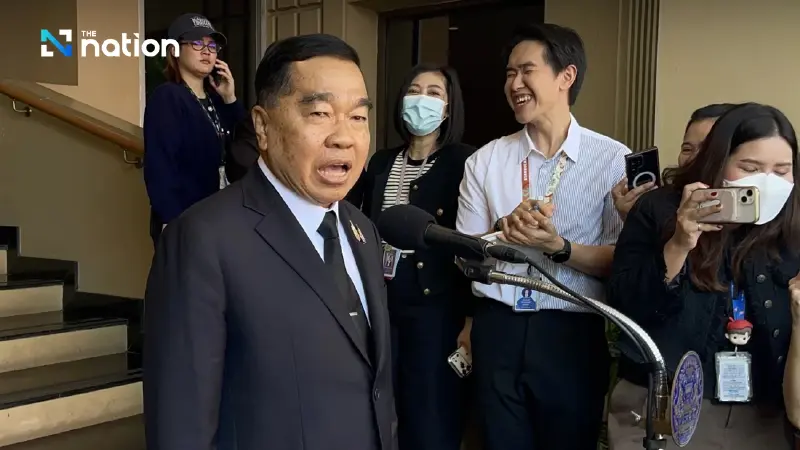


Defence Minister Gen Nattapon says July ceasefire efforts were made in good faith, but questions trust as Hun Sen talks of “prolonged war” ahead of GBC
On December 23, 2025, at Government House, Defence Minister Gen Nattapon Nakpanich spoke ahead of the Thailand–Cambodia General Border Committee (GBC) meeting in Chanthaburi on December 24. He said the session was a meeting at secretary level, and if the secretaries cannot reach the outcome he expects, he will not sign anything.
Citing what he described as Cambodia’s recent conduct, Gen Nattapon listed five main points:
1. Ottawa Convention violations: He said Cambodia has violated the Ottawa Convention in three ways—possessing anti-personnel mines, “producing” them by modifying anti-tank mines into anti-personnel mines, and using newly laid anti-personnel mines. He said evidence found around the Ban Sam Lang area included a document with coordinates and a date written in the top right corner as “30/10/2025”. He said Thailand signed a joint declaration in Kuala Lumpur on October 26, 2025, but mines were allegedly laid on October 30, which he said showed non-compliance.
2. Using ancient sites as military positions: He said Cambodian forces have used three historical sites as military strongholds—Prasat Ta Kwai, Preah Vihear, and Prasat Khana.
3. Using communities as heavy-weapon firing sites: He said Cambodia has fired heavy weapons, especially BM-21 rockets, from community areas and then moved back into residential zones, making it difficult for Thailand to destroy launch positions because Thailand “respects the rules” and does not strike civilian targets.
4. Using civilian buildings as military sites and weapons storage: He said Cambodia has used civilian buildings as military positions and ammunition depots, including locations linked to scam operations and casinos. He said Thailand targets military use, not scam networks, but when such sites are used for military purposes they may be hit as part of operations.
5. Using civilians as shields: He claimed Cambodia has used civilians as shields, including using civilians in ways intended to deter Thai action, and that if civilians are harmed Cambodia would accuse Thai forces of attacking civilians.
Gen Nattapon said these five points form the basis of his approach. He then outlined a three-stage process he said he has followed throughout.
He said the first stage was to pursue negotiations before July 24, adding that Cambodian authorities knew he had sought a peaceful solution. He said his guiding principle as a former soldier was that “winning without fighting is best, and if you fight, you must win”. Thailand’s initial aim, he said, was to use negotiations to get Cambodia to withdraw forces so fighting could be avoided.
He said the second stage came after clashes began, when Thailand sought a ceasefire around July 28. He said Thailand took a positive view at the time, believing Cambodia might not have intended to invade. But he said the clearest evidence of bad faith was that mines were allegedly laid even after the joint declaration was signed, which he said showed a lack of sincerity.
He said Thailand is now in the third stage, and that the media could likely infer what that means. He noted that from last night into this morning, some areas still saw BM-21 fire, and questioned how Thailand could trust Cambodia when Hun Sen, Cambodia’s Senate President, was publicly saying he was ready for a prolonged war while the Cambodian government was saying it was ready for a ceasefire.
Gen Nattapon said Thailand still adheres to the joint declaration, but future arrangements would not be “the same as before” and would require more detailed provisions. Some elements, he suggested, might need to be deferred. He urged the public to have confidence that the GBC would protect sovereignty and national interests and act in line with international law.
He also said he felt no country was truly standing with Thailand. Many, he said, claimed neutrality but appeared to side with Cambodia by relying on Cambodian information and viewing Thailand as the larger country that had invaded. He insisted Thailand has acted in self-defence under Article 51 of the UN Charter, and said its actions were necessary and proportionate. He added that he had not seen countries condemning Cambodia for allegedly laying mines in Thai territory, but instead calling on Thailand to reduce the use of weapons and lower violence.
He said he could not say more because it could make the secretary-level meeting more difficult, but wanted the media to understand the facts and help communicate them to Thai society and the world.
Asked why foreigners seemed to believe Cambodia more than Thailand, Gen Nattapon said he did not want to go into it because it could trigger a backlash. He said some commentators had spoken aggressively, and when Thailand defended itself they claimed Thailand had prepared in advance. He also alleged Cambodia uses lobbyists, while he was unsure whether Thailand does. He said he believed “the truth can fight back”, adding that time would prove facts.
He called on Thai media to compete in the information space, saying this conflict is not only military but also political—domestic and international—as well as involving diplomacy, psychological operations and information warfare. He said that is why a border situation briefing centre has been set up at Channel 5, with personnel from all armed services, because there are three fronts: the border battlefield, the diplomatic arena, and the information arena—where he said the media are an essential part of the effort.
Asked whether Thai forces have fully secured the key battle areas, he said it was in line with what the military has reported, including Hill 350.
Asked whether fighting would continue until there is a GBC negotiation, he said as long as Cambodia continues attacking Thai positions, Thailand must respond as necessary and proportionately. He said Cambodian fire was still being reported in First Army Area zones this morning, and in Second Army Area zones around Prasat Ta Kwai and Prasat Ta Muen Thom. He said only the Chanthaburi–Trat sector had been quiet, which is why Chanthaburi was selected as the GBC venue, as it was considered safe and Cambodia also had security concerns.
He urged residents in Chanthaburi to help reassure Cambodian officials about safety, saying Thais can distinguish between fighting and negotiation. “War is war; talks are talks,” he said, adding that the negotiation arena should not be mixed with weapons.
Asked whether Cambodia had still not decided to attend talks in Thailand, he said he was not sure. He acknowledged Cambodia’s concerns, and said Thailand had similarly been concerned about travelling to meet in Koh Kong. He said he wanted Cambodia to feel confident about security because the meeting would take place in the border area, not deeper inside Thailand.
