
'Extinct' No More: Predatory Legend Rediscovered in Southern Thailand’s Peatlands
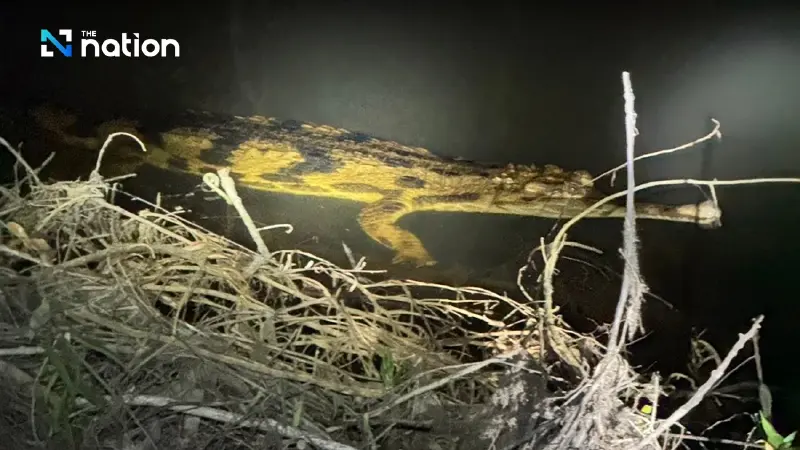


The historic sighting of two False Gharials in Narathiwat ends decades of uncertainty and confirms the survival of the species in the Thai wild
- The False Gharial, a large crocodilian species long considered extinct in the wild in Thailand, has been officially rediscovered in a peat swamp in the southern province of Narathiwat.
- The discovery was confirmed after two individuals of different sizes—one over three meters and a second, smaller one—were sighted, providing the first official evidence of the species in decades.
- The presence of different-sized gharials suggests a potentially healthy and breeding population, confirming the species' survival within the Thai ecosystem.
- Following the rediscovery, Thai wildlife authorities are increasing patrols and planning to establish a protected zone to safeguard the rare predator.
The historic sighting of two False Gharials in Narathiwat ends decades of uncertainty and confirms the survival of the species in the Thai wild.
In a discovery that has stunned the international conservation community, researchers have confirmed the first official sighting of the False Gharial in the Thai wild for decades.
The legendary reptile, which many experts feared had vanished from the kingdom's natural habitats, was captured on film in a remote canal in Narathiwat province.
The encounter began with a pair of "mysterious eyes" reflecting the beam of a torch above the ink-black waters of a Tak Bai waterway. As the creature emerged, it revealed a prehistoric form over three metres in length—a living testament to a species the world feared had been lost to history.
The breakthrough occurred on 25 January 2026, when local resident Natthawut Yuenchon managed to film the three-metre specimen at dusk. Following this report, specialists from the Hala-Bala Wildlife Research Station conducted an immediate survey of the area.
Their efforts yielded an even more significant result: the discovery of a second, smaller individual measuring roughly 1.5 metres. This variation in size provides empirical evidence of a healthy population structure, suggesting that the species is not merely surviving but potentially breeding within the Tak Bai peat swamp ecosystem.
The False Gharial (Tomistoma schlegelii) is one of the world’s most elusive crocodilians. Historically found across Southeast Asia, its numbers have plummeted due to agricultural encroachment, illegal poaching, and the construction of dams.
The International Union for Conservation of Nature (IUCN) currently places the species on its "Red List" as Endangered, estimating that fewer than 2,500 mature adults remain globally.
It is also protected under Appendix I of CITES, the most stringent level of international trade protection. Until this week, official records in Thailand had been reduced to hearsay and unverified tracks, leading many to categorise the species as "Extinct in the Wild."

Sukhee Boonsrang, director of the Wildlife Conservation Office, described the find as a triumphant moment for Thai conservation.
"The presence of these animals proves that our southern peatland ecosystems remain sufficiently pristine to serve as the final sanctuary for some of the world’s rarest wildlife," he stated.
In the wake of the discovery, authorities have announced a surge in "Smart Patrol" operations within the Princess Sirindhorn Wildlife Sanctuary.
The Department of National Parks, Wildlife and Plant Conservation (DNP) plans to work closely with local communities to establish a sustainable protection zone, ensuring that this rediscovered predator remains a permanent fixture of the Thai wilderness.
