
NARIT invites stargazers to watch Orionid meteor shower on October 21–22
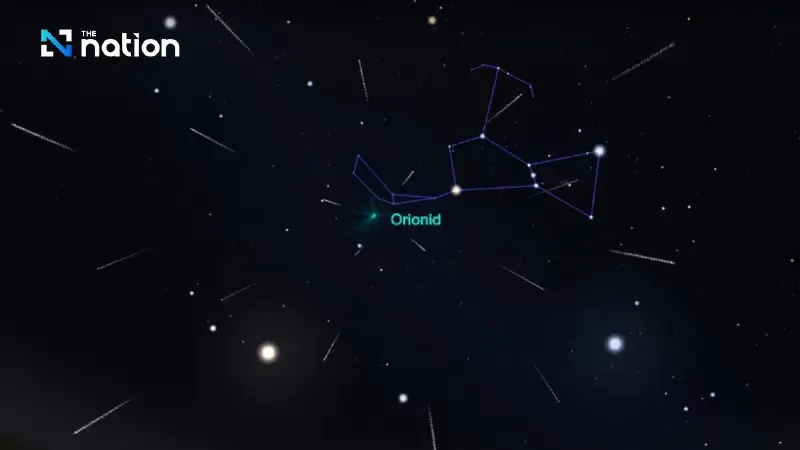


The National Astronomical Research Institute of Thailand (NARIT) says the Orionid meteor shower, peaking on October 21–22, will feature up to 20 meteors per hour, best viewed after midnight in dark areas.
The National Astronomical Research Institute of Thailand (NARIT) is inviting the public to witness the Orionid meteor shower from the night of October 21 through the early morning of October 22, when up to 20 meteors per hour are expected at peak.
The Orionids, which appear to radiate from the constellation Orion (the Hunter), occur annually between October 2 and November 7. The meteors originate from debris left behind by Halley’s Comet (1P/Halley). As Earth passes through the comet’s orbital path, tiny dust particles and fragments are drawn into the atmosphere by Earth’s gravity, where they burn up and create bright streaks of light across the night sky.
This year’s peak activity is expected to reach about 20 meteors per hour. The best viewing period will begin around 10.30pm on October 21, when the radiant point near Orion’s arm rises in the eastern sky before climbing toward the celestial meridian. The display will continue until dawn, offering a clear view throughout the night.
Tips for watching the Orionids
NARIT recommends finding a dark, open location away from city lights to maximise visibility. Although the meteor rate is moderate, the Orionids are known for their bright and fast-moving streaks, making them easy to spot with the naked eye.
The best time to observe is after midnight, when Orion is high overhead and meteors can be seen across much of the sky. With the radiant located near the celestial equator, the Orionid meteor shower offers a spectacular show visible from most parts of Thailand, no telescope required.
